Searching for the Shalshelet
Finals are officially over, which means I have the headspace to think about something other than chemistry. I am delighted.
This is what I’m thinking about: the boy across the table who is really more of a man, but he’s so endearingly young-looking that I find it difficult to call him a man. He speaks with the authority of someone who knows – someone who knows of important things like tradition and responsibility and god. Maybe it is the way he matches his Hebrew accent to the rabbi’s sitting beside him that gives him this authority. Perhaps it is the fact that he uses two small clips to keep his kippah on, the one that remains on his head even outside this Chabad house where it is easy to forget we’re Jewish in exchange for ideas like the Maxwell-Boltzmann Distribution Curve or Heisenberg’s Uncertainty Principle, the concepts that keep us occupied on ordinary weekdays. Or maybe it is the fact that he’s shomer negiyah, his refrain placing him on a level above us chiloniyot who wear short skirts and spaghetti straps in the summer heat – although he is in a frat, so no one is quite sure how that works.
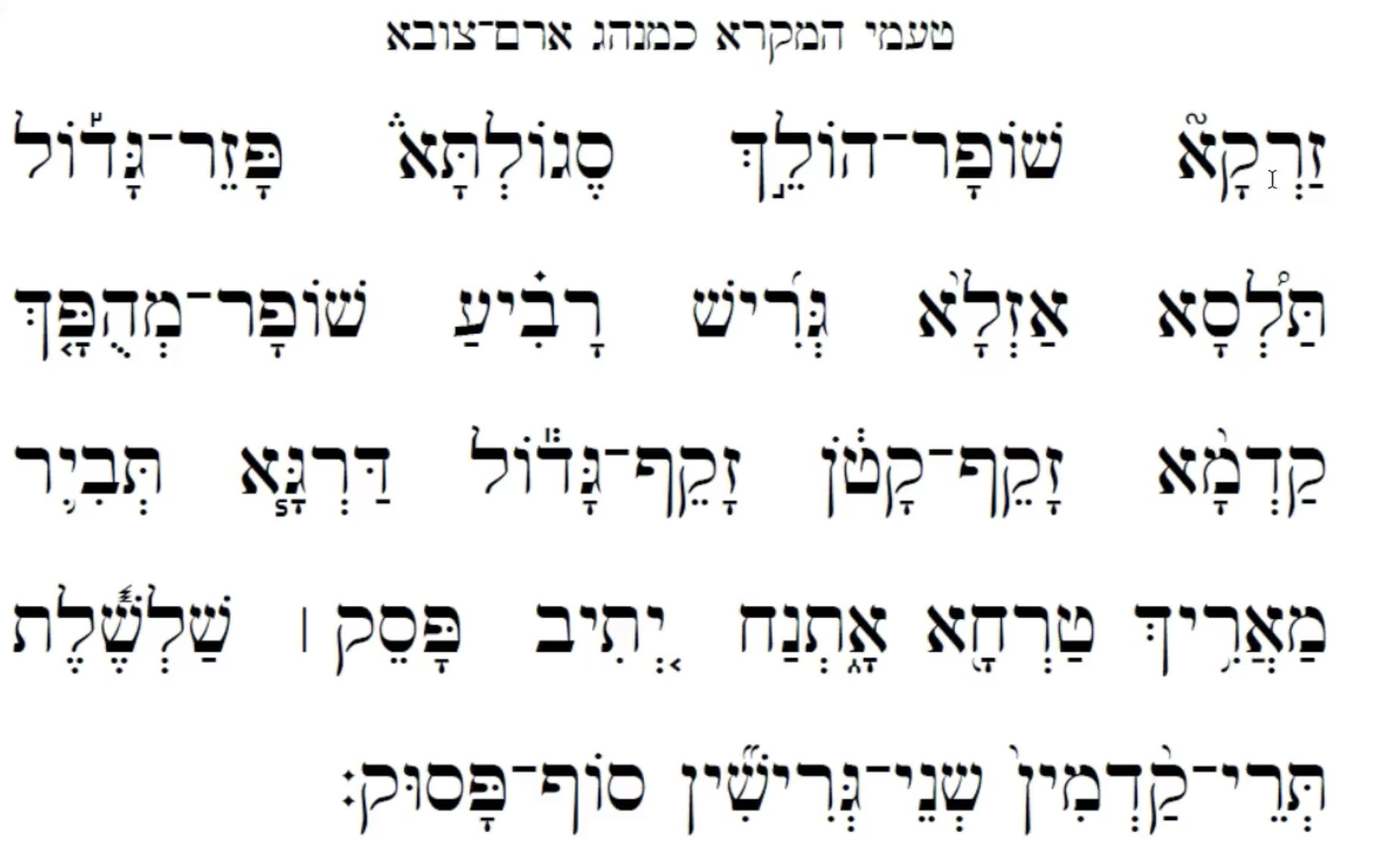
While he is speaking about tradition and responsibility and god, he mentions a cantillation. Where I’m from, we call that a ta’am and refuse to forget it is written with an ayin rather than an aleph.
He describes the cantillation swelling back and forth in indecision. Without thinking twice, I say, “That’s a shalshelet.”
Joseph’s biblical hesitation and my recent reflex hang in the air as he continues, his hands moving up and down and to the side while he describes tradition and responsibility and god. I bring out a chumash and begin searching for the shalshelet, reading with the melodies of my ancestors who refused to forget the difference between an ayin and an aleph, a chet and a chaf.
When the Chabad rabbi, tipsy on the Shabbat bourbon that he shares with the boys – excuse me, men – at the table forgets the name of the ta’am, ask the Syrian girl from Brooklyn.
She’ll know.