

Advancing Women's Health, One Policy at a Time
Seeing Is Not Witnessing
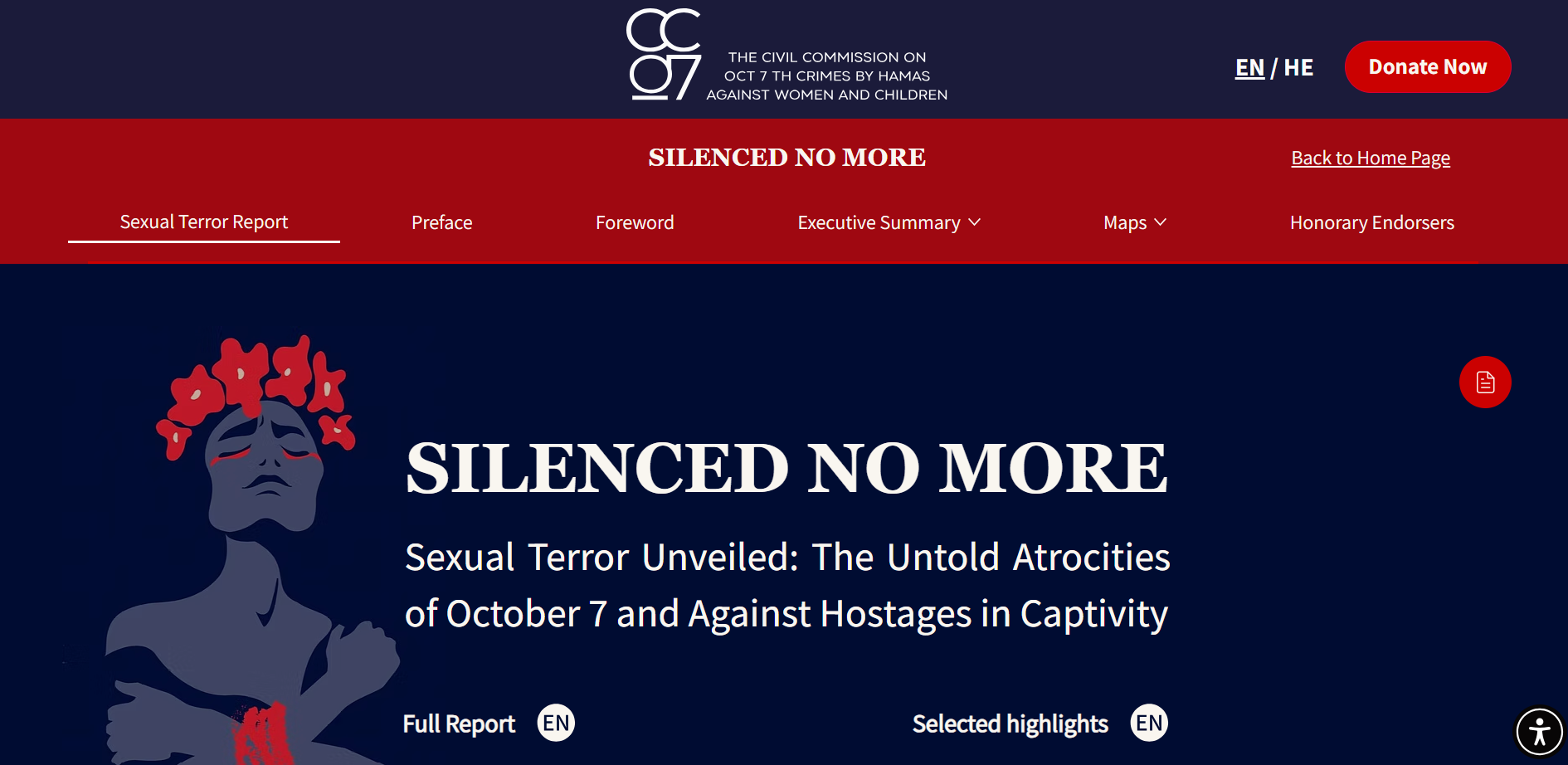
There are reports one reads for information, and there are reports one reads because looking away would be a moral failure.
Silenced No More, the newly released report of the Civil Commission on October 7th Crimes by Hamas Against Women and Children, is the second kind. It is 300 pages of documentation, testimony, legal analysis, and unbearable evidence of sexual and gender based violence committed on October 7th and against hostages in captivity. The report draws on more than 430 interviews, testimonies, and meetings, more than 10,000 photographs and video segments, and over 1,800 cumulative hours of visual analysis. It identifies thirteen recurring patterns of sexual and gender based violence across multiple locations and concludes that these crimes were not isolated, but systematic, premeditated, widespread, and integral to the attacks and their aftermath.
For decades, we have understood sexual violence in conflict as something hidden, buried beneath shame, fear, stigma, trauma, death, and silence. Survivors are threatened or disbelieved. Bodies disappear. Families are left with fragments. Much of the global struggle against sexual violence has therefore been a struggle to make the hidden visible, to bring what happened in the dark into the moral light and legal record of humanity.
But October 7th forced us to confront something else.
This was sexual violence meant to be seen.
The victims, survivors, and hostages of October 7th were women, men, children, babies, families, Israelis, foreign nationals, Jews and non Jews. The report notes victims from 52 nationalities and documents sexual and gender based violence against women, girls, men, and boys. The horror was not only that human beings were raped, abused, tortured, mutilated, humiliated, abducted, and murdered. The horror was that so much of this violence was turned into spectacle. Bodies were displayed. Violence was filmed. Images were circulated. Families learned the fate of people they loved through videos and photographs distributed by the very people who harmed them.
Visibility itself became part of the weapon.
This is not a small detail. It changes the moral question. The perpetrators did not only want to harm the people in front of them. They wanted the violence to travel. They wanted it to enter homes, phones, memories, nightmares, and history. They wanted families, communities, a nation, and the world to see degradation, fear, exposure, helplessness, and death.
And the world did see.
But seeing is not the same as witnessing.
A few days ago, a video circulated of a nun in Jerusalem being violently shoved to the ground and kicked. The assault itself was horrifying. But what stayed with me, what I could not stop replaying in my mind, was a man standing nearby. He saw. He watched. For a moment that felt endless, he did nothing. Others eventually intervened but the image of that man standing there is burned into my brain. How could he stand there and do nothing?! How could he see that horror and take no action?!
That, to me, is the difference between seeing and witnessing.
Seeing is the eye. Witnessing is the conscience.
Seeing is what happens when an image reaches us. Witnessing is what happens when we understand that the image now asks something of us.
Seeing can be passive. It can scroll past horror. It can consume suffering without being changed by it. It can ask for more proof, then more, then more, until the violated body becomes a piece of evidence rather than a person. Seeing can turn pain into content, politics, debate, ideology, or public positioning.
Witnessing is different. Witnessing is an ethical act. It means allowing what has been seen to make a claim on us. It means refusing to let the victim be reduced to an image, a headline, an argument, or an inconvenience. It means saying, before anything else, this was a human being. This happened. It matters. I am now responsible for what I know.
Seeing without witnessing becomes another form of abandonment. Like that nun left bleeding on the floor as a bystander stood idly by, it leaves victims exposed but not protected, visible but not recognized, documented but not mourned. It allows the world to know and still remain untouched. It turns suffering into something people scroll past, argue about, doubt, or worse, politicize. It is observation without responsibility.
Witnessing demands that we allow what we have seen to change what we are willing to say, what we are willing to remember, what we are willing to refuse, and above all else, what we are willing to do.
It demands that we name sexual and gender based violence when it happens, even when the victims complicate our politics. It demands that we protect the dignity of those who cannot speak for themselves. It demands that we stop asking victims of sexual violence, including murdered victims, to provide endless proof of their own suffering. It demands that we recognize that denial, delay, or silence are no longer neutral. They are conscious choices.
Witnessing means raising our voices. It means naming what happened. It means demanding accountability. It means protecting the dignity of those whose bodies were used as weapons against them. It means ensuring that sexual and gender based violence is never minimized or politicized. It means teaching our institutions, our professions, our movements, and ourselves that “never again” is not only a memory. It is something we are responsible for. It is an obligation to act.
This is true for every victim. Israeli, Palestinian, Jewish, Muslim, Christian, foreign national, woman, man, child. Human suffering is not a competition. Grief is not a limited resource. Recognition of one atrocity does not erase another. But refusing to name one atrocity because another also exists does not create justice. It creates hierarchy. It teaches victims that their pain will be recognized only if it does not disturb the moral comfort of others.
To bear witness is to refuse to be the person standing in the corner.
It is to understand that once we have seen, we are no longer innocent bystanders. We have a moral obligation to respond, and what we do next becomes part of the record.
The victims and survivors of October 7th do not need the world to consume their pain. They need the world to carry responsibility for what it has seen. They need us to say clearly that sexual violence was used as a weapon of terror, that the victims deserve recognition, that the dead deserve dignity, that the survivors deserve belief, and that the truth must not be buried beneath politics.
We all saw.
Now we have to decide whether we will bear witness.
About the Author
Gila Zarbiv is a certified nurse midwife with a master’s degree in women’s health and a PhD candidate in public health at Ben-Gurion University of the Negev, specializing in global health systems management and implementation science. She is Chair of the Board of Directors of Outbrave Israel and Head of Midwifery at Keren Briya. A dedicated advocate for midwifery models of care, she has held leadership roles with the Israel Midwives Association and the International Confederation of Midwives. As a doctoral fellow at the Israel Implementation Science and Policy Engagement Centre (IS-PEC), her work bridges research, policy and practice to transform maternal health systems in Israel and globally.
Related Topics
Related Posts
Gila Zarbiv