
Self-Sabotage: When Getting What We Want Costs Too Much – Tol’dot 5787

So, I’m curious.
Have you ever come home late, seen some chips on the counter, opened the bag, and eaten one?
And then a few more. And you just kind of keep eating.
And then you ate the whole bag of chips?
What about ice cream? Just a little bit, and then the whole pint?
I’ve been trying really hard to stop eating at night.

Just trying to stop.
But my body craves carbohydrates.
And then once I eat, I get more energy, so I start watching TV, YouTube, or playing chess against the computer, and then I’m eating even more.
The next thing I know, it’s eleven, it’s twelve, who knows what time it is.
Sometimes it’s work, and I have been known to get… pretty into that. Sometimes it’s sports, and I have also been known to get pretty into that. And sometimes it’s junk food.

But these behaviors can all fit a larger pattern: for me, they become a form of self-sabotage.
We want one thing for ourselves — like eating healthy and getting a good night’s sleep — but we keep doing something that pulls us in another direction.
I want to feel rested tomorrow.
But, apparently, part of me also wants to play one more game of chess.
*****

At first glance, I thought we had the quintessential case of self-sabotage from the narrative of Esau and Jacob, and the conflict and favoritism that shape their family.
Esau — the hunter — comes home exhausted.
Jacob has stew.
Esau sells his birthright for something to eat.
The birthright is a big deal.
What could be more self-sabotaging than that unfair deal – a bowl of soup for something that is much, much more?
When I think of this scene, I’m often reading it through a familiar strand of rabbinic interpretation that sees Esau very negatively.
Over time, Esau and the Edomites — ancient enemies of the Jewish people — became symbolic stand-ins for Rome and later Christian powers.
Jewish experiences of oppression helped shape these readings.
One example: when the Torah says וְהוּא עָיֵף — “and [Esav] (he) was weary,” Rashi, following an earlier midrash, explains that Esau was weary from committing murder.
That’s… a lot to read into the word “tired.”
And it doesn’t make Esau look great.
I guess I internalized that reading over the years. So when I started thinking about self-sabotage, I immediately thought of Esau.
But what happens when I slow down — and look again at what each brother actually does?
Esau comes in from the field, exhausted, and asks for some stew.
Jacob replies: מִכְרָה כַיּוֹם אֶת־בְּכֹרָתְךָ לִי.
“First sell me your birthright.”
Esau says he is about to die. But before giving his brother food, Jacob tells him to swear — to make sure he gets the birthright.
Couldn’t Jacob have just given his brother some food?
*****
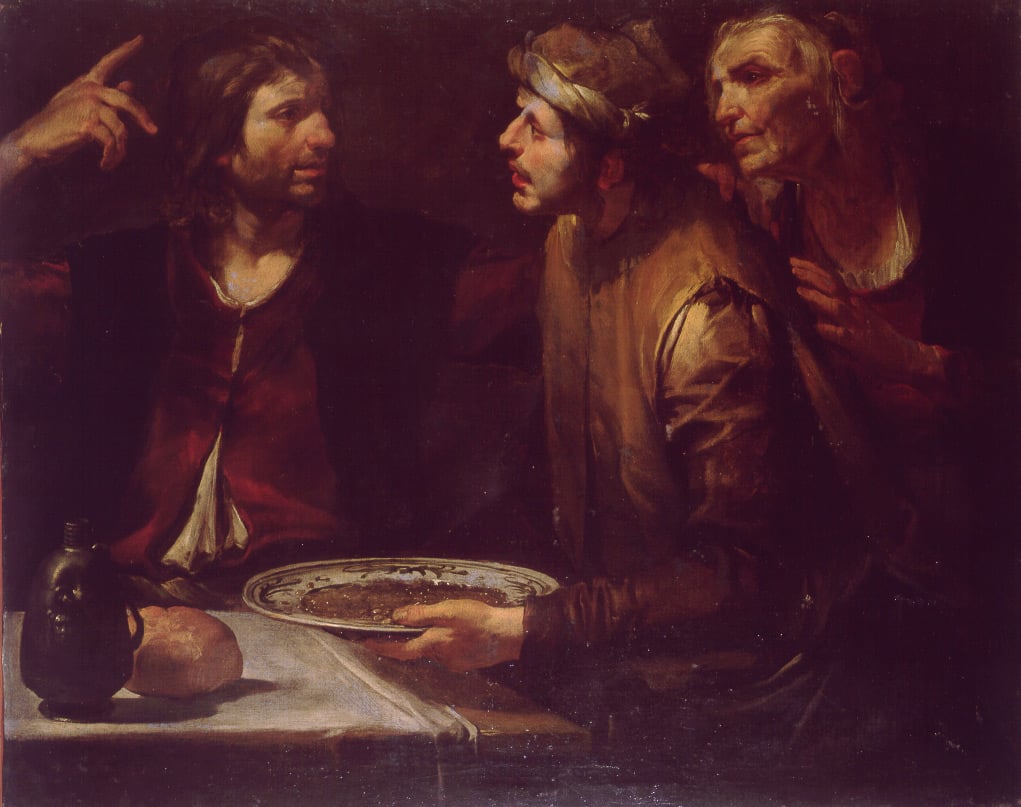
Photo credit: Wikimedia Commons
The Torah gives us far more than black and white. It is full of shades of gray, just like life.
Even our greatest figures are not painted as perfect.
Far from it.
Isaac favors Esau.
Rebecca favors Jacob.
Jacob takes advantage of his brother’s weakened state.
Later, Rebecca directs Jacob in deceiving Isaac.
The Torah does not whitewash our spiritual ancestors. And we should not simply reverse the colors, making Jacob the villain and Esau the innocent.
But we can ask: Did Jacob and Rebecca get what they wanted by the end of the parashah?
Well, maybe. Jacob got the blessing.
But look at the family.
Esau cries out for his father’s blessing. Then his hurt turns into murderous intent.
Rebecca learns that he plans to kill Jacob.
And there is a painful echo here.
Earlier, when Rebecca tells Jacob how to obtain the blessing, she begins:
וְעַתָּה בְנִי שְׁמַע בְּקֹלִי.
“Now, my son, listen to me.”
Near the end of the chapter, she says those same exact words again.
וְעַתָּה בְנִי שְׁמַע בְּקֹלִי.
“Now, my son, listen to me.”
But this time, what follows is: וְקוּם בְּרַח־לְךָ — “Get up. Flee.”
First: Listen to me, and get the blessing.
Now: Listen to me, and run for your life.
Jacob gets the blessing — but has to leave home.
And Rebecca, who worked so hard to secure her son’s future, now has to send him away to keep him alive.
We started by asking why Esau would give up so much for a bowl of stew.
But now we have to ask: What are Jacob and Rebecca giving up to get what they want?
*****
And we know something about that.
Have you ever kept an argument going because you wanted the other person to admit you were right?
You explain it again. You bring up another example. Maybe something from a few years ago, because apparently sometimes we hold on to things for too long.

And eventually they stop arguing.
You won.
But did anything between you get better?
Of course, sometimes we need to stand our ground.
This is not about avoiding hard conversations.
It is about remembering what we hope those conversations will accomplish.
Sometimes we pursue something good — being understood, helping our children, getting our work done — in a way that damages something else we love.
We can care deeply about a relationship and still behave in ways that wear it down.
And that is the harder kind of self-sabotage to notice. Because we can tell ourselves: But I got what I wanted.
- But what did it cost?
So what would something different look like for Jacob?
*****
Years later, Jacob returns to the Land of Israel and before he sees his brother, he sends him many gifts. He’s afraid of how Esau will receive him.
And Esau — the brother we were so ready to dismiss — runs to embrace him. They weep together.
Now, listen to these two key words in the Hebrew.
בְּכֹרָה — bekhorah — means birthright.
בְּרָכָה — berakhah — means blessing.
They sound pretty close.
Two different words, but Esau himself brings them together after the deception: “He took my birthright – bekhorah, and now he has taken my blessing – berakhah.”
And now, at their reunion, Jacob says:
קַח־נָא אֶת־בִּרְכָתִי — Kaḥ-na et birkhati.
“Please take my blessing.”
On the simple level, Jacob means his gift — not literally returning Isaac’s blessing.
But listen to what has changed.
At the bowl of stew: Give me what is yours.
At the reunion: Please take what is mine.
Once, Esau said: He took my blessing.
Now, Jacob says: Take my blessing.
Their history has not disappeared. We do not have to imagine that all their wounds have healed.
But they are not simply repeating the old pattern.
And maybe that is where change begins. Not by becoming a different person overnight, but by doing something different the next time.
*****
I’m going to keep working on the chips and chess situation.
But whether it’s another handful or another round of an argument, we can get what we want — but hopefully, lose something we don’t really need.
This week, before sending that message or correcting someone who needs us to listen, perhaps we can pause:
What am I trying to get? And what might I be giving up?
Maybe we can offer a little generosity.
Not every opportunity has to become an advantage.
Sometimes it can simply become a kindness.
A bowl of stew could have brought two brothers together.
Love instead of sabotaging someone or yourself.