
English Professor; Executive Director, Writing on the Wall
Sex, God, and the Crossroads: How the Book of Ruth Reclaimed the Future
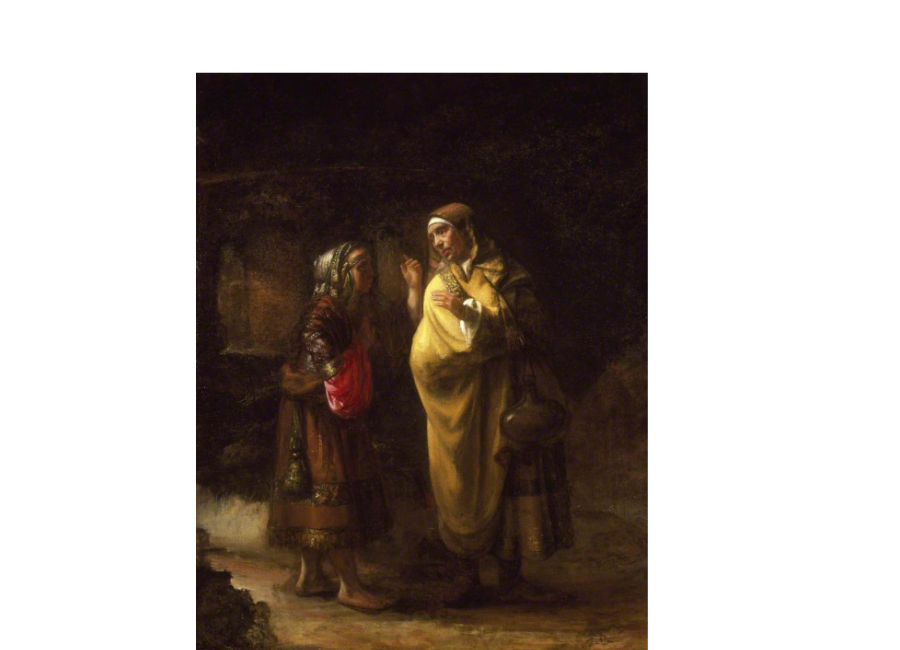
Whose Baby is it Anyway? - 'Ruth and Naomi,' Willem Drost, 1632 - Wikipedia Commons
In the Book of Ruth, Naomi returns to Yehudah from Moab with nothing. No husband, no sons, no future. She tells the women of Bethlehem to stop calling her Naomi – the pleasant one – and call her Mara, bitter. Her claim to hope is couched between words of hopelessness: I have no future.
But on a threshing floor in the middle of the night, the stories of Ruth and Naomi join in a common destiny.
Ruth goes down, uncovers Boaz’s feet, lies down. Boaz wakes in the dark, startled. In the morning he sends her home before anyone can see her. When she returns, Naomi asks: Who are you? She looks directly at her, knows her voice, has known her for years. The question is not about recognition, but transformation.
What happened on the threshing floor? The rabbis identify it as the place David will designate for the Temple. The story of the girl from Moab and covenantal history intersect there, in the dark.
The Names of God
When Naomi arrives in Bethlehem, she demands a radical, tragic renaming: Do not call me Naomi, Pleasant; call me Mara, Bitter. Referring to her time in Moab, she refers to God by the name the patriarchs knew – El Shaddai, the Almighty, the God of nature and power. But broken on her return, she uses two names against herself in a single, devastating breath: Hashem has testified against me, and Shaddai has afflicted me.
This is her ultimate covenantal crisis. Shaddai – the raw force of nature and cosmic power -is the one who has actively crushed her world. But it is Hashem – the personal, covenantal God of mercy who fulfills promises – who stands by and certifies the disaster, testifying to her destruction.
Ruth, however, invokes the name Naomi has just used in her bitterness and claims it as a covenant. Your people, my people. Your God, my God. Boaz already sees it in her – he recognizes her as a woman of hesed. Perhaps he already knows: This stranger will transform chance and wandering into covenantal history.
Reading Ruth requires seeing two stories running at once – wandering and redemption. On the threshing floor, the two stories become one. What seems illicit and what is sacred are not opposed. On that particular night, they are the same thing.
Who Are You?
History and covenant collapse into one another, but so do Ruth and Naomi. The Book of Ruth cannot always tell the two women apart. In the written text (the ketiv) of Chapter 3, it is not entirely clear who descends to the threshing floor — Ruth or Naomi. In Naomi’s instructions to Ruth, she says: I will descend to the threshing floor.‘ The scribes correct the ambiguity, but it remains. Naomi goes down through Ruth. Ruth carries Naomi’s future into the night.
Boaz tells Ruth to return at a time when people cannot recognize her, when people cannot make distinctions. Thus she asks: who are you?
The Man Without a Name
The resolution of the threshing floor must first travel through the gate of the city, the place of judgment.
Enter Ploni Almoni — Mr. Nobody — the kinsman who has a prior legal claim to Ruth’s inheritance. He first agrees to take on the role of redeemer, but Ruth, the Moabite, the refugee – he can’t chance it. I cannot redeem it, lest I ruin my own inheritance. By choosing to protect his inheritance, he loses the only one that matters.
The transaction is sealed with a shoe. Ploni Almoni draws it off and hands it to Boaz. He walks out of history. Boaz walks in.
Boaz’s path through history is fortified by his courage – to turn to the past for the sake of the future. He rediscovers what the law says: a Moabite man is excluded from Israel’s story – but not a Moabite woman.
The elders confirm it with a blessing that to Mr. Nobody would sound like a reproach: let your house be like the house of Perez, whom Tamar bore to Judah. Tamar, who sat at the crossroads in disguise, who forced recognition through an act that looked like transgression. The royal line, the elders are saying, has always come from the threshing floor, where divine and human meet, where the categories break down.
Whose Baby is It?
The rabbis compare Naomi to Jacob, but the Book of Ruth turns Naomi into Rachel and Leah, the beginning of a tradition where the woman refugee from Moab – where the vulnerable feminine – plays an indispensable role.
The place where God’s presence ultimately rests – the Temple Mount, the Holy of Holies – is a threshing floor that once belonged to a Jebusite stranger. The site of holiness is the place where the outsider turns out to be carrying something essential, where the night of uncertainty gives way – slowly, through law and courage and careful reading – to the morning when everything becomes clear.
When the child is finally born, the women of Bethlehem say: a son is born to Naomi. Ruth’s story absorbed into the woman whose story she came to complete. Naomi, who said she had no future, nurtures the child. Ruth becomes part of covenantal history.
Naomi thought history was over. Ruth lived as though it was not. Boaz read the law in a way that made the future possible.
The tradition survives because the stranger Ruth chose it, and Boaz, the judge was courageous enough to find a way to let her in.
Related Topics
Related Posts