Shabbat Is Not About Rest — It Is About Knowing When to Stop
Shabbat Is Not About Rest — It Is About Knowing When to Stop
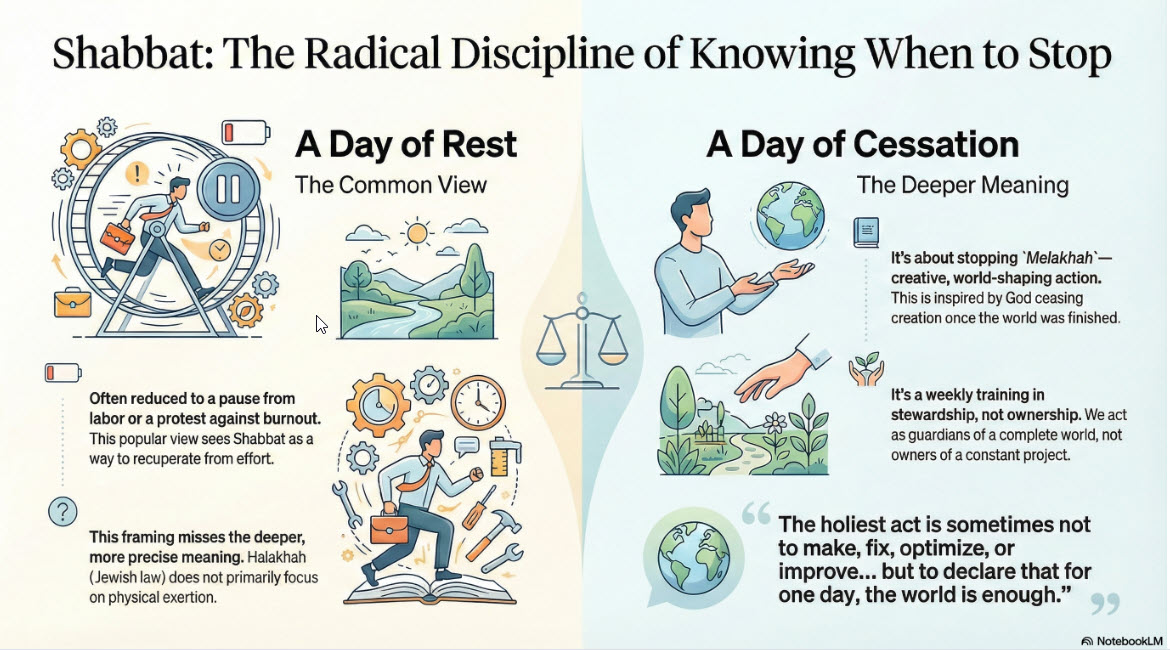
Public discussions of Shabbat often reduce it to a day of rest: a pause from labor, a spiritual recharge, a protest against burnout. While not wrong, this framing misses something far more radical — and, for a halakhic community, far more precise.
Shabbat is not primarily about recuperation from effort.
It is about cessation from melakhah — the Torah’s category of creative, constructive human action — and the disciplined choice to stop exercising mastery over the world.
The Torah’s opening chapters reach their climax not with humanity, but with cessation. In Genesis, God does not rest because of fatigue. The text emphasizes completion: creation is finished, and God ceases from creating. Only then is the seventh day blessed and sanctified. This is not mere narrative theology; it is the template for a mitzvah that will later be commanded, detailed, and lived.
The moment guardianship begins
Creation’s completion marks a transition. Once the world is declared finished, responsibility shifts. Humans enter not as owners of an unfinished project but as stewards of a world that can be harmed by unbounded intervention. Shabbat is the Torah’s first training in restraint: the weekly refusal to treat reality as raw material for endless improvement.
That training is not “spiritual” in the vague sense. It is concretized in halakhah. The Torah forbids melakhah not because melakhah is tiring, but because melakhah is world-shaping. That is why halakhic categories famously do not track exertion: a small act of writing can be more significant than strenuous lifting; a tiny flame matters more than a long walk. Shabbat is not a nap day. It is a day on which we cease a certain kind of authorship over the world.
“Zachor” and “Shamor”: meaning and protection
When the Torah commands, in Exodus, “Remember the Sabbath day to sanctify it,” the mitzvah is not to remember God’s tiredness. It is to sanctify time—to mark the day as different through speech, practice, and orientation. Kiddush is the most obvious expression of this: holiness is not only refraining; it is also declaring.
Later, the Torah speaks in the language of shamor — guard, keep. Notably, this comes to the fore alongside the Mishkan narrative: even sacred building must stop. Here halakhah’s role becomes unmistakable. Without “guarding,” Shabbat becomes sentiment; with only “guarding,” it becomes anxiety. The Torah gives both because human beings need both: purpose and boundary.
For a halakhic audience, this is not a critique of “fences” but a call to place them correctly. The safeguards and constraints exist so that the telos of Shabbat can survive real life. But the criteria of observance cannot be only what we avoid. Halakhah itself insists on kavod and oneg Shabbat: preparation, dignity, enjoyment, and the positive shaping of an atmosphere where holiness is plausible.
Why “not working” is not enough
Sleeping all day may comply with “not doing melakhah,” but it may fail “lekadsho.” Sanctification requires intentionality. Shabbat has a texture: different speech, different tempo, different priorities. In halakhic terms, the day is made holy through the weave of prohibition and positive obligation: Kiddush and Havdalah, tefillah and Torah, meals and menuchah, honor and delight. The point is not to be inactive. The point is to practice a weekly limit on creative dominion.
And that, in turn, returns us to the Torah’s first lesson about human power: you may build for six days — even for heaven — but on the seventh you stop, because the world is not yours.
A word to Israeli public culture
This is where Shabbat’s meaning presses against Israeli life in a uniquely urgent way. In Israel, Shabbat is not only private ritual; it is a public argument about coercion and freedom, about commerce and family, about identity and pluralism. Too often, the debate collapses into slogans: either Shabbat is “religious control” or it is “just another weekend.” The Torah’s Shabbat offers a third language: Shabbat as a national practice of restraint. A society that cannot stop—cannot limit consumption, traffic, noise, buying, building, scrolling—will eventually discover that it is not free but driven. Israel’s public Shabbat conversation could mature if it shifted from “who is imposing on whom” to “what kind of human (and national) life are we protecting?” Even without uniform observance, a shared cultural capacity to stop is itself a form of guardianship.
A Torah for becoming human
Seen this way, the Torah is not primarily a historical record of what God once did. It is a curated narrative designed to shape what humans become. Its chronology is pedagogical: creation teaches capability; Shabbat teaches limit; Exodus teaches freedom; law teaches responsibility.
Shabbat, then, is not an escape from the world. It is training for inhabiting it properly.
In an age of technological dominance and perpetual growth, Shabbat’s message may be the Torah’s most urgent contribution: knowing when to stop is not failure. It is fidelity — to creation, to human dignity, and to the One who sanctified time.