Shavuot: Torah at the Center
At first glance, Shavuot appears to stand apart from the other pilgrimage festivals.
Pesach and Sukkot are expansive, physical, and highly structured. They fill the home with ritual and symbolism. Matzah, marror, sukkot, lulavim. They are festivals experienced through action, objects, and atmosphere.
Shavuot feels quieter. In Israel it lasts only one day. It has no defining physical mitzvah. Its central experience is Torah study and revelation. Compared to the other festivals, it can feel more inward, reflective, almost austere.
And yet that impression is misleading.
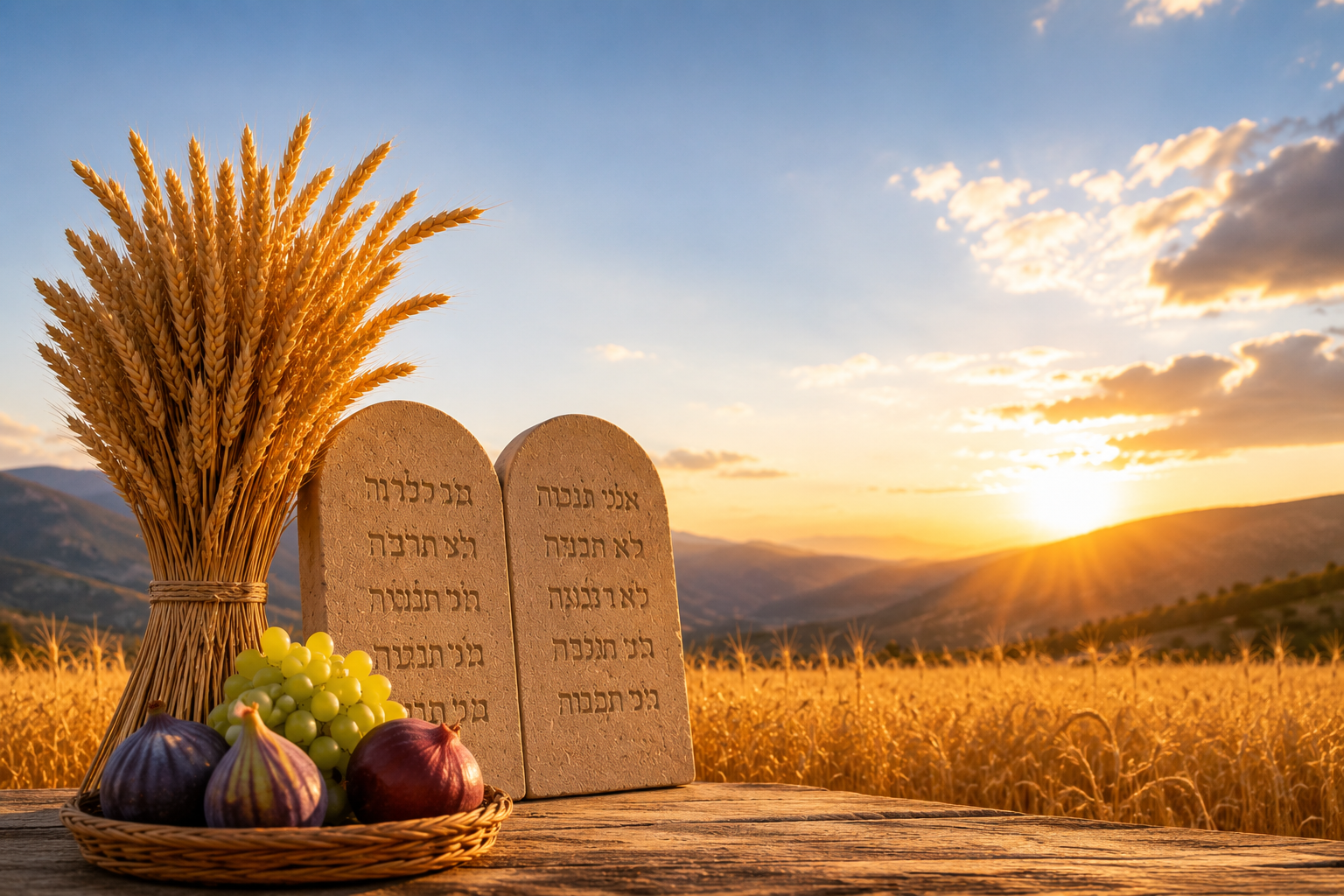
In Temple times, Shavuot was deeply connected to the physical world. It was Chag HaKatzir, the harvest festival. It was Yom HaBikkurim, when the first fruits were brought to the Temple in celebration and gratitude. The festival was rooted in the land, the seasons, and the rhythms of agricultural life.
Shavuot therefore contains a remarkable duality. It is both the festival of the harvest and the festival of revelation. It speaks simultaneously to the earth beneath us and the heaven above us.
Perhaps that is precisely the point.
Rabbi Jonathan Sacks often described the counting of the Omer as unfolding on two levels at once. On one level, the seven weeks trace the agricultural movement from the barley harvest to the wheat harvest. On another, they trace the spiritual transformation of a people journeying from Egypt to Sinai.
The counting itself captures the essence of Shavuot. Unlike every other festival, Shavuot has no independent date in the Torah. It arrives only through counting. Count fifty days from Pesach and the festival emerges.
That structure matters.
Freedom alone is incomplete. Leaving Egypt was only the beginning. The journey reaches its meaning only at Sinai. Redemption leads somewhere. Liberation becomes covenant.
Torah stands at the center.
Nowhere is this idea more beautifully expressed than in the Book of Ruth, which we read on Shavuot.
Ruth’s story contains no overt miracles, no splitting seas, no revelation from heaven. It unfolds entirely within ordinary human life: harvest fields, loyalty, kindness, responsibility, uncertainty, and love.
Yet within that ordinary world emerges one of the deepest acts of spiritual commitment in the entire Tanakh.
Ruth does not encounter Torah in abstraction. She encounters it within life itself. Her declaration to Naomi is spoken not at Sinai, but on a dusty road between Moav and Bethlehem. And yet it carries the full weight of covenant and destiny.
That is the deeper message of Shavuot. Torah is not detached from the world. It is meant to be lived within it.
Perhaps this is also why the Rabbis referred to Shavuot simply as Atzeret.
Atzeret means a gathering, a completion, the point at which everything that came before is drawn together into meaning.
We encounter the same structure at the end of the Tishrei festivals. Rosh Hashanah, Yom Kippur, and Sukkot each carry their own distinct mood and mitzvot. But the cycle concludes with Shemini Atzeret and Simchat Torah.
And at the center stands Torah.
Simchat Torah is not merely the completion of a reading cycle. It is the recognition that Torah gives coherence to the entire journey. The awe of the Yamim Noraim and the joy of Sukkot both culminate there.
Shavuot functions in much the same way for Pesach.
Pesach gives us freedom, but Shavuot gives that freedom direction. A people released from slavery become a nation shaped by covenant, responsibility, and purpose.
Torah stands at the center of the Jewish journey because it stands at the center of Jewish life.
Perhaps that is why the Torah itself continually moves in two directions at once: upward toward God and outward toward other people. Two of the most famous sentences from the Torah articulate this very clearly.
“שמע ישראל ה’ אלוקינו ה’ אחד.”
The recognition that there is something above us, beyond us, deserving of our gratitude, loyalty, and awe.
“ואהבת לרעך כמוך.”
The recognition that holiness is measured not only in our relationship with Heaven, but also in the way we treat one another.
One command turns us toward God. The other turns us toward humanity. Together they form the foundation of covenant.
That is what Shavuot asks us to receive again each year.
Not Torah removed from life, but Torah at the center of it.
Chag Shavuot Sameach.