CFO | Empower Society for Good I Author
Shavuot – Who Is a Jew?
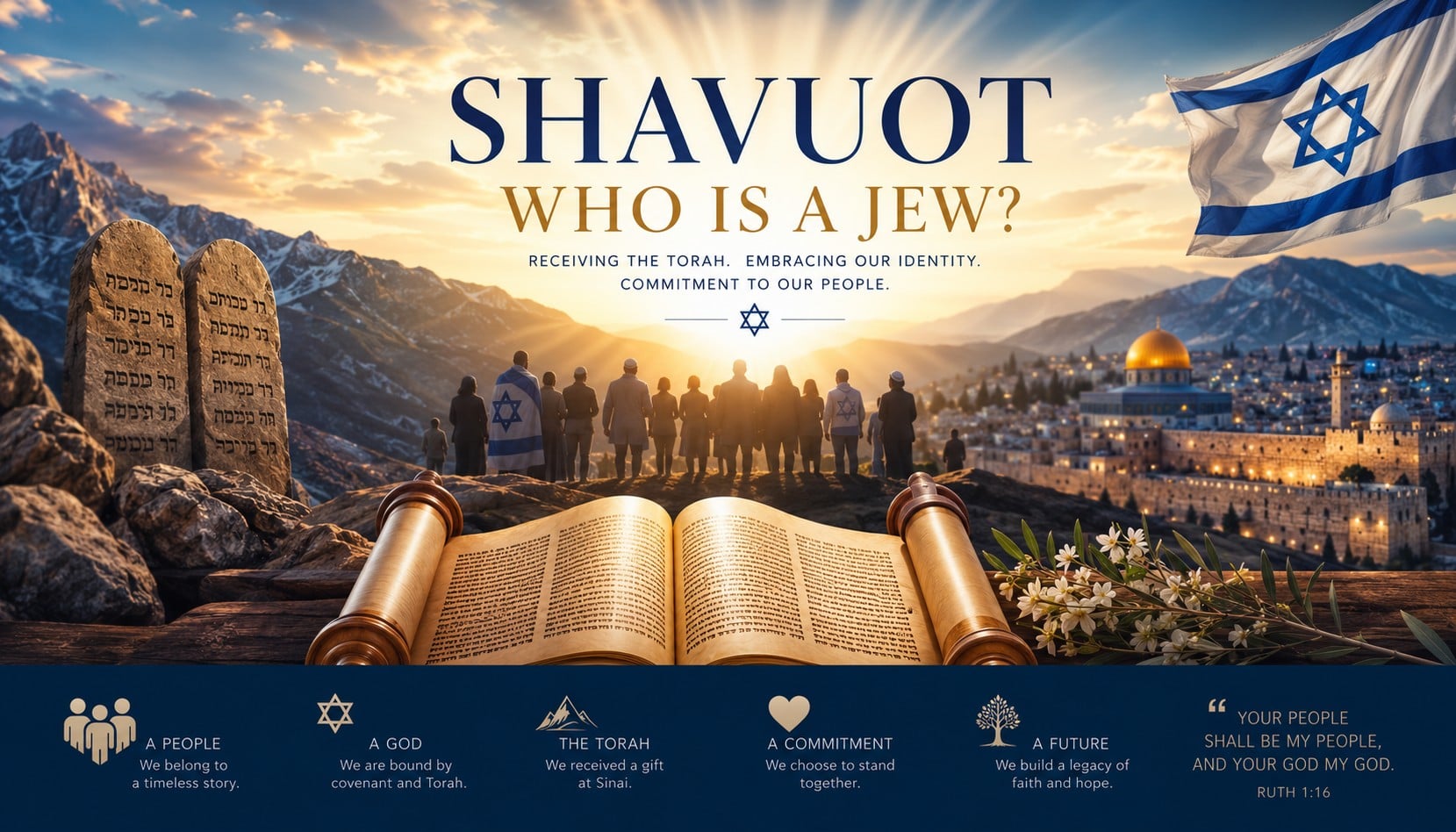
As Shavuot approaches and we once again stand spiritually at Sinai, we return not only to the giving of the Torah, but also to one of the deepest and most emotional questions confronting the Jewish world today:
Who is a Jew?
In a post-October 7 world, this no longer feels like an abstract theological discussion. It has become deeply personal and existential.
Is Judaism merely a religion? A culture? An ethnicity? Or is it something larger — a covenant, a people, a shared memory, and a shared destiny?
Perhaps the answer was already embedded thousands of years ago in the Book of Ruth, the very text we read on Shavuot.
But we must not forget something essential:
Shavuot is not only about Ruth.
It is about receiving the Torah itself.
And perhaps after October 7, many Jews instinctively felt that we once again needed to remember who we are and what we received at Sinai.
Ruth’s immortal declaration to Naomi remains one of the defining statements of Jewish identity:
“Wherever you go, I will go… your people shall be my people, and your God my God.”
— Ruth 1:16
Notice the order carefully.
Ruth first says:
“Your people shall be my people.”
Only afterward:
“Your God my God.”
Judaism begins not only with belief, but with belonging.
With peoplehood.
With shared fate.
With covenant and responsibility.
To join the Jewish story is not only to accept theology. It is to join a people, a history, a memory, and a destiny.
At Sinai, God did not give the Torah to isolated individuals. The Torah was given to Am Yisrael standing together “as one people with one heart.”
The covenant was collective.
Perhaps this is why, after October 7, something shifted so deeply across both Israel and the Diaspora.
Many secular Israelis began reconnecting to Judaism, prayer, Shabbat, and Jewish identity. At the same time, many Diaspora Jews who once felt distant suddenly found themselves defending Jewish identity publicly, confronting antisemitism directly, returning to synagogue, learning Torah, and rediscovering their connection to their people.
Moments of existential challenge often awaken deeper truths.
Many rediscovered that Judaism was never merely culture, folklore, or ethnicity.
It was covenant.
Memory.
Responsibility.
Survival.
Shared destiny.
At the same time, we increasingly see non-Jews who deeply identify with the Jewish people, Israel, and biblical values — while some Jews distance themselves entirely from Jewish continuity and peoplehood.
The dividing lines today feel less biological and more spiritual and civilizational.
Ruth herself was not born Jewish.
Yet she became one of the greatest figures in Jewish history because she chose loyalty, covenant, and shared destiny.
The Torah already understood that identity is not sustained by blood alone.
It also requires commitment.
This is why the modern Jewish debate has become so painful.
Judaism has always welcomed argument, criticism, and moral introspection. The prophets themselves criticized Israel fiercely.
But there is a profound difference between criticism born from belonging and responsibility, and complete disassociation from one’s own people.
For many Jews today, one of the deepest emotional wounds is seeing fellow Jews align themselves with movements that deny or diminish the legitimacy of Israel as the homeland of the Jewish people.
The pain is not merely political.
After centuries of exile, persecution, pogroms, expulsions, and ultimately the Holocaust, Israel represents for many Jews not simply a state, but refuge, continuity, dignity, and survival.
And history itself is more complicated than many modern narratives allow.
Alongside the Palestinian Nakba, hundreds of thousands of Jews were expelled or forced to flee Arab countries. Ancient Jewish communities across Iraq, Yemen, Egypt, Syria, Libya, and elsewhere disappeared almost overnight.
Those Jewish refugees were largely absorbed into Israel and Jewish communities around the world. They rebuilt their lives rather than remaining refugees for generations.
None of this erases Palestinian suffering. But it reminds us that the Jewish story, too, is one of exile, displacement, return, and rebuilding.
Ruth teaches something powerful here.
She joins the Jewish people not at a moment of triumph, but at a moment of vulnerability.
Naomi is broken.
Exiled.
Empty.
And Ruth says:
“I am with you.”
That is covenant.
That is loyalty.
That is Jewish continuity.
Perhaps the deepest Shavuot question today is not merely:
“Who is a Jew?”
But:
“What does it mean to belong to the Jewish people?”
Shavuot reminds us that Judaism was never meant to be lived entirely alone.
Torah was given to a people.
A fractured people.
A struggling people.
A debating people.
But still one people.
And perhaps Ruth still whispers across the generations:
“Your people shall be my people.”
Not because the Jewish people are perfect.
But because covenant means belonging — especially in moments of struggle, uncertainty, and history itself.
Related Topics
Related Posts