Shelach: The Spies That Got It Right
Sometimes role models are famous saints and heroes. Sometimes they are gritty, unknown and deeply flawed.
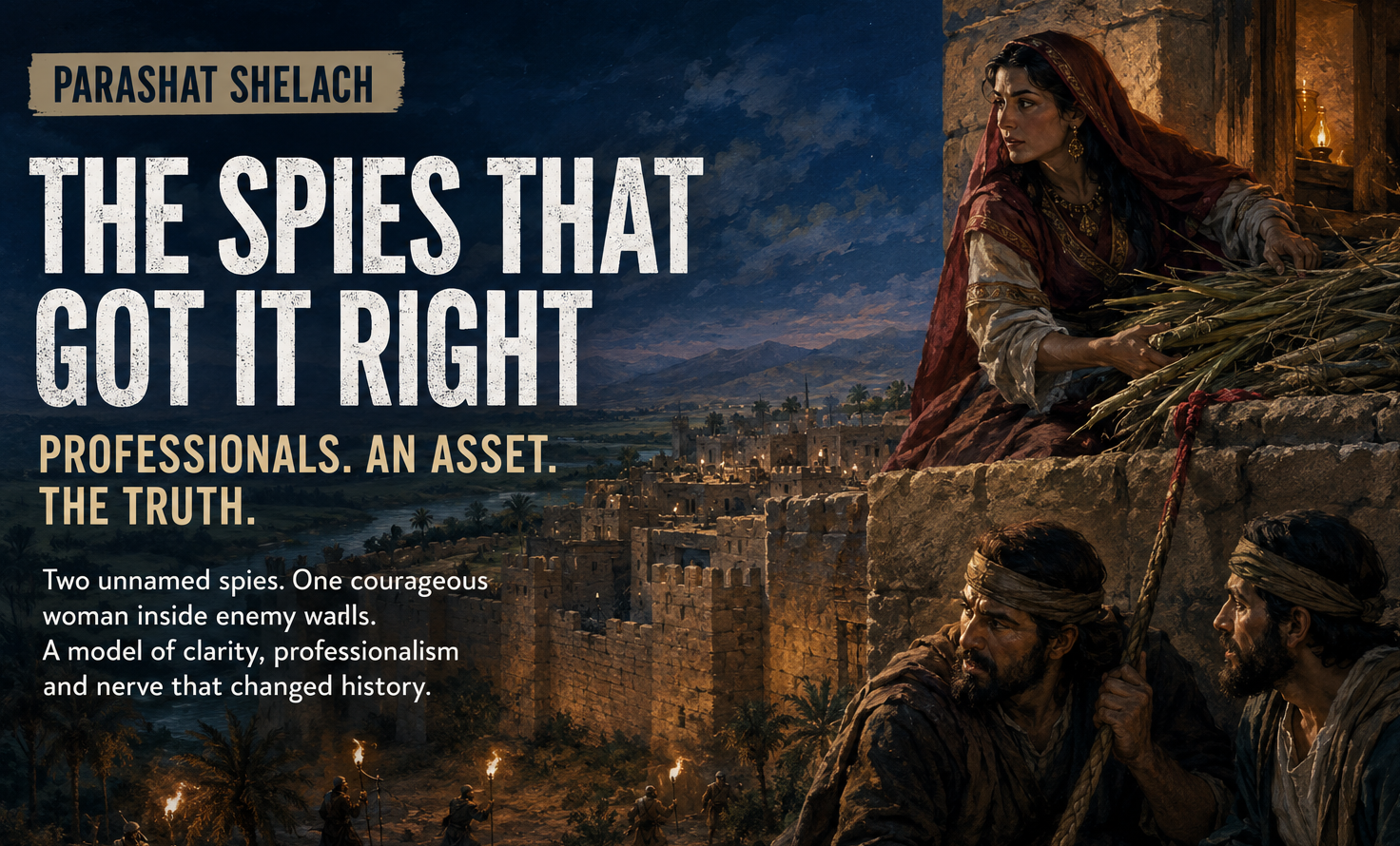
This week’s role models are exactly that: two unnamed spies and a woman called Rachav. They are worth spending time on because they represent something rarely celebrated in this literature (but heavily in fiction): professionals executing a narrow, dangerous mission without recognition, using a recruited human source inside enemy walls. You could make the case that what happens in Yehoshua 2 is the first documented instance of the modern spy and asset. They do not decide policy. They gather facts and come back with what they found rather than what they feared.
The parasha of Shelach centres on the catastrophic failure of the מְרַגּלִים, the spies sent by Moshe. They return frightened by what they saw and infect the people with that fear. The result is forty more years in the desert.
But in the Haftarah, Yehoshua sends spies very differently.
וַיִּשְׁלַח יְהוֹשֻׁוּע בִּן־נוּן שְׁנַיִם־אֲנָשִׁים מְרַגְּלִים חֶרֶשׁ
“Joshua son of Nun secretly sent two men as spies.”
Yehoshua 2:1
The famous medieval commentator, The Abarbanel, notes the difference immediately. Yehoshua does not send leaders or tribal princes with a broad mandate to assess the land, its people, its cities and its mood. That is precisely what Moshe’s spies were given, and that latitude is what destroyed them: men who were asked to form views came back having formed the wrong ones. Yehoshua gives his men no such latitude. Two anonymous professionals. One explicit instruction: go, see, return with facts.
Rashi adds that the mission was conducted quietly, during the shiva for Moshe. No ceremony. No announcement. The contrast with Bamidbar 13 could hardly be sharper.
And then, almost immediately, the operation goes wrong.
וַיֵּאׁמַר לְמֶלֶךְ יְרִיחוֹ לֵאמֹר הִנֵּה אֲנָשִׁים בָּאוּ הֵנָּה הַלַּיְלָה מִבְּנֵי יִשְׂרָאֵל לַחְפֹּר אֶת־הָאָרֶץ
“The king of Jericho was told: some men have come here tonight, Israelites, to spy out the country.”
Yehoshua 2:2
Someone talked. The spies are exposed almost at once. With the best planning and the best intentions, things go wrong. What happens next is a test of professional capability under pressure, and of the quality of the asset they have recruited.
What saves them is Rachav.
Rachav: The Asset Inside the Walls
The text introduces her bluntly: a woman running an inn in Yericho, identified as a זוֹנָה, a term for a Prostitute. Tanach does not soften her starting point, and neither do Chazal.
But her character is so much stronger than her description implies. They chose their asset well. When the king’s men arrive at her door, she does not panic. She hides the spies on the roof under stalks of flax, sends the pursuers off toward the Jordan, and keeps her nerve completely. Then she says something that stops the story cold:
יָדַעְתִּי כִּי נָתַן יְהוָה לָכֶם אֶת הָאָרֶץ
“I know that God has given you this land.”
Yehoshua 2:9
The ten spies of Moshe’s generation could not say this while standing inside the land itself. Rachav, a woman of Yericho with no Sinai and no covenant, says it with certainty. She knows what happened in Egypt. She knows about Sichon and Og. She has watched the morale of Yericho collapse from the inside. The commentator, the Radak, notes how precise her intelligence is: this is exactly what Yehoshua needed to know.
But Rachav is not simple or pure. She is wily and she negotiates for her family’s survival. Faith and self-interest are intertwined in her, and the tradition never pretends otherwise. The agreement she extracts is operational and exact: a crimson cord in the window, her family gathered inside, their lives protected when the city falls. She lowers the spies through the wall with a rope and directs their escape: go to the hills, she tells them, wait three days until the pursuit gives up, then make your way back. She is running their extraction as much as they are.
They follow her instruction exactly. And the tradition honours where she ends up. The Gemara in Megillah (14b) names her among the ancestors of prophets. The woman introduced as a prostitute becomes part of the genealogy of prophecy. Honest about the starting point. Honest about where it leads.
The Two Spies: Anonymous by Design
The spies remain unnamed throughout, and that is not an accident. The failed spies in Bamidbar 13 are introduced one by one: tribe, father, pedigree. Every name recorded. And then the text tells us exactly what they got wrong. The successful spies of Yehoshua arrive without titles, complete the mission, honour their agreement, and leave. The ego is not the instrument.
The Midrash identifies them as Calev and Pinchas, though the text never says so directly. If true, the pairing is remarkable. Calev already knows, from lived experience forty years earlier, what happens when fear is dressed up as analysis. Pinchas represents decisive action when clarity is needed. Neither of them, if the tradition is correct, announces himself. They go in as professionals, not as personalities,
Eventually they return to Yehoshua with a simple report:
כִּי נָתַן יְהוָה בְיָדֵנוּ אֶת כָּל הָאָרֶץ
“God has delivered the whole land into our hands.”
Yehoshua 2:24
No inflation. No editorialising. Just the answer to the question they were sent to answer. The ten spies told Moshe what they felt. These two told Yehoshua what they knew.
The Teaching
The deepest failure in Shelach is not lack of courage. It is collapse of self-confidence.
“We were like grasshoppers in our own eyes.”
Once they saw themselves that way, the entire report became distorted. Fear became analysis. The mission was not the problem. Their relationship with the mission was.
The unnamed spies of Yehoshua did something harder. They went in willing to find out what was actually there. And the person who saw the situation most clearly was the last person in Yericho anyone expected: a woman with a complicated reputation who had done her own assessment before they arrived and reached a conclusion the ten could not reach while standing in the same land.
She told them they were going to win. They believed her, honoured the agreement, and came back with the truth.
That is why these are the role models I chose this week. Not polished heroes. Not perfect believers. Just people doing necessary and unglamorous work with clarity, professionalism and nerve.
Two unnamed men. One complicated woman. Quietly changing Jewish history from inside the walls of a condemned city.
Israel has had to rely on its security services more than any other country and they have done unbelievable work, most of which will never be understood. It isn’t glamorous and it isn’t pretty but it is essential and Yehoshua, learning the mistakes from old, sets a precendent that we follow to this day.