
Shemini Atzeret and Simchat Torah: Dancing with a broken heart
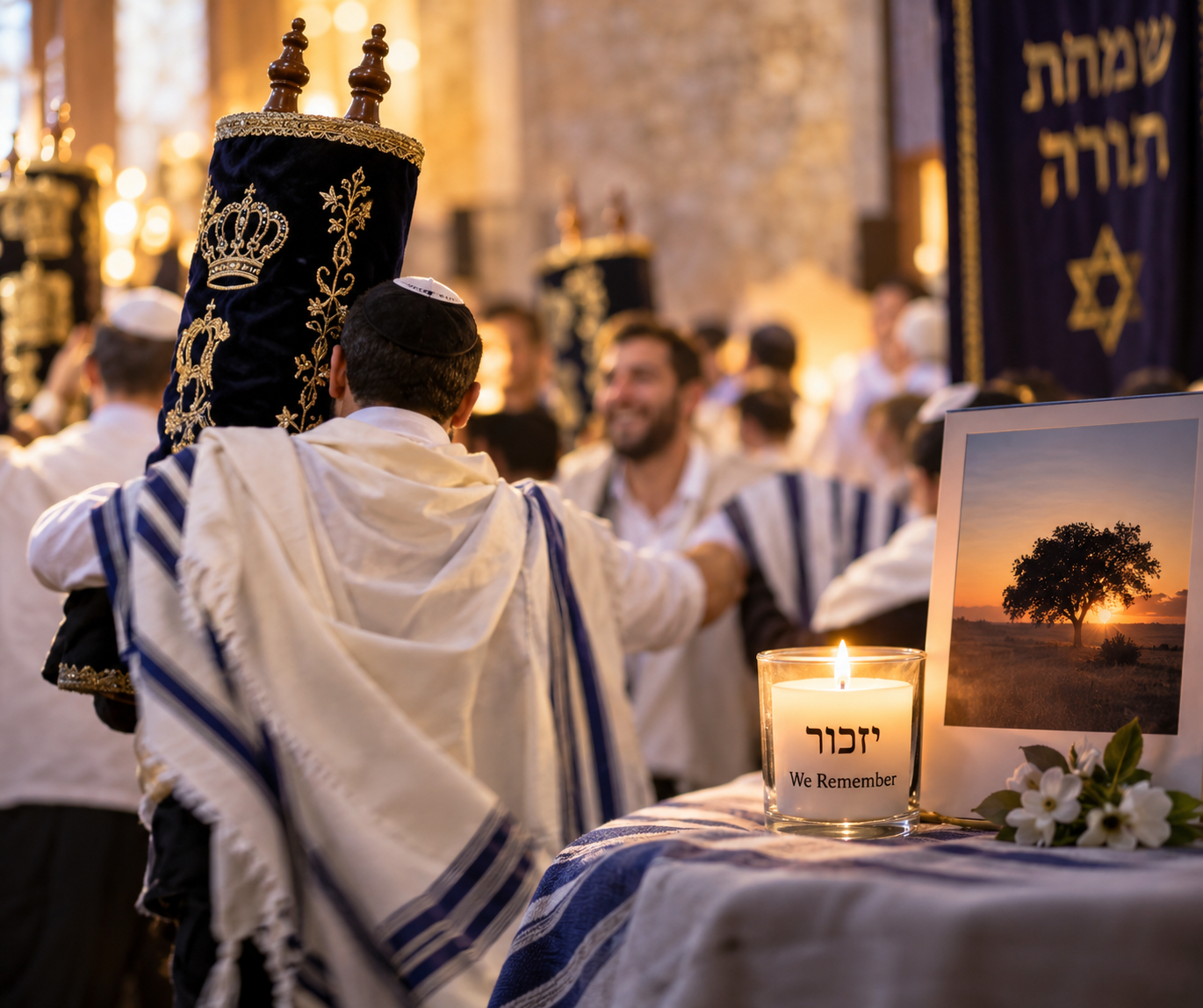
I don’t fully know how to walk into shul this week.
This is supposed to be the happiest day we have. The Torah ends and starts over, all the sifrei Torah come out of the aron; everybody dances. No hard words in the machzor, no fasting. Just joy. For most of my life, that is all this day ever was.
Then three years ago it became the other thing too. Now it is the date. The morning made for dancing is also the morning everything broke. I don’t know a single person who hears the words “Simchat Torah” the way they used to.
And this year it lands on Shabbat again, exactly the way it did three years ago. The same day of the week, the same day of the Torah, the day that has come to be called Shabbat HaShchora, the Black Shabbat. Walking into it on a Shabbat, the calendar isn’t letting us look away.
Here in Israel it hits even sharper, because for us it is all one day. We don’t have Shemini Atzeret and then Simchat Torah spread over two. It is one single day. We stand to remember the dead at Yizkor and we dance with the Torah inside the same few hours, grief and joy pressed right up against each other with nothing in between. This year, that stopped feeling like a quirk of the calendar and started feeling like the only honest way to live.
And it got very personal for us. We were blessed this year with new grandchildren. Twins, Emunah Ahavah and Amitai Shalom. Faith and love, truth and peace. And a little girl named Arbel Ruth, for Arbel Simantov, hy”d, of Kibbutz Nir Oz, who was murdered on Simchat Torah three years ago. A brand new baby in our family carrying the name of someone taken on this very day. New life holding the memory of a terrible loss, in one small person, with one name. I’ve stopped trying to explain how both of those live together. I only know that they do, and that this day has been telling us so all along.
We were never told to feel just one thing
I used to think joy and grief took turns. That if I was really grieving, letting myself laugh was a kind of cheating, and if I was really celebrating, my sadness couldn’t be the serious kind.
That’s a trap, and plenty of us live inside it. We think we have to choose. So we paste on a smile and feel like a liar, or we shut the good stuff down to prove the pain is real. Neither one is honest, and both of them wear you out.
This day won’t let me choose. It puts both in the same room and says hold them together. Dance and cry, sometimes in the same minute. That is not falling apart. That is what a real heart does, and it is what a Jewish heart has done for a very long time.
This is how we’re actually built
A lot of us secretly believe we’re doing something wrong. When joy and grief show up together, and it leaves us confused, or guilty, or a little unsteady, that is not a sign something is broken in us. It’s a sign we’re human.
Our hearts were never wired to run one clean feeling at a time. The nervous system doesn’t have a switch that flips neatly from grief over to joy and back. It carries both at once, often in the same few minutes. We can be laughing at the kiddush and feel our chest go tight a second later, out of nowhere. We cry at a wedding, and we cry at a funeral, and the body reaches for the very same tears both times. That isn’t a glitch. That’s the machinery doing exactly what it was built to do.
So when this day asks us to dance and to remember inside the same hours, it isn’t asking something impossible. It’s asking something deeply human. That unsteady feeling of holding both at once isn’t weakness and it isn’t you losing it. It’s just what it feels like to be a person whose heart is still paying attention. If anything, feeling both is the healthy response. It would be far stranger, and far lonelier, to feel nothing at all.
Grief, right in the middle of the party
Look at what we actually do this week. In the middle of a holiday the Torah calls joy, we stop and say Yizkor. We stand up and name the people who aren’t here.
I don’t think we notice how strange that is. We don’t send the grief off to some sad corner of the calendar. We put it right in the middle of the happiest day. Whoever built it that way understood something it takes most of us years to learn. The best joy isn’t the kind that pretends nobody’s missing. It’s the kind with room enough for the missing too.
So if the dancing sticks in your throat this year, if you can feel the empty spots where people should be standing, you didn’t get the day wrong. That is the day.
We dance with it closed
Here is what gets me every single year, and I notice it more now. When we dance with the Torah, it’s closed. Wrapped, dressed, pressed up against us. We aren’t reading it. We can’t even see a word. We just hold on and move.
That’s been the last three years, hasn’t it. Longer, if we’re honest. We can’t read the meaning. There’s no verse that makes it make sense, no way to line the words up into an answer. And we’re asked to hold on and keep moving anyway. Not because we understand. Because it’s still ours, and we’re still here, and some years holding on is all the faith a person can find.
Some years we dance because our hearts are full. Some years we dance because our arms just won’t let go, even with our hearts in pieces. I used to think only the first kind counted. I don’t think that anymore.
The whole word is “stay”
Shemini Atzeret barely has anything to do. No shofar, no sukkah, no lulav. The word atzeret means something close to linger, hold back, stay. Our sages imagined Hashem saying, after the long run of holidays is over, it’s hard for Me to say goodbye. Stay one more day.
I can’t get that out of my head this year. After everything, a whole day whose only real message is stay. Don’t go yet. Stay close, stay together, stay with Me one more day.
If staying has been hard for you lately, in whatever way you mean that word, I think this day is talking straight to you. Stay. Not because it stopped hurting. Because you’re wanted here, close, one more day. That’s the whole ask.
How the Torah ends
And then on Simchat Torah we finish the entire Torah, and look how it ends. Moshe dies. The greatest of all of us, dying in sight of a land he never gets to walk into, buried where no one can find him.
We end on loss. And the second we finish, no pause, not even a breath, we roll the sefer Torah all the way back to the start and begin again. Bereishit. In the beginning. Light coming up out of the dark.
That’s the rhythm this day hands us for a year like this. We don’t skip the loss or rush it. We read every word of it, out loud, in front of everyone. And then we start again anyway. Not instead of grieving. Right next to it. The end and the beginning touch with no space in between, the way they always do in a real life.
What I’m holding onto this week
None of this is me having it figured out. It’s just what I’m trying to carry in with me, and if any of it is yours too, let’s carry it together.
I’m trying to stop making myself choose. I’m allowed to grieve and to dance in the same hour. The joy doesn’t cheat the pain, and the pain doesn’t ruin the joy.
I’m trying to let the missing into the room instead of leaving it at the door. The empty seats are real. Naming them, even mid-celebration, isn’t weakness.
I’m trying to keep holding on even when I can’t read the words. Some of this won’t make sense this year, maybe not for years. I can hold on anyway.
And I’m trying to stay. Close to the people who are hurting, close to each other, close to the One who asked us to linger one more day. Nobody should be dancing, or grieving, alone this year.
If you end up with tears on your face in the middle of the dancing this Simchat Torah, you didn’t do it wrong. You did it exactly right. I’ll probably be right there with you, holding a closed sefer Torah with my new grandchildren somewhere in the back of my mind. Faith, love, truth, peace. And little Arbel Ruth, carrying the name of Arbel Simantov, hy”d, so it keeps on living. That is this whole day, held in a few tiny people. The broken heart and the dancing feet are the same day, and the same people. We do it together. Chag sameach.
If any of this is sitting close to home, please reach out. In the US you can call or text 988, the Suicide and Crisis Lifeline, any hour of any day. In Israel, ERAN’s emotional first-aid line is 1201. Wherever you live, a local crisis line, your doctor, or one person you trust is a good place to start. None of us has to carry it alone.
Dedicated l’ilui nishmat Zev (Will) Shakin, z”l, who loved Israel and lived v’ahavta l’reacha kamocha. May his memory be a blessing, and may his light keep reaching the people who need it.
Mental Health in the Parsha is a weekly series on the weekly Torah portion and what it can offer us right now. These thoughts are meant for reflection and conversation, not as a replacement for professional mental health care.