


Middle East Forum Fellow/North Africa Risk Consultant
Shifting the Border to the Nile: The UK’s Desperate Bid to Buy Off North Africa
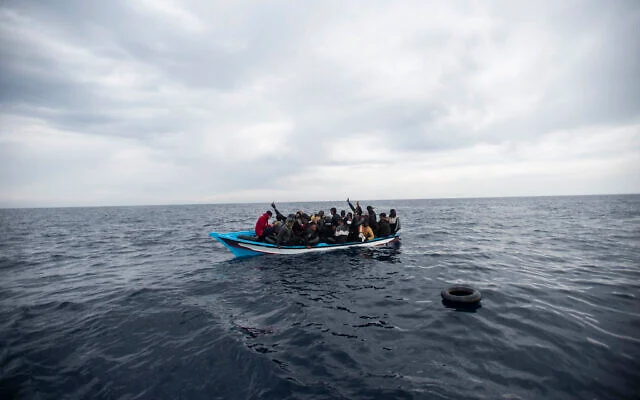
Illustrative: A wooden boat with 28 refugees from Africa and Magreb is rescued by Open Arms NGO, some 45 nautical miles away from the Libyan coast in the Mediterranean Sea, March 5, 2022. (AP Photo/Andoni Lubaki)
The Mediterranean Sea is no longer the southern border of Europe. As of this week, that boundary has been officially relocated to the banks of the Nile and the sweeping sands of the Sahara. UK Foreign Secretary Yvette Cooper’s high stakes visit to Cairo on June 19 signals a profound shift in Western migration diplomacy. By announcing a £9 million expansion of the North Africa Migration and Development program (NAMAD), the UK has laid bare its ultimate strategy. Europe is outsourcing its border control to the highest bidders in North Africa.
This new funding extends the UK’s financial footprint directly into Libya for the first time, alongside expanded operations in Egypt, Tunisia, and Algeria. The explicit goal is to contain the immense wave of Sudanese and regional refugees closer to their countries of origin and block their transit to European shores. It is a policy born of pure political panic rather than long-term vision.
The global context is undeniably grim. The Sudanese refugee crisis has displaced a staggering 12 million people, driven by a brutal civil war and looming famine. Neighboring countries are buckling under the sheer demographic weight of this unprecedented exodus. Egypt alone currently hosts over a million Sudanese refugees. European capitals are watching the cascading regional destabilization with mounting dread, terrified that the human tide will inevitably turn northward across the Mediterranean.
Instead of developing resilient, coordinated asylum systems, Western powers are reaching for the continent’s favorite quick fix. They are throwing millions of pounds at financially strained autocracies and fractured states to act as external border guards. This approach is not just a moral abdication. It is a catastrophic strategic miscalculation that hands local regimes unprecedented leverage over European foreign policy.
Consider the dynamics at play in Egypt. Cairo is navigating a severe economic crunch, grappling with massive debt and soaring inflation. The sudden influx of over a million refugees has stretched public services to the absolute breaking point. When the UK and other European nations arrive with open checkbooks, they are not fostering regional stability. They are paying protection money. By making North African states the primary gatekeepers of fortress Europe, Western governments are handing these nations a loaded geopolitical weapon.
History offers a clear warning about this exact dynamic. Regimes tasked with holding back migration flows quickly realize that refugees are their most valuable diplomatic asset. If a host country wants debt relief, favorable trade terms, or a blind eye turned to domestic human rights abuses, they only need to threaten to open the gates. Europe becomes a hostage to its own outsourced border enforcement. The threat of a manufactured migration crisis guarantees that autocrats hold all the cards at the negotiating table.
The situation in Tunisia illustrates this perfectly. The Tunisian government has frequently deployed harsh rhetoric and brutal crackdowns against sub-Saharan migrants. Funneling European development funds into such environments effectively subsidizes state-sponsored xenophobia. Similarly, Algeria has faced intense criticism for quietly abandoning migrants in the harsh desert borderlands. Partnering with these governments turns European nations into silent accomplices to gross human rights violations.
Yet, the decision to funnel NAMAD funds into Libya represents the most alarming escalation of this failed playbook. Libya remains a profoundly fractured state. It is governed by competing factions and heavily influenced by armed militias who have turned human smuggling into a highly lucrative industry. Pouring British taxpayer money into this volatile vacuum under the guise of migration management borders on strategic malpractice.
In Libya, the line between state security forces and smuggling cartels is notoriously blurred. Funding detention centers or border patrols in a nation without a unified, accountable government means the UK is effectively subsidizing the very militant networks profiting from the crisis. The horrific conditions within Libyan migrant camps are well documented globally. Tying European border security to these facilities tethers Western governments to ongoing atrocities, guaranteeing future scandals and severe diplomatic blowback.
The core delusion of Western migration diplomacy is the belief that wealthy nations can simply purchase a geopolitical shield. You cannot buy a permanent border wall from unstable partners. The millions of pounds flowing into Cairo, Tunis, Algiers, and Tripoli will inevitably evaporate into state bureaucracies or the pockets of local power brokers. The root causes of the migration crisis remain entirely unaddressed by these superficial financial transfers.
The war in Sudan continues to rage without a diplomatic resolution in sight. Climate shocks are accelerating agricultural collapse across the broader Sahel region. Economic despair is deepening across the developing world. A £9 million investment in North African border enforcement is akin to putting a small bucket under a bursting dam. It might offer politicians in London a momentary illusion of control, but the underlying demographic pressure is only increasing.
Yvette Cooper’s Cairo agreement will undoubtedly be celebrated in Whitehall as a pragmatic victory for border security. In reality, it marks a dangerous deepening of European dependency on volatile transit states. By treating North Africa as a mere containment zone, the UK is ensuring that its future foreign policy will be dictated by the whims of autocrats and warlords. When the checks inevitably stop clearing or the host nations decide the price has gone up, the gates will open. And Europe will quickly find that it spent millions only to buy a crisis it can no longer control.