

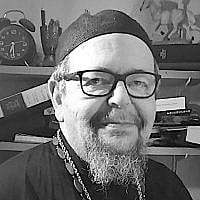
Shio III: Georgia, Memory Beyond Empire
The election of Shio III as Patriarch of Georgia has already triggered predictable reactions across parts of the Western press and among ecclesiastical commentators abroad. The words arrive almost automatically now: “pro-Russian,” “Moscow influence,” “Orthodox nationalism,” “reactionary Church,” “Kyrill’s orbit.” The tone is familiar, often anxious, sometimes accusatory, and not entirely without reason in the present atmosphere created by the war in Ukraine and the brutal fracture now running through the Orthodox world.
Yet much of this commentary says less about Georgia than about the lenses through which Georgia is being viewed.
To understand the Georgian Church merely as a territory contested between Moscow and Constantinople is to misunderstand one of the oldest Christian organisms still alive on earth.
Georgia is not an ecclesiastical invention of modern geopolitics. It is not a recent national Church seeking identity through ideology. It is one of the earliest autonomous patriarchates of Christianity, formed through mountains, invasions, liturgical memory, monastic endurance, and an almost improbable continuity of language and script. Christianity entered Iberia long before many peoples now issuing theological judgments upon it had themselves become Christianized.
And unlike many other ancient Eastern Churches, Georgia evolved without a parallel Catholic counterpart permanently standing beside it. This gave Georgian Christianity a unique historical psychology: more internally cohesive, more isolated, sometimes more defensive, but also profoundly organic.
Georgian Christianity itself was born not through imperial conquest but through the strange gentleness associated with Saint Nino, the woman who evangelized Iberia carrying a cross woven from vine branches and bound with her own hair. In Georgian memory, she is not merely an evangelizer but almost a maternal figure of the nation itself: fragile in appearance, immovable in endurance. Her cross was not made of iron, nor carried by armies. It emerged from vineyard, earth, hair, prayer, and presence. Something of this paradox still inhabits Georgian Christianity today – a civilization repeatedly wounded by stronger empires yet refusing disappearance.
The late Catholicos-Patriarch Ilia II understood this instinctively. Whatever criticisms could be directed at him, he embodied continuity on a civilizational scale. For many Georgians, he was less a modern church administrator than a surviving elder from another historical rhythm altogether. His death therefore marks not merely a succession crisis but the end of an era in which a single figure symbolized stability amid Soviet collapse, civil war, economic ruin, territorial fragmentation, Westernization, Russian pressure, and cultural disorientation.
Shio III inherits not a throne, but a fault line.
This memory also explains why many Georgians react painfully when foreigners reduce the Church to a simple extension of Russian influence. Georgia knows Russian domination not as abstraction but as lived experience. The loss of Abkhazia and South Ossetia after Russian military intervention remains an open wound in national consciousness, combining territorial fracture, displacement, demographic trauma, and the enduring sense of vulnerability experienced by a small mountain civilization surrounded by larger powers. One cannot understand contemporary Georgian ecclesiastical caution, ambiguity, or strategic balancing without understanding this underlying historical insecurity.
The difficulty is that much foreign commentary now approaches Georgia through imported categories that flatten reality. In this framework, every Orthodox Church must immediately declare itself either “with Moscow” or “with the liberal democratic West.” Yet Georgia has survived for centuries precisely by refusing to dissolve entirely into larger imperial systems, whether Persian, Ottoman, Russian, or Soviet.
This does not mean innocence. It means historical memory.
The Georgian Church knows very well what Russian domination can mean. The abolition of Georgian ecclesiastical autocephaly under the Russian Empire in the nineteenth century remains deeply engraved in national memory. Georgian liturgical life, language, and ecclesiastical structures were subordinated and partially Russified for decades. This is not forgotten in Tbilisi, even when Western analysts imagine that every conservative Orthodox reflex must necessarily equal submission to Moscow.
At the same time, many Georgians also observe with caution the expanding ambitions of Constantinople, whose claims to coordination, arbitration, and transnational ecclesiastical authority are increasingly viewed by some local Churches as another form of centralization – albeit expressed in different vocabulary.
The tragedy of contemporary Orthodoxy is that nearly every center accuses the others of imperial behavior while denying its own.
Moscow speaks of canonical protection while expanding influence through resources, property, and geopolitical gravity – outside its own canonical and traditional territories, all over the planet.
Constantinople speaks of primacy of service while extending jurisdictional claims far beyond its shrinking demographic base.
Others survive somewhere in between.
Jerusalem, perhaps more than any other patriarchate, understands this balancing act because it lives permanently under overlapping pressures impossible to explain to outsiders who imagine Church politics as clean ideological alignments.
The Patriarchate of Jerusalem survives amid Israeli realities, Palestinian realities, Arab Orthodox frustrations, Greek monastic interests, Russian property struggles, financial fragility (the terrible situation of the Saint Katharina Monastery in the Sinai), and now the aftershocks of the Ukrainian ecclesiastical rupture. Every decision is interpreted as a hidden alliance. Every silence becomes a rumor.
Thus one hears today that Patriarch Theophilos of Jerusalem “backs Moscow.” This is simplistic to the point of absurdity. Jerusalem cannot afford ideological absolutism. It operates instead through a form of survival diplomacy inherited from centuries of Ottoman, British, Jordanian, and Israeli transitions.
One must also remember that Russian influence in Jerusalem did not begin with the present war. The tensions go back decades and include failed ecclesiastical strategies, property struggles, Soviet-era networks, and complex personal biographies. The case of Metropolitan Timotheos of Vostra – once seen by some as a possible patriarchal candidate – belongs to this broader history. His family background, his studies in Leningrad, and his perceived proximity to Russian circles created anxieties long before the current geopolitical catastrophe. Jerusalem remembers such things for generations.
Yet there is another dimension almost entirely absent from international discussion: the Georgian presence in the Holy Land itself. Or rather, its disappearance.
For centuries, Georgian monasticism formed one of the great Christian presences in Jerusalem and throughout the Holy Land. Georgian monks, scribes, translators, and pilgrims left inscriptions, frescoes, manuscripts, monasteries, and liturgical traces extending back to the earliest centuries of Eastern Christianity. The Monastery of the Cross remains perhaps the most visible symbol of this heritage, but it is only part of a much larger historical landscape.
Long before the modern rediscovery of “Christian roots” by political actors, Georgians were already praying, translating, and building in Jerusalem.
Many forget that the Georgian Christian connection to the Holy Land precedes even the full crystallization of Georgian national Christianity under Saint Nino and the later development of the Georgian alphabetic tradition. Jerusalem was not peripheral to Georgian Christianity. It was one of its spiritual lungs.
And yet, since the beginning of the 2000s, the Georgian Patriarchate has effectively disappeared institutionally from Jerusalem.
This remains a painful and insufficiently discussed reality.
The ancient Georgian sites gradually passed under Greek Orthodox administration, sometimes through legal and financial processes, sometimes through the simple demographic impossibility of maintaining Georgian monastic life after Soviet collapse and post-Soviet impoverishment.
But there is also a more uncomfortable truth that should not be erased for the sake of diplomatic politeness.
A number of ancient Georgian inscriptions, frescoes, and traces were damaged, neglected, overwritten, or destroyed over time under later custodianship. Some restorations had eventually to be corrected or compensated for. Among Greek clergy themselves there are honorable and cultivated figures who recognize this openly and without hatred. Historical honesty requires saying it.
This is not about inciting ethnic resentment inside Orthodoxy. It is about memory.
Small Churches often disappear not through formal persecution but through slow erosion, administrative absorption, demographic collapse, and the gradual loss of visible traces.
The Georgians know this. So do the Armenians. So do many Arab Orthodox Christians.
In Jerusalem, stones remember even when communiqués remain silent.
At the same time, the Georgian story in Israel is not reducible to ecclesiastical loss. Israel itself contains one of the most remarkable Georgian diasporas in the world: Georgian Jews who arrived with powerful communal cohesion, distinctive traditions, and a deep attachment both to Judaism and to the memory of Georgia itself.
This too is rarely discussed seriously.
Georgia occupies a unique place in Jewish historical memory. Unlike much of Christian Europe, it never became identified primarily with systematic theological antisemitism. This does not mean paradise or perfection. No society is free from tensions. But Georgian Jewish memory remains strikingly different from the memories carried out of many neighboring regions.
That distinction matters today.
Particularly at a time when ideological simplifications dominate discourse and entire civilizations are judged according to imported political templates.
The Georgian Church therefore stands in a singular position. Ancient, vulnerable, conservative, multilingual, wounded by empire yet wary of Western dissolution, tied to Jerusalem yet largely absent from it, historically close to Jews without possessing a Catholic counterweight, suspended between Russia, Turkey, Iran, Europe, and the Caucasus itself.
No press headline can adequately contain such a reality.
Shio III now enters this landscape at one of the most dangerous moments in modern Orthodox history. Every gesture will be interpreted geopolitically. Every silence will be decoded as allegiance. Every liturgical encounter will become diplomatic theater.
Yet perhaps the deeper question is not whether Georgia will “choose a side.”
Perhaps the deeper question is whether ancient Churches can still survive without becoming instruments of larger civilizational blocs and show what it means to act with faith.
For centuries, Georgia survived precisely because it refused complete absorption by stronger powers. Its Christianity was formed not through triumphal empire but through endurance among mountains, invasions, and cultural crossings.
Shio III inherits not only a throne or a fault line, but the burden of preserving a Church whose deepest symbol is still the vine-cross of Saint Nino rather than the machinery of empire.
That memory still exists beneath the current noise.
And Jerusalem, despite all its own fractures and contradictions, still remembers that the Georgians were here long before many modern ecclesiastical rivalries took shape.
Their absence today is therefore not merely administrative.
It is a spiritual and historical diminishment of the Holy Land itself.