
Journalist and Host of The Spiro Circle Podcast
Should Israel’s democracy require a plane ticket?
A few weeks ago, I was on a call with a founder I’ve interviewed before. He told me the story of a woman in New York City who has lived there for 17 years. She has three kids and badly wants to come home in October and vote – but she’s afraid to do so. Not of the flight itself, but of getting stuck here if the war flares up again before she can get back to her children.
It’s the same calculation that half a million Israelis abroad are being asked to make this year, because Israel is one of the few democracies in the world that doesn’t allow citizens overseas to cast an absentee ballot. If you want to vote in what may be the most consequential election in the country’s history (the first since October 7), you don’t get to do it from London, or New York, or wherever you’ve built a life.
You either get on a plane, or you don’t vote at all.
The founder I was speaking to was Shai Bargil, CEO of Sequent. This Israeli company develops cryptographically verifiable online voting systems that are already used in elections in Canada and Europe.
“One of the hardest topics we’re currently talking about,” he told me, “is overseas voting. When governments start with us on digital voting, they typically start with a specific population [like] overseas citizens, people with disabilities, sometimes the elderly.”
Later this year, Canada will use its secure cryptographic system to verify 208,000 registered online voters across 15 municipalities in the country’s October elections. Shai told me it is somewhat of a stepping stone into the North American market, hoping it will lead to more discussions with municipalities in the United States.

His story struck a nerve because it reminded me of my own experience in Israel these last few years. I’ve been chasing expensive flights to and from London on short notice, often not knowing how long I would remain overseas or if I would be able to return at all. As recently as May, I remained in London for a month because I was unsure whether, if I landed back in Israel, I could return soon after. And voters who live overseas are now feeling the same squeeze.
Sequent doesn’t operate in Israel, but not because there is a law that forbids it, as it turns out. Shai argues that introducing overseas voting may not require any sweeping new legislation. He says conversations with election law experts suggest the Central Elections Committee could begin with embassy voting before considering digital systems.
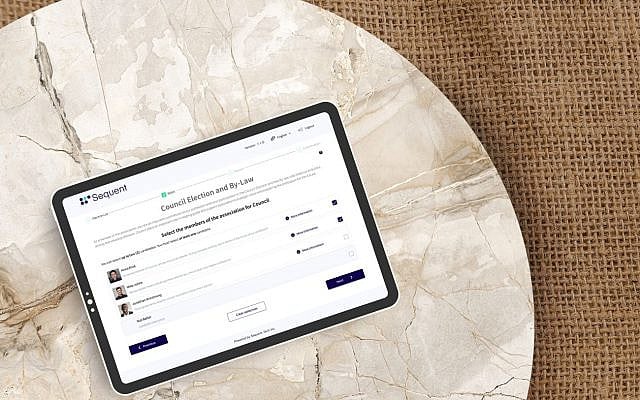
It is, therefore, possible to reform the voting procedures in Israel with an open-source and verifiable system for those overseas – but nothing is being done to make it easier for those to partake in the democratic process.
I brought up a report that alleged the Transportation Ministry had discussed limiting charter flights bringing expats home to vote, out of concern that returning Israelis skew against the current government. “Those kinds of things will always happen,” he said. “They say they’re making it harder, they say they’re making it easier. It’s always like this.” Whatever the truth of that specific report, the fact that it’s plausible enough to run at all says something about how contested access to this election already is, before a single ballot is cast.
Voter anxiety has gone global
Widen the lens and the anxiety isn’t unique to Israel. Days before this call, President Trump gave a speech reviving claims about the integrity of American elections, tied to a push for stricter voter ID legislation and citing declassified documents alleging foreign actors had acquired hundreds of millions of US voter files.
I asked Shai if a cultural moment like this, that calls into question the validity or integrity of governments and voting systems, helps Sequent, or if talk on any new voting technology could become toxic in this hyper-partisan fight over legitimacy. “It proves our point,” he said. “It doesn’t matter if you do everything correctly; it has to be evidence-based. There’s no public scrutiny in most US voting machines, no verification, besides a manual recount instead of an automatic one. You have no way to know [whether] whatever was tabulated was tabulated correctly.”
He compared Sequent’s election verification technology to an airbag in a car: “You don’t use it every day, and most of the time you don’t even think about it. But when an accident happens, you need it to work, and to work very well.”
There are indeed legitimate questions about whether citizens who live permanently abroad should shape the country’s future, but democracies around the world have grappled with those questions for decades! Many Olim who now live in Israel may vote in their native country’s elections, whereas Israel does not return that luxury. That may have sufficed in the country’s early days, but the world is becoming intolerant of its archaic system – especially from a country that also sells itself as a startup and innovation nation.
This year will see two democracies come to terms with two different failures of the same instinct. Israel’s crisis is whether the people entitled to vote can physically get to the count, and America’s crisis is about whether those counts can even be trusted. Both fail to answer the same basic question: why is this still this hard?
Somewhere in New York, that woman with three kids is still checking flight prices. Until a new system can be installed in elections in Israel, most of the half a million like her will have to decide whether an election this consequential is worth what it now costs just to show up.
I spend a lot of time speaking to founders and investors across Startup Nation. You can read my work on my independent platform and podcast, The Spiro Circle.
Related Topics
Related Posts