
Welcome to the Ongoing Situation
Shylock in the Age of Social Justice
The old myths about Jewish evil now come with citations, hashtags, and institutional approval
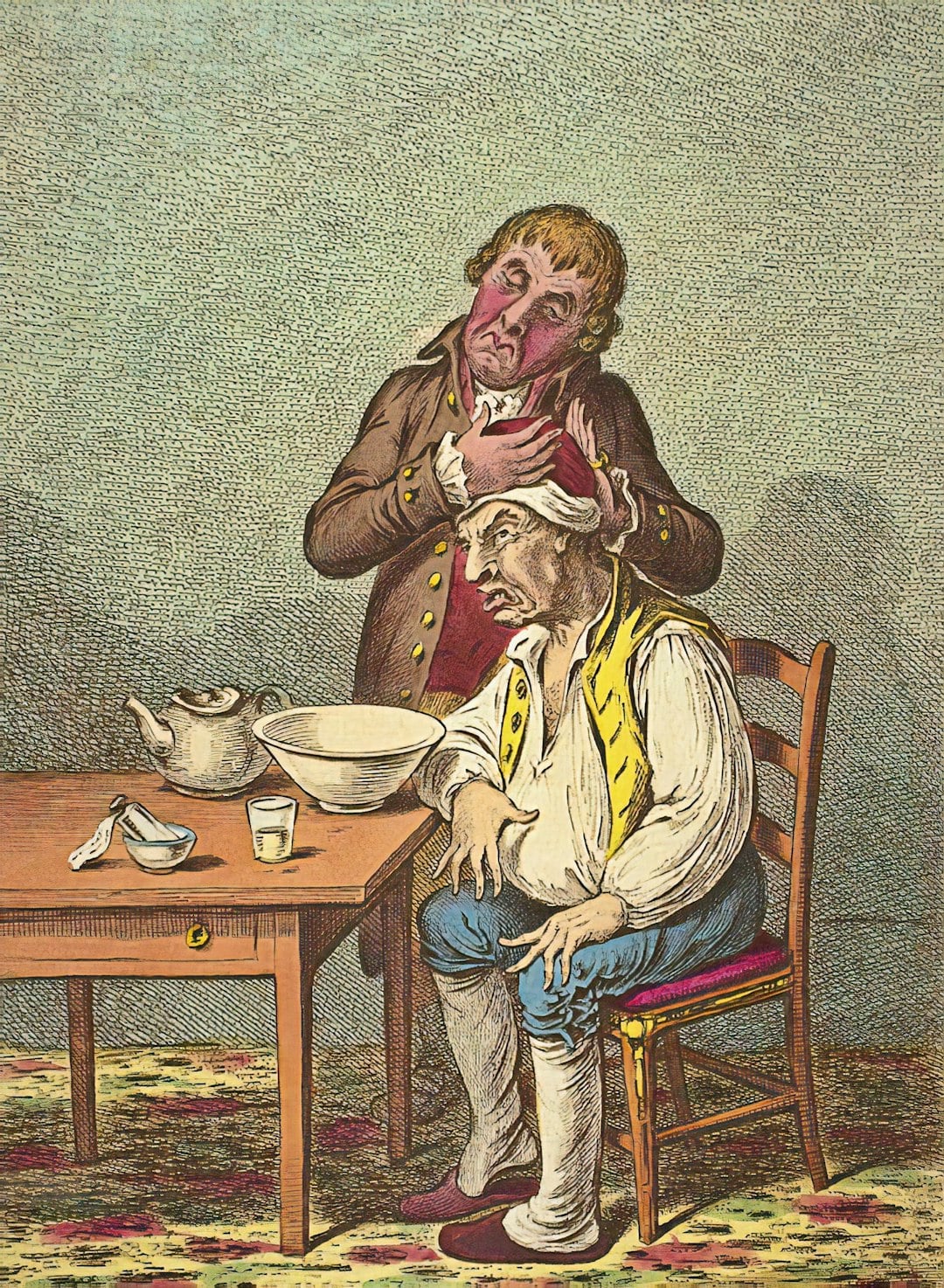
Gentle Emetic. 1804. James Gillray (1756-1815). (Photo by McGill Library/Unsplash)
For a long time, many Jews believed antisemitism had survived mostly as a residue.
Embarrassing residue. Fringe residue. The sort of thing muttered by men with swastika avatars or shouted outside synagogues by extremists who still seemed, reassuringly, outside respectable society.
The Holocaust belonged to history books, museums, memorials, and our grandparents’ nervous systems. “Never Again” may not have meant Jews were fully accepted everywhere, but it suggested Western civilization had at least learned to recognize its oldest hatred before it metastasized again.
Then came the past two years.
Not merely the protests or the slogans or even the violence against Jews across Europe and North America. Hatred itself is ancient. Jews are familiar with hatred.
What has been startling is the speed with which educated people — journalists, activists, academics, cultural institutions, and ordinary readers who consider themselves rational and humane — have shown themselves willing to believe almost anything about Jews, and particularly about Israelis.
Not criticism. Not accusations of military wrongdoing. Those are legitimate subjects of debate in any democracy, including Israel.
Something deeper and older. Something mythological.
Recently, a respected publication ran allegations involving Israeli military dogs being used to sexually assault Palestinians. Even writing the sentence feels like part of some sick satire. It reads less like war reporting than something that would have circulated in Europe centuries ago, beside stories of Jews poisoning wells or baking matzah with the blood of Christian children.
And yet thousands of educated people encountered the claim not with immediate skepticism but with readiness. Preparedness. A kind of warm familiarity.
That is the unsettling realization many Jews are struggling to stomach.
The frightening thing is not simply that people hate Jews. It is how believable Jewish evil still feels to the Western imagination.
In The Merchant of Venice, Shakespeare gave the world Shylock, perhaps the most famous Jewish character in Western literature. Modern audiences often emphasize his humanity, and rightly so. “Hath not a Jew eyes?” remains one of the most moving indictments of prejudice ever written.
But Shylock’s humanity never fully frees him from his role in the story. He remains calculating. Alien. Morally distorted. Even sympathetic productions rarely escape the fact that the Jew still occupies the narrative position of the dangerous outsider whose grievance mutates into something monstrous.
Shylock became one of the templates through which Europe learned to imagine Jews. We were not merely different but uniquely capable of cruelty hidden beneath intelligence, cleverness, and woundedness.
Centuries later, the archetype remains alarmingly intact.
The language changes. The politics change. The costumes change. But the underlying narrative survives.
The Jew is still imagined as uniquely manipulative, uniquely soulless, uniquely conspiratorial, uniquely indifferent to human suffering. The Jewish state, in turn, is often treated not as a flawed nation among flawed nations, but as a kind of metaphysical villain capable of crimes so grotesque they border on folklore.
That is why certain accusations spread so easily.
Not because evidence no longer matters, but because the accusation already feels emotionally true to people conditioned by centuries of cultural storytelling.
Blood libels never really disappeared. They secularized.
The medieval Christian feared the Jew who murdered children in secret rituals. The modern progressive fears the Zionist who delights in oppression with clinical sadism. The aesthetics evolved into the language of human rights and decolonization, but the emotional architecture remains eerily familiar.
And perhaps that is what has shaken so many Jews since October 7.
Not simply the antisemitism itself, but the realization that the West’s civilizational guardrails against antisemitism may have been thinner than we thought.
Many secular Jews grew up believing another Holocaust was the paranoia of traumatized grandparents. History had progressed. Liberal democracy had matured. The evil fantasies about Jews belonged to another era.
But history has a way of revealing which instincts societies have truly overcome and which merely went dormant under conditions of comfort.
What many Jews are confronting now is the horrifying possibility that antisemitism is not simply a prejudice Western culture occasionally falls into, but one of the stories it knows best.
And stories this old do not disappear simply because societies become educated. Sometimes education merely teaches people to retell them in more sophisticated language.
The old myths about Jewish evil now come with citations, hashtags, and institutional approval.
Shylock never left the stage. He simply learned new lines.
Related Topics
Related Posts