
Shylock: The Dagger That Still Pierces the Jewish People
When I hear the word “Shylock,” I don’t think of Shakespeare. I think of a beautiful little blonde girl in Warsaw, born in the wrong place at the wrong time in history.
Her name was Edna. She was my mother-in-law, and I was privileged to know and love her for 37 years.
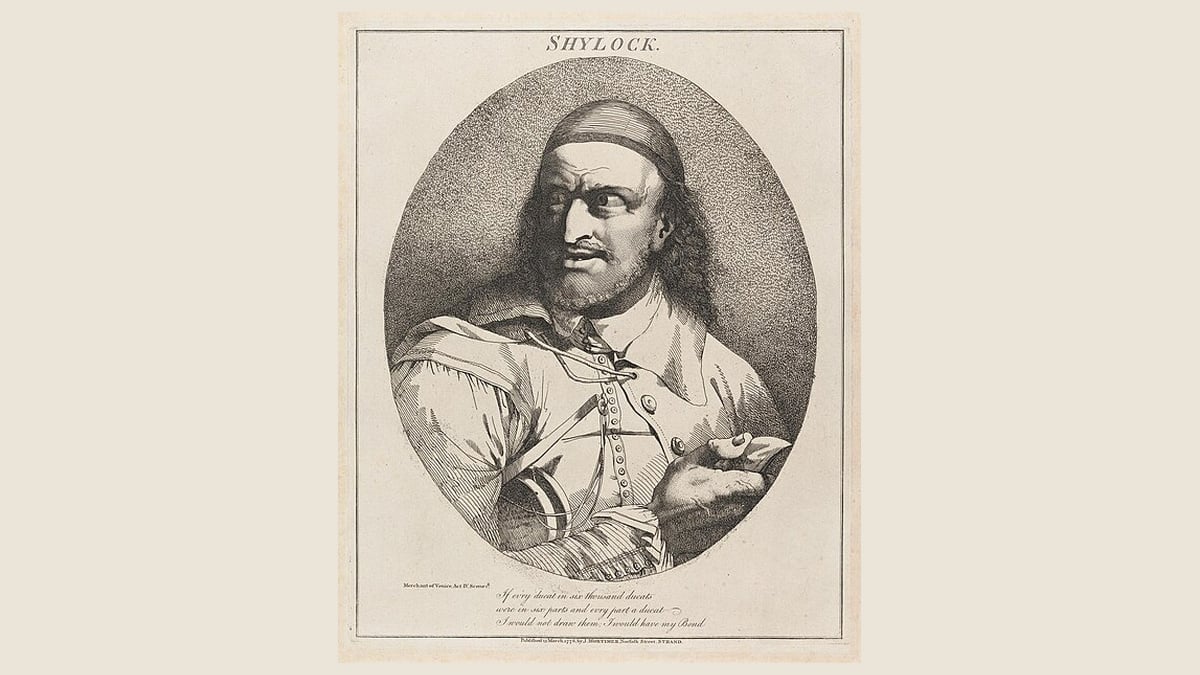
To most people, Shylock is a character from a play: the Jewish moneylender in The Merchant of Venice who demands a pound of flesh from a Christian who cannot repay his loan. Students read him in high school. Actors line up to play him. Critics debate whether Shakespeare meant him as a villain or a victim.
To Jews, Shylock is something else. He is a dagger lodged in our side for more than 400 years.
Think of the image Shakespeare gave the world: a Jewish moneylender demanding the right to cut a pound of flesh from a Christian man’s body. Even Shylock’s most famous speech, “Hath not a Jew eyes?”, moves from an assertion of shared humanity to a declaration of revenge.
And in the end, Shylock is defeated, stripped of much of his wealth and compelled to convert to Christianity. His daughter has already abandoned him and embraced the Christian world.
The price of his survival is the surrender of his Jewish identity.
The Nazis understood the power of that image.
After Hitler came to power in 1933, Nazi propagandists exploited The Merchant of Venice as a vehicle for antisemitism. Productions of Shakespeare’s play continued under the Third Reich, with Shylock portrayed through the grotesque stereotypes already familiar to German audiences.
The most notorious production opened in May 1943 at Vienna’s Burgtheater. Werner Krauss, who had appeared in the antisemitic Nazi propaganda film Jud Süß, played Shylock in a performance that turned Shakespeare’s Jewish moneylender into a monstrous caricature.
Consider the obscenity of that moment.
In Vienna, audiences watched an actor portray a murderous Jew while the Nazis were deporting and murdering actual Jews.
That same spring, in Warsaw, a Jewish girl of eight was fighting to stay alive.
The Nazis did not invent the hook-nosed Jew counting his gold. They inherited centuries of European antisemitic imagery and transformed it into an instrument of state propaganda.
The caricature appeared in the pages of Der Stürmer, on posters, in exhibitions and in children’s books that taught German schoolchildren to identify Jews by supposedly distinctive physical features and an imagined obsession with money.
Shylock was not the source of all this hatred. But he was one of its most enduring cultural symbols.
Edna was born into a world that had already decided what a Jew was.
She was the very opposite of everything that world imagined.
Born in Warsaw in 1934, she was four years old when Nazi Germany invaded Poland. At seven, she risked her life smuggling food into the Warsaw Ghetto. At nine, she served as a courier for the Polish Home Army during the Warsaw Uprising. At ten, she was decorated for extraordinary courage.
But courage could not protect her family from the machinery of Nazi persecution.
Her father, Avraham, trusted an offer conveyed through the Jewish Council, the Judenrat. He was told that if he reported for labor in the Lublin district, he could work for the Germans and send money home.
He went, taking his eldest son, Shlomo, with him.
They were forced to work at Majdanek, the Nazi concentration and extermination camp near Lublin.
Avraham was murdered there.
According to the testimony passed down through Edna’s family, Shlomo was forced to place his own father’s body into a crematorium oven.
Imagine being a son and being forced to do that.
Shlomo survived Majdanek and was subsequently imprisoned at Mittelbau-Dora and Buchenwald, where he was liberated. But survival did not mean freedom from the horrors he had endured. He struggled with alcoholism and died young.
Edna survived too.
She survived the Warsaw Ghetto, Nazi-occupied Poland, the Warsaw Uprising and German captivity. She went on to become a wife, a mother, a grandmother and one of the most courageous women I have ever known.
She lived to see children and grandchildren grow up in freedom.
Yet the word “Shylock” survived alongside her.
More than four centuries after Shakespeare wrote his play, the name still functions as an insult, a shorthand for greed, ruthlessness and financial exploitation.
It is sometimes tossed around as though it were harmless, merely a literary reference or an old-fashioned expression.
But words carry history. And this one carries centuries of contempt for Jews.
There is a remarkable story about the great Yiddish actor Maurice Schwartz, who offered a different interpretation of Shylock’s final confrontation with Antonio.
As literary critic Harold Bloom recalled, Schwartz’s Shylock raised the knife, then let it fall, crying out, “Ikh bin dokh a Yid!”
After all, I am a Jew.
In that moment, the man who had been portrayed as merciless became the one who showed mercy.
I think of Edna.
She was seven years old when she risked her life smuggling food into the Warsaw Ghetto. Nine when she served the Polish resistance. Ten when she was decorated for extraordinary courage.
She was everything the Nazi caricature of the Jew insisted she could never be.
Shakespeare’s Shylock has endured for more than four centuries. Edna survived the Nazis, but millions of Jewish children did not.
The Nazis murdered the children. They did not murder the stereotype.
That is why words matter. That is why history matters. And that is why I will keep telling Edna’s story.
Because the dagger is still there.
And silence only drives it deeper.
Janet Bond Brill, PhD, is the author of Little Edna’s War, the extraordinary true story of her mother-in-law’s survival as a Jewish child resistance fighter in Nazi-occupied Warsaw. Published January 27, 2026, International Holocaust Remembrance Day. Order now on Amazon.