NAnews - Nikk.Agency Israel News
Silence Is No Longer an Option: Stolen Ukrainian Grain Tests Israeli Society
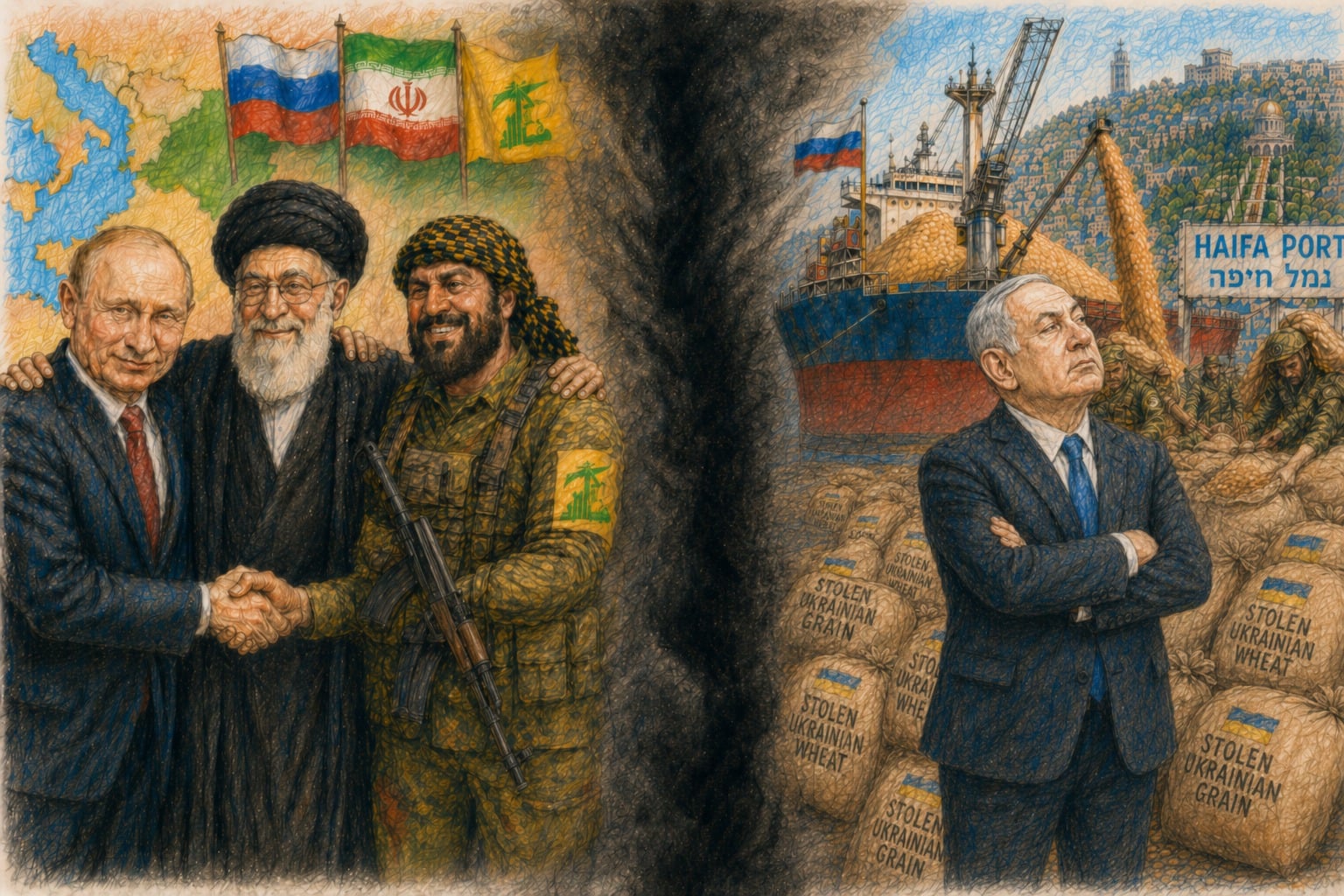
Israeli Society Has Started Talking About Stolen Ukrainian Grain. Silence Is No Longer an Option. The illustration was drawn using AI.
Why does this matter to Israel?
The story of Ukrainian grain that, according to Ukrainian officials and media reports, may have been taken by Russia from occupied Ukrainian territories and delivered to the port of Haifa is no longer just a diplomatic scandal.
In Israel, this issue has moved into the public sphere — through social media, journalists, activists, the Ukrainian community, and Israelis who feel uncomfortable seeing their country mentioned in connection with such a scheme.
It was the public reaction that made this story visible.
While official institutions spoke cautiously, people online asked much more direct questions. How can Israel demand fair treatment for itself if it appears next to trade in goods that Ukraine regards as stolen?
Why does the port of Haifa appear in such reports at all?
And why did the official response seem delayed when the issue concerns Russia’s war, occupation, and the possible laundering of stolen property?
The first important reaction did not come as an official diplomatic formula. It came as a wave of public discussion. People wrote on social media, argued, shared reports, and directed questions at journalists and politicians.
The most noticeable voices were those who see Russia’s war against Ukraine not as some distant foreign issue, but as a moral test for Israel itself.
A simple idea kept returning in these discussions: if a country knows, or even seriously suspects, that cargo may have been stolen from occupied territory, it cannot behave as if this were an ordinary commercial shipment.
One of the strongest public arguments used a comparison with Israeli pain. If terrorists seized the southern kibbutzim, took their harvest, equipment, and residents’ property, and then tried to sell it through a foreign port, how would Israel react to another country’s indifference?
That kind of analogy translates the Ukrainian tragedy into a language Israeli society can immediately understand.
For many Israelis of Ukrainian origin, this is not just “grain.” It is a symbol of how Russia turns occupation into business: taking resources, changing documents, using ships, ports, and intermediaries, and trying to make stolen goods look like part of normal trade.
The issue touches another sensitive point in Israeli society.
Israel itself constantly fights for its right to security. It asks the world to understand its pain. It explains that one cannot close one’s eyes to terrorism, murder, and the seizure of civilian property.
That is why the question is so painful: if Israel wants the world to hear its pain, can it refuse to hear Ukraine’s?
The public reaction grew stronger after Israeli media reports. But the point is not only that these reports appeared. The real importance is that, after them, the issue stopped being a narrow Ukrainian warning and became an Israeli conversation.
People began asking questions not only of Ukraine, but of their own government.
Why was the vessel Abinsk able to unload cargo?
Were there warnings from Kyiv?
Who checked the origin of the cargo?
Who in Israel is responsible for such decisions?
Why did the issue become visible only after it was widely discussed in the media and on social networks?
This is exactly the kind of case in which civic pressure forces official systems to respond. Even if the response sounds dry and legalistic, the very fact that there is a response shows that the issue is no longer in the shadows.
Israelis who support Ukraine played a special role. For them, this story became not just a news item, but a question of dignity.
The public reactions were often harsh. Some wrote that accepting stolen goods means becoming part of someone else’s robbery.
Others spoke of “bread with the taste of a lost conscience” and of the fact that, in the holds of such ships, there is no longer only grain, but also the reputation of the state.
Yes, these are emotional words. But that is precisely the strength of public reaction: it does not speak the language of diplomatic notes. It speaks the language of moral shock.
In Israeli reality, where so many issues are quickly swallowed by security, coalition battles, war, hostages, and internal politics, the Ukrainian issue often risks disappearing from the agenda.
This time, it remained — because people themselves began to raise it.
The reaction was not uniform. There were also opposing voices online. Some began reminding Ukraine of its votes at the United Nations, historical grievances, old wounds, antisemitism, Kyiv’s policy, and the complicated history of Ukrainian-Israeli relations.
But that only revealed the depth of the problem.
Instead of answering a simple question about cargo that may have been stolen, part of the debate escaped into the familiar “what about you?” argument. That tactic solves nothing. It does not explain the origin of the grain. It does not answer the question of Haifa. It does not remove possible sanctions risks. And it does not protect Israel’s reputation.
For many people, such a reaction looked like an attempt to use the historical pain of Jews to justify today’s Russian looting.
The memory of Jewish victims must not become a cover for indifference toward a new war and new crimes.
In this story, Israeli society has encountered an uncomfortable mirror.
One can speak for a long time about diplomacy, legal requests, evidence, procedures, and communication channels. All of that matters.
But the public question is simpler: can Israel afford to look like a country that accepts goods when there are serious suspicions that they were stolen from a people living through war?
The answer should not depend only on officials.
Journalists must ask questions. Activists must apply pressure. The community must demand clarity. Israeli citizens must understand that the country’s reputation is shaped not only by government statements, but also by what passes through its ports.
If society remains silent, such schemes become cheap and convenient.
If society speaks, argues, demands checks, raises documents, turns to members of Knesset, journalists, and lawyers, then every participant in such a chain begins to understand that accepting stolen goods becomes risky, expensive, and publicly dangerous.
That is exactly what is happening now.
The story of grain in Haifa has become not only a diplomatic issue, but also a public test for Israel.
There are many questions. They need answers — not someday, not after another ship, not after another report, but now.
At NAnews — Israel News, we believe such issues must be examined to the end, because they are not only about Ukraine. They are also about Israel, its conscience, its public standards, and the way it wants to be seen by the world.
Silence is no longer neutral.
In a story like this, silence becomes part of the answer.
Related Topics
Related Posts