

An Aging Jewish Feminist
Simchat Torah: Joy, Grief, and an Unfair God
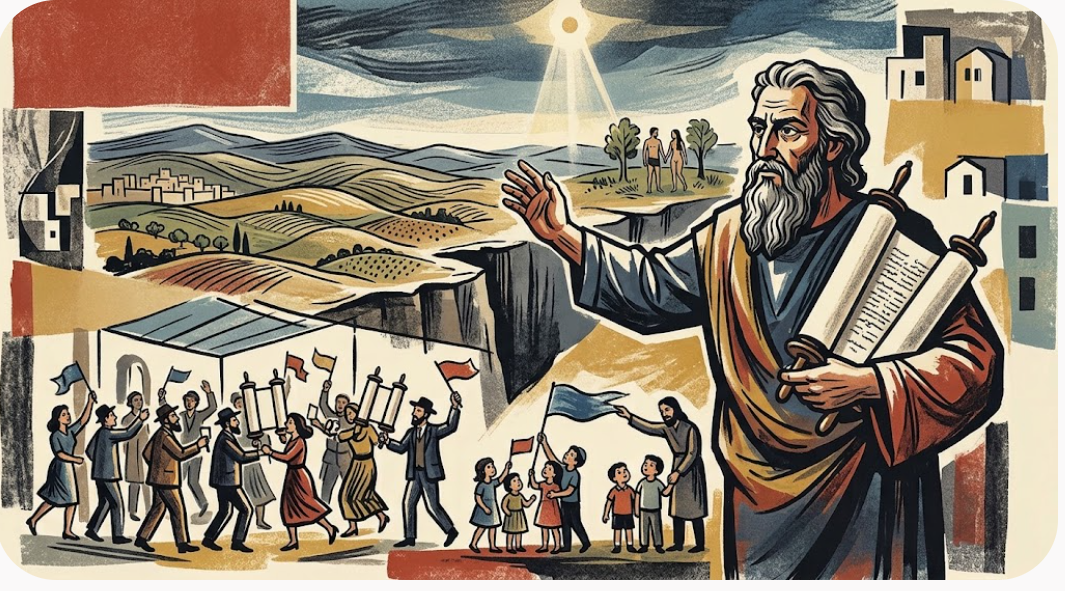
- gemini image for simchat torah in style of Irving Amen (1918-2011 NYC)
Every year on Simchat Torah, we finish reading the five books of the Torah and immediately begin again with the creation of the world. Ve-zot Ha-berakhah – And this is the blessing—tells of Moses’s final farewell to the people of Israel and his death. The Torah emphasizes that Moses was still fully capable, both mentally and physically: “Moses was a hundred and twenty years old when he died; his eyes were undimmed and his vigor unabated” (Deut. 34:7).
Then, almost without a pause, Bereishit begins with the creation of the world, culminating in the creation of human beings in God’s image (Gen. 1:27) and the completion of creation with va-yechulu ha-shamayim ve-ha-aretz ve-chal tzeva’am (Gen. 2:1–3), the words we recite every Friday night at Kiddush.
We do not know where Moses is buried. There are even traditions that he never really died and is still somewhere out there, flying around like Elijah. Meanwhile, the human race is created and placed in the mythical Garden of Eden, a paradise from which—spoiler alert—we will soon be expelled.
Before the Torah readings on Simchat Torah, we have seven hakafot, dancing, surrounding the Torah scrolls–possibly fetishizing them–marching around the synagogue with flags, singing hoshanot, asking God for salvation. The haftarah for Ve-zot Ha-berakhah begins exactly where the Torah leaves off (Joshua 1:1–18). God appoints Joshua as Moses’s successor and tells him to be “strong and resolute” as he prepares to lead the people across the Jordan and into the land of Israel, which he will, more or less, conquer.
Then there is Yizkor, the prayer for remembering the dead, followed by the prayer for rain which makes for a very long service. No wonder many congregations provide wine or hard liquor, cakes, and other munchies throughout the morning. And during the Torah reading, everyone is called up for an aliyah, which can also seem to take forever.
One of the loveliest customs is the blessing of the children, accompanied by the haunting melody of hamalach ha-goel oti, from Genesis 48:16.
In Israel, all of this takes place in one day, because Simchat Torah is combined with Shemini Atzeret. In the Diaspora, the celebrations are spread over two days. Is one way better? I don’t know.
Since making aliyah in 1967, I have experienced Shemini Atzeret in the Diaspora only three and a half times: once when my father-in-law died in Lincoln, Nebraska, during Sukkot; once during a sabbatical at Mount Holyoke; and twice when my husband had interim pulpits in Los Angeles and New York City. The “half” was when I spent all of Sukkot in Israel because my daughter had a play in the Akko Festival, and then flew to Los Angeles to celebrate Simchat Torah a second time in our synagogue. After a fifteen-hour flight and no sleep, I was promptly drafted to read from the Torah.
Now the holidays are finally over, and we return to “normal”—which means doctor’s appointments, vaccinations, and preparing to teach my classes. The holiday season is wonderful, but it can also be confusing. There are so many holidays, and so many changes in what we are supposed to say. Is it moadim le-simchah or chag sameach? When do we return to Shabbat shalom? And then there is the question of remembering that on yom tov one may cook, provided there is a lit yahrzeit candle nearby.
This last point was brought home to me one year, at the end of services. I was sitting outside the synagogue when a strange man entered the courtyard and asked whether there was a lit yahrzeit candle inside. Why? Because he had a cigarette and desperately needed a light. I told him to come back in a few minutes when services were over. However, he was not willing to wait and left.
This can only happen in Israel. My friend sitting beside me was astounded. I thought it was rather wonderful.
Moses and the Unfairness of God
But beneath the humor and celebration of Simchat Torah is a scene that has always disturbed me. As we finish Deuteronomy, Moses climbs Mount Nebo. God shows him the entire land of Israel—the land promised to Abraham, Isaac, and Jacob—and then tells him that although he can see it, he will not enter it:
“I have let you see it with your own eyes, but you shall not cross there” (Deut. 34:4).
The Hebrew is brutally stark: ve-shamah lo ta’avor—“but there you shall not cross. ”Why show him everything and then tell him he cannot enter?
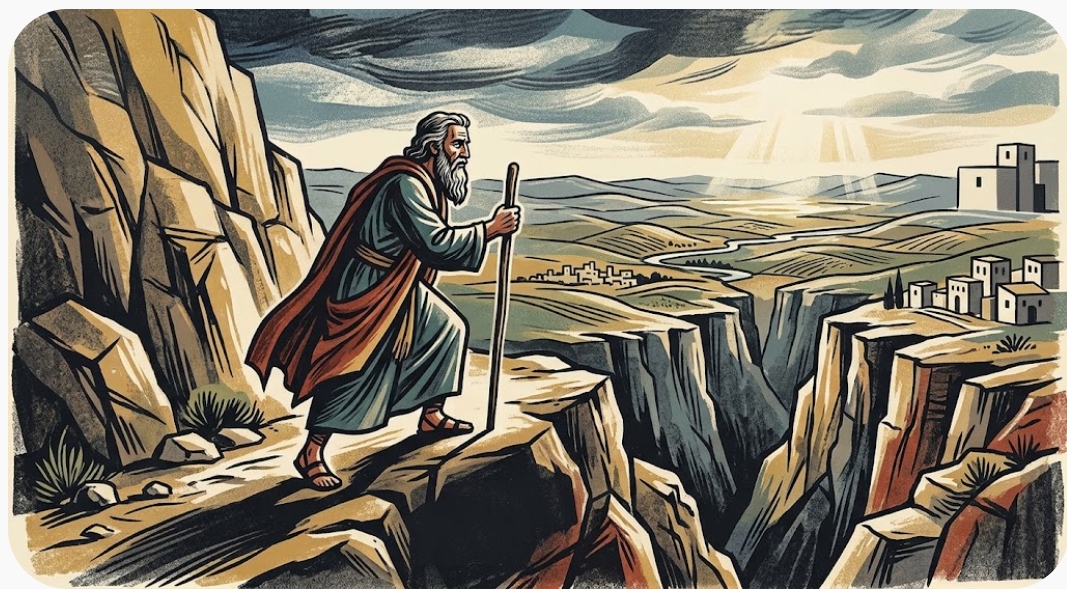
Every year I find this cruel. Last year, when I finished reading the Torah, our young rabbi seemed to sense my sadness and reassured the congregation: “Don’t worry. Moses will be back next year when we get to Shemot.” That may be temporarily comforting, but it misses the point.
The Torah itself reminds us of the reason Moses was excluded. In the second aliyah, Moses is described through the story of mei Merivah, the waters of contention: the place where he was tested and challenged. The traditional explanation is that Moses sinned by striking the rock instead of speaking to it. Perhaps the reference in VeZot HaBerakhah is meant to remind us why Moses was punished. Or perhaps it is an attempt to balance the apparent harshness of God’s treatment of His beloved servant.
The portion itself is mysterious. Much of its poetry is difficult to understand, and unlike Ha’azinu or Az Yashir, it is not clearly set apart as a distinct poetic unit in the Torah scroll. Perhaps the reason for including it here is simply to emphasize the future inheritance of the land and to name and bless the twelve tribes. the placement of Moses’s death remains troubling.
How the Commentators Explain It
I wondered whether the classical commentators were troubled by the same problem. Many of them respond with explanations that soften God’s treatment of Moses.
Obadiah ben Jacob Sforno (c. 1470/1475– c. 1550) a renowned Italian rabbi, asks why the Torah needs to repeat that Moses will not enter the land when this has already been stated several times. Why emphasize the prohibition again at the very end?
Moshe Alschich (1508–1593), a leading 16th century rabbi, preacher, and biblical cmmentator during the golden age of Safed, offers a more positive interpretation. Rather than humiliating Moses by showing him a land he cannot enter, perhaps God is honoring him. Moses accomplished so much for Israel without ever entering the land himself. Alschich also points out that righteous people often die outside the land but are eventually brought there to be buried. Moses, however, could not be buried there because the land was not yet sufficiently pure. His physical death outside Israel therefore does not diminish his spiritual connection to it.
Alschich also pays attention to the seemingly unnecessary word sham—“there”—in the verse that describes Moses’s death: Vayamot sham Moshe eved Adonai, “So Moses, the servant of Adonai, died there.” Moses was God’s eved, His servant, and served without demanding a reward. In this reading, Moses’s death becomes an expression of God’s continuing love: he dies in God’s presence, as though with a final kiss from God.
Yaakov Tzvi Mecklenburg (1785-1865), an Ashkenazi rabbi and scholar of the 19th century, best known as author of the Torah commentary Haketav VehaKabbalah, seems less willing to smooth everything over. His very first response is essentially: God forbid that God intended to cause Moses additional pain by showing him the land he had devoted his life to and then telling him he could not enter it.
Mecklenburg suggests that the wording can be understood differently. The primary purpose of Moses’s vision was not to torment him but to allow him to see the land, its boundaries, and its future. The words “you shall not cross there” could therefore be read almost as a secondary statement: Moses does not need to enter physically because he has already been allowed to see the land and, in some sense, its future.
These interpretations are thoughtful and even beautiful. But I am not completely persuaded. If I were to write a commentary, I might be persuaded to focus on this: Is the sham where Moses is to buried related to the shama of the earlier passage. You cannot go there (shama), but you will be buried there (sham)–which has a different meaning, since the second “there”, is really here, on this side of the Jordan. This interpretation fits in with all of the traditional commentators and is also somewhat mystical. Since we don’t really know where Moses is buried, is God hinting that his presence is hovering over the land of Israel even after his death? Just a fleeting thought–something to think about.
Is a Fully Conscious Death a Blessing?
There is another part of Moses’s death that troubles me.
The Torah tells us that Moses died at the age of 120 with his eyes undimmed and his vigor unabated. We usually read this as a blessing. How wonderful to remain mentally alert and physically capable until the end! How fortunate to be able to say goodbye, communicate with those we love, and remain aware of what is happening.
But is it necessarily a blessing for the person who is dying?
From the perspective of the living, certainly. We want the person we love to recognize us, to understand that we are there, and to have the opportunity to say goodbye. But what about the person who knows that death is approaching?
Would it perhaps be easier not to understand what is happening? To lose one’s awareness before having to confront the fact that life is ending?
I have thought about this in relation to my own family. My husband died fully alert and aware that the end was near, although he continued, with his characteristic humor, to hope for a miracle. My sister, on the other hand, did not let me say goodbye. She told me she was not planning to die and that we would talk the next day.
We never did.
These experiences make me question our tendency to describe Moses’s death as an ideal simply because he remained strong and lucid until the end. What is a blessing to those of us left behind may not necessarily feel like a blessing to the person who is dying.
Perhaps we, the readers and commentators, protest too much. We keep trying to put a positive spin on Moses’s death and on his exclusion from the land, as though we are uncomfortable simply acknowledging that something painful and unfair has happened.
A Complicated Ending
And this may be the deeper problem with VeZot HaBerakhah. We are celebrating Simchat Torah, but the Torah ends not with an uncomplicated happy ending, but with Moses dying outside the land he spent his life bringing Israel toward.
And then there is the final blessing itself. VeZot HaBerakhah. concludes:
O happy Israel! Who is like you,
A people delivered by GOD,
Your protecting Shield, your Sword triumphant!
Your enemies shall come cringing before you,
And you shall tread on their backs.
Reading these words today, I find the ending difficult in another way. The triumphant language of enemies being crushed sits uneasily beside the joy of the holiday. The Torah ends with both blessing and violence, hope and exclusion, celebration and death.
Perhaps that is why I find Simchat Torah so complicated.
We move from Sukkot to Shemini Atzeret to Simchat Torah, celebrating, singing, dancing, completing the Torah and immediately beginning it again. Yet woven through those celebrations are memories of those who are no longer with us, stories of suffering, questions about God’s justice, and the knowledge that even our greatest leaders do not always receive the endings they deserve.
Maybe we do not have to resolve these contradictions.
Perhaps we can hold joy and grief together. We can celebrate the Torah while questioning it. We can love Moses while wondering whether God treated him fairly. We can remember the dead while continuing to bless our children and hope for their future.
And perhaps the blessing of hamalach ha-goel oti can reach our children in a deeper sense—not only protecting them from individual harm, but helping us create a world in which fewer people suffer needlessly.
As we begin the Torah again, may we find room for reflection, hope, memory, and even disagreement with God.
And may we begin to repair the nation and the lives of all those who have suffered and are still suffering.
Moadim le-simchah.
Continue to have a meaningful and joyful holiday.