The views expressed herein are solely mine.
Sinai Is Being Re-Armed—and the West Is Asleep
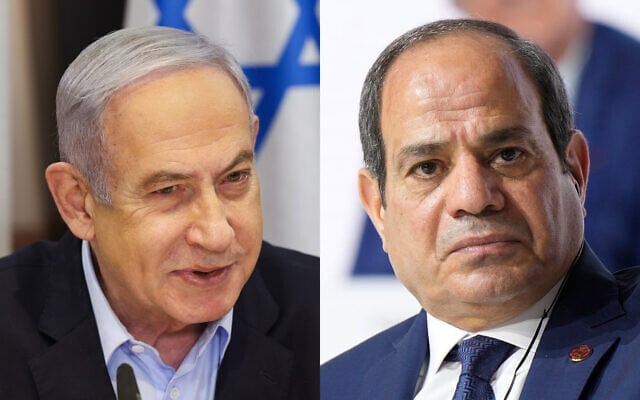
Left: Israeli Prime Minister Benjamin Netanyahu in Tel Aviv, January 7, 2024; Right: Egyptian President Abdel Fattah el-Sissi in Paris, June 23, 2023 (Ronen Zvulun/via AP; /Lewis Joly/AP).
For forty years, the Sinai Peninsula was not demilitarized out of goodwill. It was stripped of heavy force because history proved that when massed armies sit across from each other in the Middle East, war is not a question of “if” but “when”. Thus, Sinai was engineered as a shock absorber — a geographic firewall designed to eliminate surprise, temptation, and miscalculation.
However, that firewall is thinning.
Over the past several years, Egypt has expanded military infrastructure in Sinai well beyond what counter-insurgency operations require. Extended runways, fortified bases, expanded logistics hubs, and persistent armored presence are not tools for chasing jihadist cells. Insurgencies are defeated by intelligence, mobility, and precision — not by permanent strategic installations. Irrefutably, these are assets designed for state-level contingencies.
This distinction matters. Military infrastructure reflects intent to preserve options, not just address current threats. States do not pour resources into hardened facilities for enemies they claim are defeated. They build them to ensure freedom of action tomorrow — under different political circumstances.
The argument that this buildup is purely defensive misses the point. Deterrence does not operate on declared intentions; it operates on capabilities and positioning. Once a demilitarized zone begins absorbing a permanent force, the logic that sustained it collapses. What was once exceptional becomes routine. What was once restricted becomes normalized.
Hence, the stability of Sinai depended on enforcement. For decades, the rules held because deviation carried cost — diplomatic, financial, and strategic. That cost was imposed by an external guarantor willing to act decisively. Today, that guarantor is visibly less present. Washington still funds agreements and issues statements, but it no longer enforces red lines with the clarity or consistency that once froze behavior in place.
This erosion is not happening in isolation. Across the region, security arrangements built on American credibility are quietly being tested — from maritime routes in the Red Sea to proxy warfare on Israel’s borders. Sinai fits the same pattern: incremental pressure applied in an environment where enforcement is uncertain and consequences are negotiable.
The danger is not an Egyptian attack. The danger is precedent. Once the buffer logic collapses, deterrence shifts from structure to psychology. Suspicion replaces predictability. Planning replaces trust. Arms balances replace treaties.
Middle Eastern history is unforgiving on this point. Wars rarely begin because one side wants them. They begin because buffers erode, warnings are ignored, and decision-makers discover too late that the architecture that restrained escalation no longer exists.
Sinai was meant to remove history from the battlefield. Its gradual remilitarization signals history’s return — quietly, bureaucratically, and dangerously. Peace treaties do not die in dramatic violations. They die when enforcement weakens, when guarantors retreat, and when everyone convinces themselves that today’s deviation won’t matter tomorrow.
In geopolitics, buffers do not vanish overnight. They thin, they fray — and then one day, they fail.
Related Topics
Related Posts