


Middle East Forum Fellow/North Africa Risk Consultant
Sisi Has Run This Con Seven Times. Washington Keeps Falling for It.
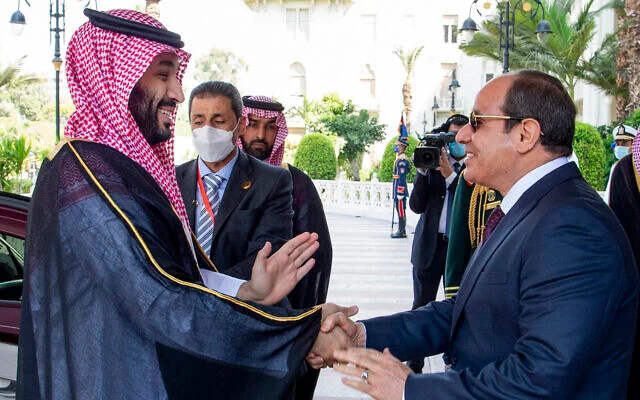
In this photo released by the Saudi Royal Palace, Saudi Crown Prince Mohammed bin Salman, left, is greeted by Egyptian President Abdel-Fattah el-Sissi, after their talks at the presidential palace, in Cairo, Egypt, June 21, 2022. (Bandar Aljaloud/Saudi Royal Palace via AP)
The International Monetary Fund’s seventh review of Egypt’s economic reform program is scheduled for June 15. Six days from now. An IMF delegation arrived in Cairo last month to launch the review, with talks focused heavily on how the Iran war is affecting Egypt’s economy and whether Cairo can unlock a potential disbursement of $1.65 billion. If history is any guide, the review will pass, the money will flow, and everyone will call it progress.
Egypt has been reviewed by the IMF six times since 2022. Each review found progress. Each review released funds. Egypt now carries $169 billion in external debt, owes $27 billion in external debt service in 2026 alone, and devotes more than half of total government expenditures to interest payments. Poverty afflicts a third of the population. The Egyptian pound has shed the majority of its value over the past three years. Whatever metric the IMF has been using to define reform, it has not appeared in the lives of ordinary Egyptians.
The structural reason for that gap is one that every review acknowledges and none demands be fixed. Egypt’s military controls an estimated 40 percent of the economy, commanding an empire spanning construction, food manufacturing, real estate, fuel retail, and logistics. This empire is constitutionally insulated from civilian oversight, and military commercial revenues are exempt from state budget scrutiny. A senior defense ministry official declared more than a decade ago that anyone seeking to curtail military economic control “threatens Egypt’s national security.” That position has never changed and no review has challenged it.
The IMF calls what Cairo is doing “privatization.” What Egypt is actually doing is asset substitution. In December 2025, $3.5 billion was received from the sale of land rights to Qatar, while divestment proceeds are expected to reach $1.5 billion by end-June 2026. Gulf sovereign wealth funds have absorbed Egyptian state assets in consecutive rounds. These transactions reduce the state’s formal role in the economy while transferring strategic national assets to foreign sovereigns who provide Cairo with diplomatic and financial patronage in exchange. That is not market reform. It is the purchase of political survival using Egyptian territory as currency.
The Iran war has provided Sisi his most useful cover in years. Egypt is among the countries most affected by the war’s spillovers alongside Jordan and Pakistan, with the pace of disinflation likely to slow amid rising global commodity and energy prices. Egypt suffered an $8 billion outflow due to the conflict according to Moody’s. Suez Canal revenues collapsed as shipping rerouted away from the Red Sea. Every underperformance that Cairo needed to justify now has a legitimate-sounding external cause, and the IMF has accepted each one without enforcing a structural condition that the regime could not maneuver around.
Washington enables this because it believes it cannot afford not to. Egypt’s role in Gaza ceasefire mediation, its maintenance of the Rafah crossing, its formal peace with Israel, and its basing arrangements for US military assets make Cairo politically untouchable in Washington’s strategic calculus. The Trump administration, like its predecessor, will not allow the IMF to withhold Egyptian funds over reforms that might destabilize a government it depends on for regional management. The seventh review is set for June 15, with a final review scheduled for November that would release an additional $1.65 billion. The eighth review will be scheduled before anyone processes whether the seventh delivered anything real.
The logic is self-defeating. A regime that cannot be pressured is a regime that will not reform. An Egypt running a fiscal deficit of 6.8 percent of GDP while interest payments consume more than half of total government expenditure is not on a trajectory toward stability. It is deteriorating slowly enough that each year’s crisis can be managed with the next loan. Eventually that stops being true. With $53 billion in international reserves against $27 billion in external debt service due this year, the margin is narrower than the IMF’s carefully calibrated optimism implies.
Washington should instruct its Executive Director at the IMF to vote no on the seventh review unless Cairo produces a public, independently audited commitment to reduce the military’s commercial share of GDP by a defined amount before the EFF program concludes in December 2026. Not a roadmap. Not a commitment to consider. A verifiable benchmark with clawback provisions attached. Reducing the military’s economic footprint is the only version of privatization that changes Egypt’s structural dysfunction. Every other divestment is theater.
Egypt is not too big to fail. It is too protected to reform, and that protection is Washington’s choice to maintain or end.