


Middle East Forum Fellow/North Africa Risk Consultant
Sisi Is Using the Nile to Distract from His Failures
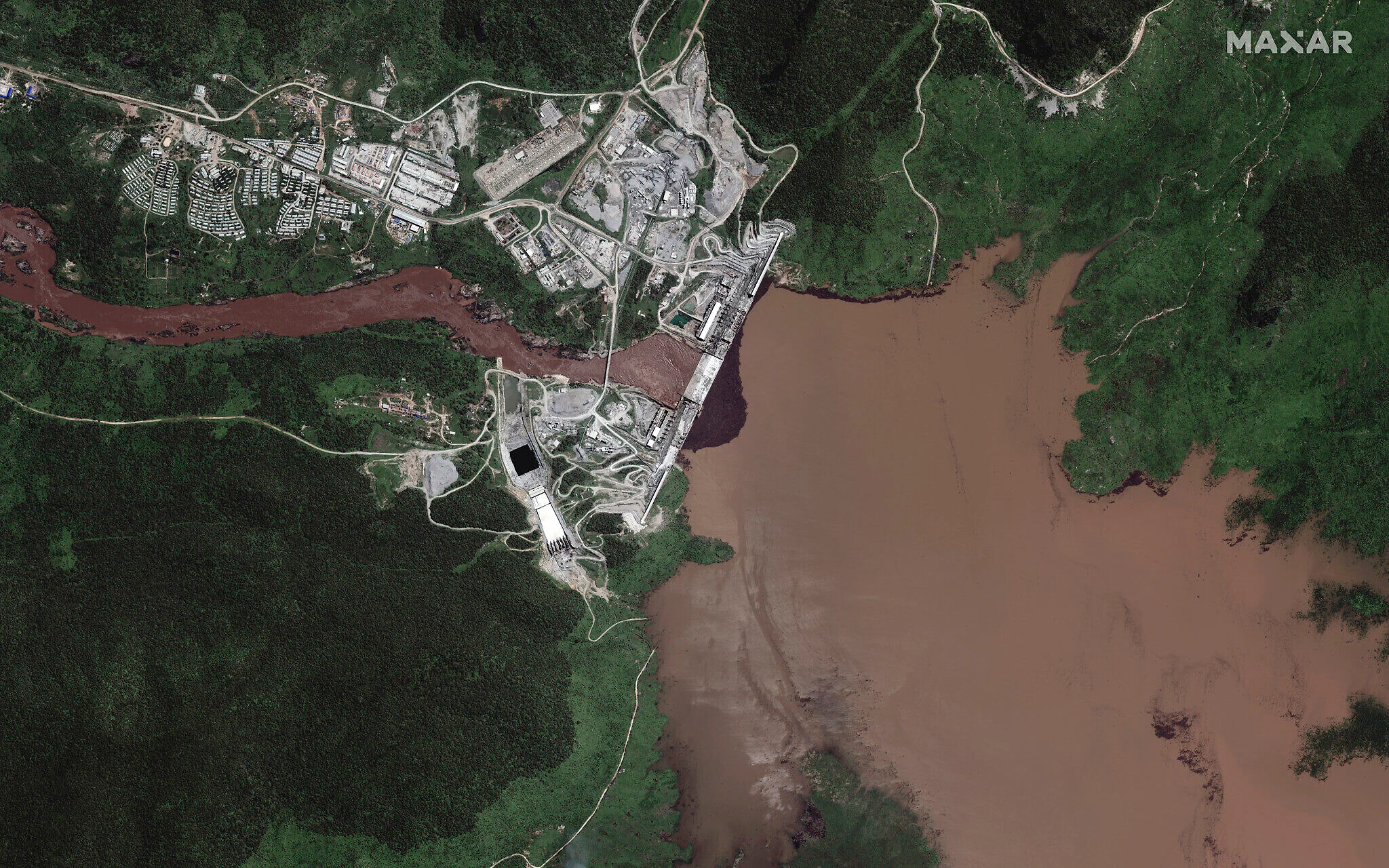
The Grand Ethiopian Renaissance Dam on the Blue Nile river in the Benishangul-Gumuz region of Ethiopia, on July 12, 2020. (Maxar Technologies via AP)
Ethiopia’s Red Sea ambitions and its Grand Ethiopian Renaissance Dam have become the twin pillars of a Cairo narrative that serves one purpose above all others: keeping Abdel Fattah el-Sisi’s regime relevant in a region that is rapidly reorganizing around new power centers. The latest round of Egyptian-Ethiopian diplomatic friction, triggered by Egyptian Foreign Minister Badr Abdelatty’s coordinated visit to Asmara and his public declaration that Red Sea governance belongs exclusively to littoral states, is less a coherent strategic doctrine than a performance designed for domestic consumption. Washington should think carefully before it allows itself to be recruited into underwriting that performance under the banner of GERD mediation.
Start with the optics. Abdelatty traveled to Asmara on May 17 to reaffirm with Eritrea, one of the region’s most isolated and repressive governments, that Ethiopia has no business near the Red Sea. The choice of partner is instructive. Isaias Afwerki runs a hermit state with a mandatory indefinite military conscription system that has driven hundreds of thousands of Eritreans into refugee camps across the region. That Egypt has chosen Asmara as its primary regional ally in hemming in Ethiopia says something about the quality of Cairo’s strategic judgment and the character of the coalition it is building. Israel, which has its own deep historical and security relationship with Ethiopia dating back decades, should pay close attention to who exactly is organizing Ethiopia’s containment and why.
Ethiopia is not a perfect actor. Its management of the GERD negotiations has been frustrating, its domestic human rights record in regions like Tigray has been catastrophic, and its pursuit of Red Sea access through arrangements with Somaliland created legitimate regional tensions. None of that changes the underlying reality that Addis Ababa’s desire for maritime access is a reasonable aspiration for a landlocked nation of 130 million people, and that Egypt’s campaign to foreclose that aspiration entirely is driven by regime politics as much as genuine national interest.
Sisi has used the GERD as a political instrument since he came to power. The dam allows him to cast himself as the defender of Egyptian civilization against an upstream aggressor, mobilizing nationalist sentiment that papers over an economy struggling under debt, subsidy cuts, and chronic unemployment. The drama of existential threat is useful precisely because it never fully resolves. A negotiated agreement on the GERD would deprive Sisi of one of his most reliable rallying points. That is not a conspiracy theory. It is a rational reading of how authoritarian leaders manage legitimacy crises, and Sisi’s Egypt is in the middle of one.
The Trump administration’s senior advisor Massad Boulos has been shuttling between Cairo and Addis Ababa in recent weeks, attempting to revive a modified version of the Washington Document that Ethiopia rejected in 2020. The American instinct to broker a deal is understandable. What is less understandable is the degree to which Washington has accepted Egypt’s framing of the dispute as a simple case of upstream aggression against a downstream victim. That framing obscures the extent to which Cairo has consistently refused compromise arrangements that would have protected Egypt’s water security while allowing Ethiopia meaningful operational flexibility over its own infrastructure.
A genuinely pro-American and pro-Israel policy posture in the Horn of Africa would look different from the one currently being pursued. It would recognize that Ethiopia is a stabilizing anchor in the world’s most fragile region, that its collapse or prolonged isolation would create security vacuums that Iran, Russia, and China have every incentive to fill. It would acknowledge that Egypt under Sisi is a transactional partner that pockets American support while pursuing regional policies, whether on Gaza, Libya, or the Red Sea, that frequently cut against American and Israeli interests. And it would apply pressure on Cairo to negotiate seriously rather than simply validating Egyptian intransigence by treating every Ethiopian proposal as a provocation.
Israel has particular reason to think carefully here. Ethiopian-Israeli relations have historically been among the most substantive and warm that Jerusalem maintains on the African continent, grounded in shared security interests, the history of Operation Solomon, and ongoing defense cooperation. An Egypt that successfully organizes the Horn of Africa against Ethiopian interests is an Egypt that grows more confident in its ability to shape regional outcomes, including outcomes that matter to Israel. Cairo’s expanding alignment with Eritrea and its effort to use the Red Sea access issue as a permanent lever against Addis Ababa should not be treated as a neutral regional development by Jerusalem’s policymakers.
American mediation has value, but only if it is genuinely even-handed. Right now it risks becoming a vehicle for laundering Sisi’s regional strategy with a Washington seal of approval. That serves neither American interests nor Israeli ones.