Six Drafts: Writing About Ourselves After Oct. 7
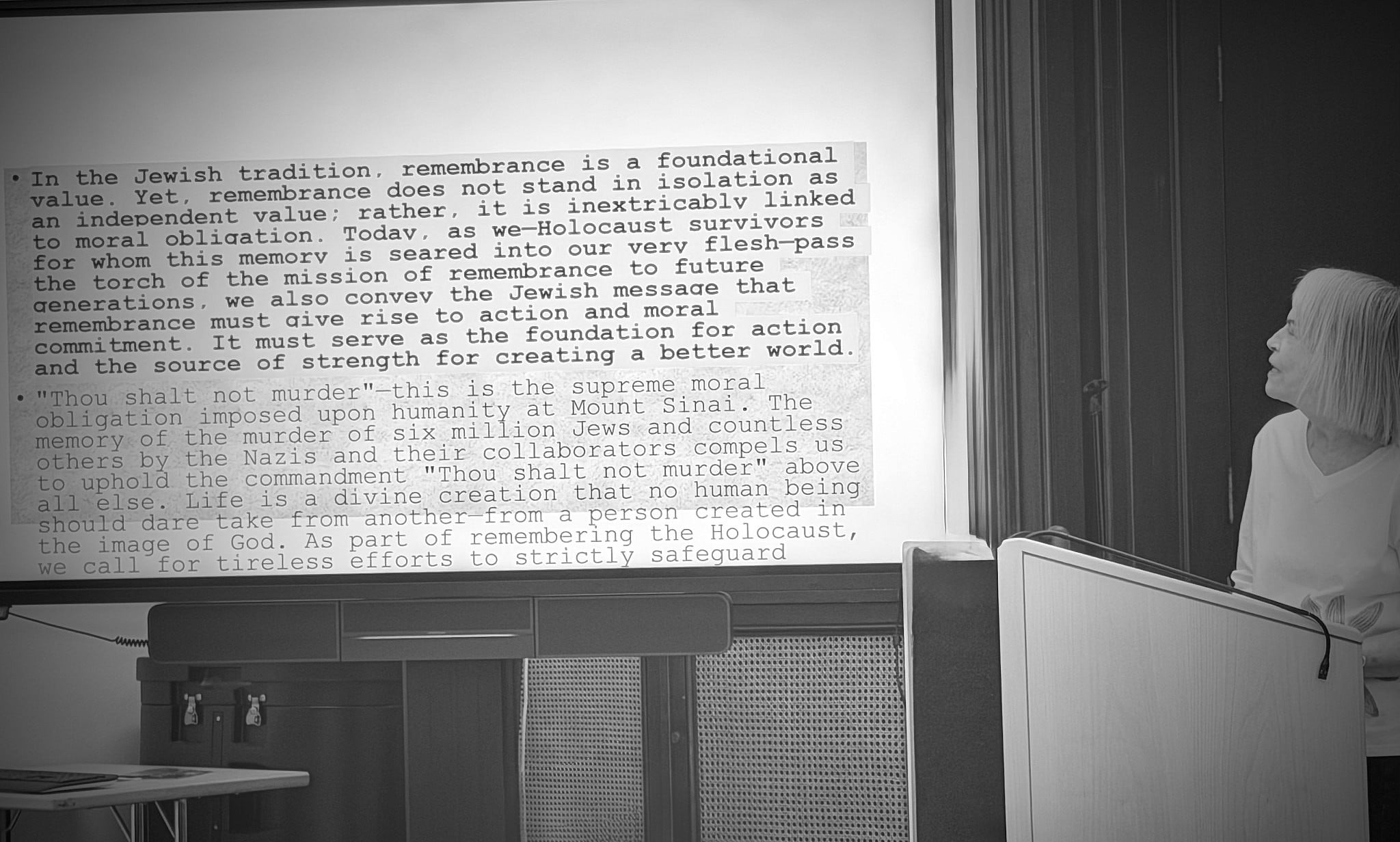
At the end of August, the Fifth Tel-Hai International Conference on the Holocaust and Genocide met at Touro University Berlin. Its title was “Us, Them, Everyone.” There I met Hanna Yablonka, a historian at Ben-Gurion University of the Negev, who has spent her career studying the survivors who came to Israel and the trials that followed them.
On the first day, we ate lunch outside together, and Yablonka told me she had written her talk six times. Jan Gross, the historian whose work on the massacre at Jedwabne forced Poland to face what its own citizens had done, got up to clear his plate. For a moment we both looked out at the green beyond the terrace. Then she said that for the first time, she understood what her parents meant about not hanging out the dirty laundry.
The rule is about audience. The neighbors are listening, and they keep a ledger. You can say what you like in the kitchen; on the line, nothing. The rule has always bothered me because a family that can’t speak honestly in front of others eventually can’t speak honestly to itself.
I had read Yablonka years earlier, when I could think about little besides the Eichmann trial. In one article, on how Israelis came to understand the Holocaust, she traces a Jewish argument about the catastrophe through four sets of trials over fifteen years: Nuremberg, the trials of Jews who had served as camp and ghetto functionaries, the Kastner affair, and Eichmann. Initially, I read the article as a history of how Holocaust memory changed, but during those two days, I began to see another history inside it. It was also about what Jews were willing to say about themselves, who got to interpret it, and what happened once an accusation could finally be answered.
Hanging Out the Laundry
Each trial put something on the line. The first was Nuremberg, in 1945 and 1946, when the Allies tried the surviving Nazi leaders before an international tribunal. The case centered on Germany’s plot to wage aggressive war; the murder of six million Jews appeared as one atrocity among many. The prosecutors relied mostly on captured German documents and called few witnesses to describe what had happened to the Jews. As the historian Laura Jockusch notes, the American chief prosecutor, Robert Jackson, thought Jewish witnesses might be more vengeful and less reliable than others — a strange suspicion in a trial held partly to answer for what had been done to them. Auschwitz was described instead by a French Resistance member who had been deported there. In the transcript, she speaks of the victims in the passive voice: They were made to undress. They were escorted to a red-brick building.
The Yishuv, the Jewish community under British rule, followed the trial in its newspapers. While most of its readers had come from Europe, their stories were absent from the coverage. One Hebrew editorial asked why Jews felt so little joy at what history would record as a great victory for the Jewish people. Its answer: we do not believe they understand what happened to us, or that they would lift a finger to stop it from happening again.
The facts were in the courtroom, but their meaning did not yet belong to Jews. That began to change when Jews started putting one another on trial.
After the State of Israel was established in 1948, hundreds of thousands of survivors arrived. During the war, some had held positions the Nazis forced on them: they had been kapos, prisoners the SS put in charge of other prisoners, or Jewish police in the ghettos. Survivors recognized them in the street, on buses, at the beach.
In 1950 the Knesset passed a law to punish Nazis and their collaborators. Israel’s first justice minister said it would let “our camp” be purged. But in Israel, there were no Nazis in custody to try, so the law was used almost entirely against Jews. About forty former kapos and ghetto policemen were tried on the testimony of other survivors.
Underneath these trials lay an impossible question: what had Jews done to one another under conditions the Germans created? The witnesses and the defendants had lived through the same catastrophe. The state judging them was only a few years old, and no one could stand at a safe distance.
The Kastner affair pushed the question further, asking what responsibility means when every choice is compromised. In 1944 Germany occupied Hungary. Within months, more than four hundred thousand Hungarian Jews were deported, nearly all to Auschwitz. Adolf Eichmann came to Budapest to run the deportations. Rudolf Kastner, a leader of a small Zionist rescue committee, bargained with Eichmann and another SS officer for Jewish lives. He got a train that carried 1,685 people, including his relatives and friends, and eventually reached Switzerland.
After the war, Kastner moved to Israel and became a government spokesman. An elderly Jerusalem hotelier printed a newsletter accusing him of collaborating with the Nazis, and the attorney general prosecuted the hotelier for criminal libel on Kastner’s behalf. The defense turned the case into a trial of Kastner himself, and in 1955 Judge Benjamin Halevi ruled largely against Kastner, writing that he had sold his soul to the devil. The case threw the government into crisis: how could it defend a man the court had branded a collaborator?
Two years later, Kastner was shot outside his home in Tel Aviv, well before the Supreme Court overturned most of the ruling. The court upheld only one finding: after the war, Kastner had testified on behalf of the SS officer and helped him escape prosecution.
That was the laundry. It hung in the courts and newspapers of a country where one in four people was a survivor. Even then, the argument had somewhere to go. Halevi’s ruling could be appealed, and the Supreme Court could say the lower court had gotten most of it wrong.
Three years later, the argument changed again. Eichmann had fled to Argentina, where Israeli agents captured him in 1960; his trial opened in Jerusalem the next year. He sat behind bulletproof glass, tried under the same law that had been used against the kapos. One of his three judges was Benjamin Halevi.
The prosecutor opened by telling the judges that six million accusers stood with him. While the documents alone could have proved the case, Hausner called a hundred and ten witnesses to the stand, most of them survivors. Many had never spoken publicly about what happened to them.
For fifteen years, Israelis had asked survivors, in the street and in court, why they hadn’t fought back and how they had lived when others died. Now survivors took the stand as witnesses to another man’s crime, and the country listened.
The old questions still came up. Moshe Bejski, a survivor who later became a Supreme Court justice, was asked why fifteen thousand prisoners hadn’t rushed the hundreds of guards. His answer, Yablonka writes, was a howl.
But now the questions were asked in a room where the defendant had organized the deportations, and that changed what the answers meant. Yablonka describes it as a shift from the victims’ guilt to the murderer’s. Haim Guri, the poet whose verse gave voice to Israel’s 1948 generation, covered the trial. He wrote that Israelis should ask forgiveness of the many people they had judged in their hearts — they had judged people whose circumstances they could scarcely imagine.
The questions had not disappeared, but their structure had changed. Survivors could answer, and those who had judged them could revise their judgment. A society could discover that it had spent fifteen years asking survivors the wrong question.
Clean Hands
The part that mattered most to me came near the end. She said we need “clean hands,” a clear conscience. She said we have to keep asking ourselves who we want to be in this world.
At the end of the day, as I packed up my laptop beside her, I brought up the dirty laundry again. We know it’s there, I said. We can talk about it with each other all we want, but once it’s on the line, they’re going to steal it.
I watched her take a deep breath.
Exposure was never my fear, as Jewish self-examination had never depended on secrecy. My fear was about the custody of the argument. Each of the Israeli cases took place somewhere that could answer for what was said. The kapo trials had a statute, rules of evidence and appeals. Halevi’s ruling on Kastner went to a higher court, which reversed most of it. Bejski was asked his question in a room where he could answer, and the country that had judged the survivors heard him. Guri had judged them too, and he took it back in print, in front of readers who had judged them with him.
The people being described had a voice in the description. Public debate beyond a country’s borders can’t work like a court of appeals.
The laundry could be misread, but there was a place to dispute the reading. Once an argument travels, that place can vanish.
Custody of an Argument
Elsewhere, the same evidence becomes support for a broader judgment about what Israel is. That is what I mean by stealing the laundry. Criticism, exposure, and even hostile interpretation are not the theft. The theft happens when someone’s act of self-examination becomes evidence in a case where she no longer has any say in what it means.
Not every argument is stolen the same way. Some Israeli critics deliberately speak to the world, knowing their words will travel and sometimes wanting them to. The traveling isn’t the issue — it’s that the qualifications and context can fall away while the speaker’s authority is used to support a claim she may not have made.
Take Benny Morris’s example. In his review of Ilan Pappé’s The Ethnic Cleansing of Palestine, Morris points to a February 1948 entry in Ben-Gurion’s diary recording what a young scientist had told him about an experiment with a gas: the animals had not died, and were dazzled for twenty-four hours. Pappé renders the sentence for English readers with the animals blinded and the twenty-four hours gone. The Hebrew word for blinded is a different word, Morris notes, and no gas was used by anyone in the war of 1948. The diary is the only source for the meeting. What travels, then, is the authority of a leader’s private Hebrew record, read by an Israeli historian for readers who cannot check it. The qualification stays in the kitchen.
In July 2025, B’Tselem, an Israeli human rights organization comprising Israelis and Palestinians, published Our Genocide. At the launch, B’Tselem’s executive director, Yuli Novak, said that “our genocide has context”: decades of separation and dehumanization, followed by the Hamas-led attack of October 7 and the existential fear it created among Israelis — fear a far-right government was using to advance destruction and expulsion. The report addressed Israelis and the international community alike, and was meant to travel.
Nothing here needed to be mistranslated. An accusation by Israelis could be received abroad as an admission by Israel. And while an Israeli critic may have certain standing as a witness to her society, she does not thereby become its mouthpiece.
Often, I worry that my own sentence will come back stripped of its qualifications and attached to a conclusion I never drew. But I know the cost of the alternative. A people that argues about morality only in the kitchen grows coarser and more defensive. It gets worse at hearing itself and loses the ability to tell a bad-faith accusation from an inconvenient fact. The history Yablonka had just told was partly the story of Israelis learning to make that distinction in public, sometimes brutally, sometimes disastrously, and sometimes too late.
Silence can’t be the answer to misuse, and that’s why her question is hard:
Who do we want to be in this world?
The Question Travels
It began as a question Israelis asked themselves. But in Berlin, I noticed that one side’s self-examination was still on the table while the other side’s had been built into the walls, long established as part of the institutional architecture.
My talk followed Yablonka’s, and during the Q&A, I looked around the room. Most of the Germans there worked in or near institutes that study antisemitism, institutions that exist because of what Germany did to the Jews. They were listening to Israelis ask what power had done to them and what they had done with power. But Yablonka’s question had more than one audience.
In parts of antisemitism research, in Germany as elsewhere in Western Europe and in North America, scholars increasingly study antisemitism alongside racism, colonialism and other prejudices. That approach can reveal things older approaches missed, but it also sorts the world differently. Power becomes central to interpretation, and a sovereign state with an army enters the analysis differently from the vulnerable populations older scholarship was built around.
The history Yablonka traced was also a history of Jews gaining the authority to interpret their own experience. But what happens when that history enters a framework where Jewish power, rather than Jewish vulnerability, is the central fact?
The Technical University of Berlin houses one of Germany’s oldest centers for the study of antisemitism. In 2024 it named the center’s deputy director, historian Uffa Jensen, as its antisemitism commissioner. Jensen had signed the Jerusalem Declaration on Antisemitism, which offers an alternative to the definition used by the German government and holds, among other things, that comparing Israel to apartheid is not inherently antisemitic.
The appointment drew immediate criticism from Jewish organizations. The Central Council of Jews in Germany called it a “great disappointment,” while the president of the Jewish Student Union said universities were appointing commissioners with little understanding of Jewish life.
Jensen’s first major controversy involved the university president. She had liked several posts on X, including an image of the Israeli prime minister with a swastika. Jensen called that image antisemitic, but said accusations that Israel was committing genocide or war crimes were not antisemitic in themselves.
Josef Schuster, president of the Central Council, objected to Jensen’s reliance on the Jerusalem Declaration. He also pointed out that the university president whose posts Jensen was judging was the same person who had appointed him. Schuster called the situation barely surpassable in its absurdity.
The dispute was about which framework decides what an accusation means. No accusation makes that clearer than genocide. The word was coined while Europe’s Jews were being annihilated and is now one of the gravest charges made against the Jewish state. That history does not shield Israel from the charge, and it does not settle whether any particular accusation is true. But it does make the word carry more than its legal meaning.
The conference had put the two words side by side in its name: Holocaust and genocide. No one owns either word, and that was never my point. A charge can be misused and still be true.
Israelis can ask whether their soldiers have committed crimes, whether their government has failed morally, whether civilians in Gaza have suffered intolerably, whether power has corrupted their judgment. They have to ask; a society that won’t examine what it does with power will eventually stop seeing it. But self-examination offers no guarantee about what happens to its findings once they leave home.
By now, that custody is gone, though it is hard to say when it was lost. Durban in 2001 is one useful marker. At the NGO Forum held alongside the UN conference on racism, accusations of apartheid, genocide and ethnic cleansing were gathered into a common declaration about Israel, along with a call for its international isolation. Durban did not invent that vocabulary, but it gave it a shared framework and an international audience.
Today, the laundry is more than visible, and someone has taken it off the line and carried it into another house. Even so, it shouldn’t have stayed in the kitchen. This is the part I can’t resolve.
Secrecy warps moral judgment, and so does appropriation. If fear of the neighbors drives every hard argument back indoors, the argument decays. But if speaking in public means handing every admission and every distinction to a prosecution whose verdict is already decided, people eventually stop speaking honestly at all. The demand for clean hands remains, as does the danger of washing them for everyone to see.
So I turned the question around. I told the Germans in the room that it was addressed to them too.
Who do you want to be in this world?
Yablonka applauded. I didn’t ask her why. Since then I have wondered whether answering that question has always fallen to Israelis — in the kitchen, then on the line — while the people watching the line answered from somewhere else.
Germany has hardly escaped the question of what history demands; its institutions, including many represented in that room, grew out of decades of asking it. What struck me was the tense. German self-examination had become institutional history while Israeli self-examination was happening now, its answers taken immediately as evidence in arguments already under way.
Afterward, she put her hands on my shoulders and told me I was young. When she said I had done good work, I took it as a kindness from someone who had been in the room a long time to someone who had only just arrived.
I would still like to know what she wrote in the other five drafts.
Sources
Trial records and court documents
Attorney General v. Gruenwald, Jerusalem District Court (1955), and Criminal Appeal 232/55, Supreme Court of Israel (1958).
The Trial of Adolf Eichmann: Record of Proceedings in the District Court of Jerusalem (Jerusalem: Ministry of Justice, 1992–95): Gideon Hausner’s opening statement (Session 6, 17 April 1961); and testimony of Moshe Bejski (Session 21, 1 May 1961).
Trial of the Major War Criminals before the International Military Tribunal (Nuremberg, 1947): testimony of Marie-Claude Vaillant-Couturier, 28 January 1946, vol. 6, 202–30. The passage on the selections and the gas chamber, from which the passive constructions are quoted, is at 215–16. https://avalon.law.yale.edu/imt/01-28-46.asp
Scholarship
Orna Ben-Naftali and Yogev Tuval, “Punishing International Crimes Committed by the Persecuted: The Kapo Trials in Israel (1950s–1960s),” Journal of International Criminal Justice 4, no. 1 (2006): 128–78. https://academic.oup.com/jicj/article-abstract/4/1/128/821931
Laura Jockusch, “Justice at Nuremberg? Jewish Responses to Nazi War-Crime Trials in Allied-Occupied Germany,” Jewish Social Studies: History, Culture, Society n.s. 19, no. 1 (Fall 2012): 107–47. Source for Jackson’s view of Jewish witnesses and for the French prosecution’s choice of a resistance fighter over a Jewish deportee (121–22). https://www.jstor.org/stable/10.2979/jewisocistud.19.1.107
Michael R. Marrus, “The Holocaust at Nuremberg,” Yad Vashem Studies 26 (1998). https://www.yadvashem.org/articles/academic/the-holocaust-at-nuremberg.html
Benny Morris, “The Liar as Hero,” The New Republic, 17 March 2011, on Ilan Pappé’s rendering of Ben-Gurion’s diary entry of 2 February 1948 in The Ethnic Cleansing of Palestine (Oxford: Oneworld, 2006). https://newrepublic.com/article/85344/ilan-pappe-sloppy-dishonest-historian
Tom Segev, The Seventh Million: The Israelis and the Holocaust, trans. Haim Watzman (New York: Hill and Wang, 1993).
Hanna Yablonka, “The Development of Holocaust Consciousness in Israel: The Nuremberg, Kapos, Kastner, and Eichmann Trials,” trans. Moshe Tlamim, Israel Studies 8, no. 3 (2003): 1–24. Source for the Yedi’oth Aharonoth editorial (16 December 1945), Pinhas Rosen’s Knesset statement (27 March 1950), the survivor share of the population, the witness count, Bejski’s “howl,” Haim Guri’s column in LaMerchav (10 September 1961), and the Kastner affair, including the 1,685 passengers on Kastner’s train. https://muse.jhu.edu/article/53830
B’Tselem
B’Tselem, Our Genocide (Jerusalem, July 2025). https://www.btselem.org/publications/202507_our_genocide
B’Tselem, “B’Tselem and Physicians for Human Rights Israel: Israel Is Committing Genocide in the Gaza Strip,” press release, 28 July 2025, the source of Yuli Novak’s remarks. https://www.btselem.org/press_releases/20250728_our_genocide
The TU Berlin appointment
Jerusalem Declaration on Antisemitism (2021). https://jerusalemdeclaration.org/
TU Berlin, “TU Berlin Appoints Antisemitism Officer,” May 2024. https://www.tu.berlin/en/news-from-tu-berlin/tu-berlin-appoints-antisemitism-officer
Zentralrat der Juden in Deutschland, “Statement zur Benennung des Antisemitismusbeauftragten an der TU Berlin,” 27 May 2024. https://www.zentralratderjuden.de/aktuelle-meldung/statement-zur-benennung-des-antisemitismusbeauftragten-an-der-tu-berlin/
On Hanna Veiler’s objection and Jensen’s reply: dpa, “TU-Antisemitismusbeauftragter in Kritik,” Berliner Zeitung, 29 May 2024, https://www.berliner-zeitung.de/politik-gesellschaft/tu-antisemitismusbeauftragter-in-kritik-li.2219609; “Uffa Jensen als Beauftragter der TU: Neuer Berliner Antisemitismusstreit,” taz, 29 May 2024, https://taz.de/Uffa-Jensen-als-Beauftragter-der-TU/!6010293/
“TU-Präsidentin gesteht Fehler ein,” Jüdische Allgemeine, 29 May 2024, https://www.juedische-allgemeine.de/politik/tu-praesidentin-gesteht-fehler-ein/; “Antisemitismus-Vorwurf: TU-Chefin entschuldigt sich,” taz, 29 May 2024, https://taz.de/Antisemitismus-Vorwurf/!6010459/. Jensen’s phrase: “aus wissenschaftlicher Sicht nicht per se antisemitisch.”
Zentralrat der Juden in Deutschland, “Statement Dr. Schuster zu den Entwicklungen an der TU Berlin,” 30 May 2024. https://www.zentralratderjuden.de/presseerklaerungen/statement-dr-schuster-zu-den-entwicklungen-an-der-tu-berlin/