
Senior Rabbi at Temple Sholom, Vancouver BC Canada
Featured Post
Six-seven: The sacred rhythm of a meaningless meme
My kids torment me with their fun, but the joke's on them, as I make order of their 6 days of chaos, and observe the world-changing idea of a 7th day of rest
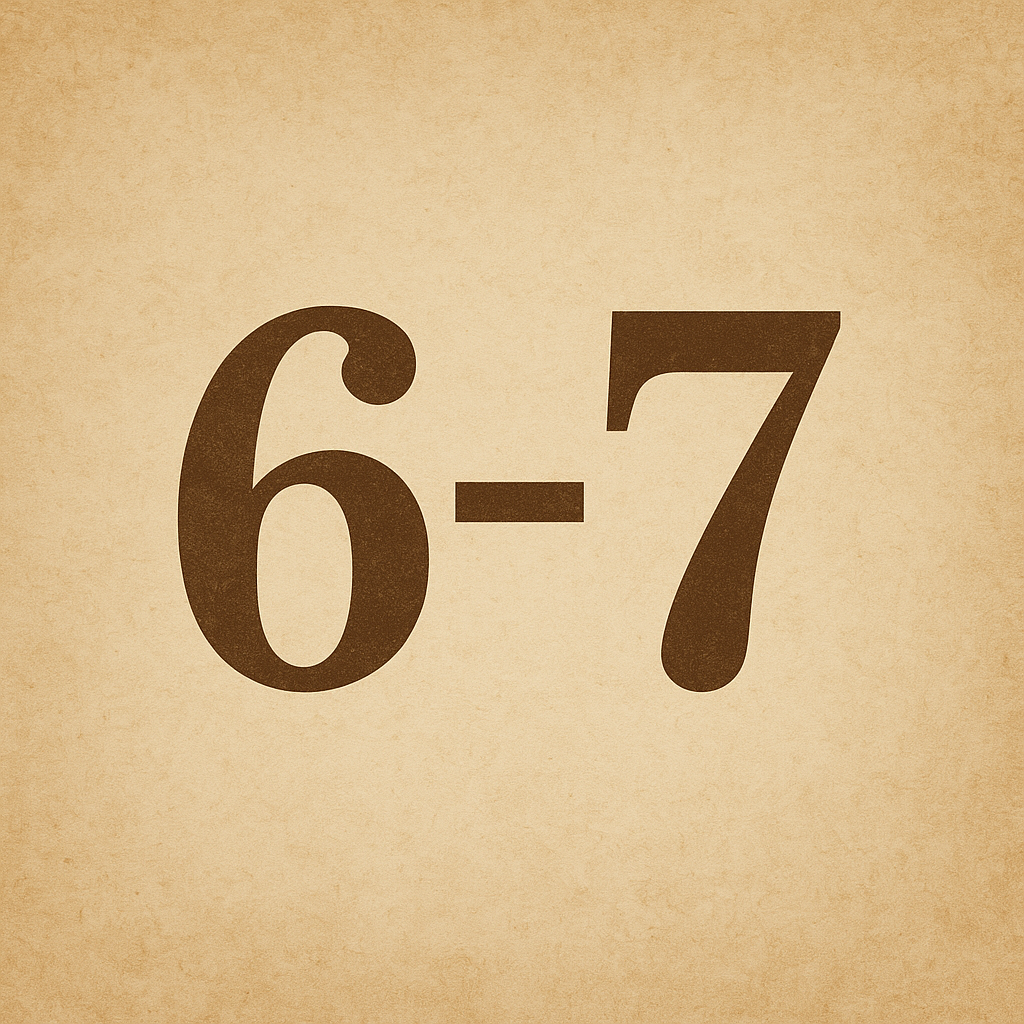
Six - Seven - the meme with no meaning, expect for Jews
Lately, math teachers have been living in fear of two numbers: six and seven.
If you say them together in class, “Turn to page 67,” or “Do problems 6 and 7,” chaos erupts. Students throw up their hands, yell “Six Seven!” and dissolve into laughter. No one knows why it’s funny. Which, apparently, is what makes it funny.
The Wall Street Journal reports that this nonsense phrase has become a full-blown meme, spreading through classrooms and social media feeds. It means absolutely nothing. It’s a joke about nothing, and that, somehow, is the joke.
I live with two teenagers, so I’ve seen this phenomenon up close. For weeks, my kids have been trying to trap me into saying, “Six seven.” They do it at dinner, in the car, and — most memorably — during an AZA poker night we hosted at our house. Every time a six and seven of any suit appeared, the room exploded in laughter. They found it hysterical. I found it maddening.
But I’ll admit, there’s something fascinating about it. Because this week’s Torah portion, Bereishit, happens to be built around those same two numbers: six and seven. Six days of creation, and one of rest.
So, in true rabbinic fashion, I’m going to do the thing adults are always accused of doing: add meaning where there was none. Which, when you think about it, is exactly what Judaism has been doing for thousands of years.
Six: The Work of Creation
The Torah begins not with perfection, but with chaos, tohu va-vohu, a void without shape or purpose. Out of that darkness, God speaks the world into order. Six days of separation and structure: light and dark, land and sea, sky and earth.
Rabbi Samson Raphael Hirsch taught that the first chapter of Genesis isn’t a science lesson; it’s a moral one. It tells us that holiness begins when we bring order out of chaos, meaning out of noise.
We live most of our lives in that world of six: the weekday world of building, striving, producing, solving. It’s good, even very good. But it isn’t enough.
Because the Torah insists that creation did not end when the work was done. It ended when God stopped.
“On the seventh day, God finished the work that He had done, and He rested” (Genesis 2:2).
Rest wasn’t what came after creation. Rest was the final act of it. The universe wasn’t complete until there was a pause.
Seven: The Sacred Pause
The seventh day introduced something the ancient world had never known: a holy day not for kings, but for everyone. A day when no one worked, no one ruled, and no one was ruled.
In Mesopotamia and Egypt, time belonged to power. The sabbath declared that time belongs to God and therefore, to all of us. It was Judaism’s first great contribution to civilization: the radical idea that human beings are not machines of production, that rest is sacred, and that dignity begins with pause.
Abraham Joshua Heschel called Shabbat “a cathedral in time.” You didn’t need a pyramid or a temple to touch the Divine; you just had to stop long enough to notice it.
From that simple idea, the moral architecture of humanity evolved. Christianity and Islam both inherited the sabbath. Secular society turned it into the weekend. Every labor law, every “day off,” every recognition that workers deserve rest all trace back to that moment in Bereishit when God rested.
Shabbat was not only Judaism’s gift to the world. It was the world’s first liberation from endless day six.
Now, my kids insist that “Six Seven” is funny precisely because it’s meaningless. They say adults ruin everything by making it serious.
And maybe they’re right. But that’s also what adulthood does: it looks at chaos and insists there’s meaning hidden inside it.
It’s what Judaism has always done. We’re the grown-ups in the room of civilization. We don’t crush laughter — we refine it. We don’t erase the ordinary — we sanctify it.
Bread becomes holy when we bless it.
Time becomes sacred when we rest.
The week becomes complete when we rest long enough to remember that we are more than what we produce.
To some, that’s annoying. To Jews, it’s sacred.
Six and Seven: The Rhythm That Holds the World
Philosopher Franz Rosenzweig taught that creation is not complete until humanity learns to imitate God’s pattern. When we work for six days and rest on the seventh, we align ourselves with the very rhythm that holds the cosmos together.
That rhythm is easy to lose in the modern world, which is all day six — constant production, endless scrolling, unrelenting noise. That’s why we still need day seven, not as escape but as restoration.
Rabbi Jonathan Sacks once called the Jewish people “the guardians of time.” Through the simple cadence of six and seven, we gave humanity the structure to live with intention — to balance creativity with compassion, movement with stillness, power with humility.
And that’s what I want us, as Jews, to remember right now: that our heritage is not only a story of survival, but a story of civilization. When we celebrate Shabbat, we’re not just observing a ritual — we’re preserving one of humanity’s greatest moral ideas.
So, yes — “Six Seven” is meaningless. But it doesn’t have to be. Every time we hear it, we can smile and remember that six and seven are how creation began: six days to build the world, and one to rest and remember why it matters.
If this ruins the meme for my kids, so be it. That’s what parents — and rabbis — are for: to find meaning in the meaningless. To bring order out of chaos. To take the noise of six and make it into holy music through seven.
That’s how God finished creation and how we, humanity, keep it going.
Related Topics
Related Posts