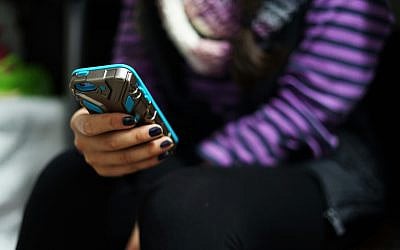
Smartphones Are Failing Israeli Students
As a high school teacher, I’ve watched phones hijack attention, learning, and even childhood itself. It’s time we say enough.
To this day I’ll still remember the clock on the classroom wall. It had a second hand. It ticked loudly. When I was in junior high, in a horrible act of divine retribution, maths was the last hour. I dreaded it. I hated maths. I willed the second hand to complete its circle – the final 10 minutes of the day was a hell-like eternity. Worst of all, I was expected to stay silent. Even doodling was banned.
Yes, my school years were punctuated by copious amounts of boredom and tedium. And, unbelievably, I survived them.
Perhaps this explains why, when Star Wars: The Empire Strikes Back premiered at the Odeon in my small town, lining up for three hours to watch the premiere seemed a very small price to pay. After all, I was quite seasoned at waiting.
And now here we are barreling our way into 2026. Anyone in a time machine from my school years might think we live in a reality that isn’t so far off from a Galaxy Far Away. Our technology, after all, borders on fantasy.
Equally far from my childlike imagination as a schoolgirl suffering nonsensically strict rules and an itchy collar was the idea that eventually I myself would be standing in front of a class and actually teaching them stuff. But here I am. Having taught high school for the past fifteen years, I feel like I’m slowly losing my moorings.
Why? Well, instead of teaching my class, my lessons are more like a dance with my students: a grab for the phones, a reaction, a counter-move, and a resolution—and a lot of resistance. I am in the midst of a losing battle with the Dark Side—the very technology that was the stuff of my teenage fantasies.
In truth, I indulge in my own private one in which I whip out a giant lighter and ignite a huge pyre in the center of the classroom, take all the Samsungs, Pixels, and iPhones—lovingly bought for these kids by doting yet sadly naive parents—and burn the damn lot.
Because I am firsthand witnessing the slow and steady destruction of a generation and I don’t know what else I can do.
I wish it was just about attention, their lack of the inner strength to deal with anything that takes longer than an instant. But it’s about so much more.
Today, the pre-smartphone era is a distant memory which could be part of their history lessons. They can neither remember nor imagine a life without—them on phones, friends on phones, parents on phones, and even teachers on phones. Their lives are no longer rooted in the here and now—they dance to a macabre rhythm between being online and off, and as an offline artifact, I’ve entered the race far too late.
Yes, our school bans use of phones in class, but no teacher that I know of has ever successfully taught kids for more than fifteen minutes without a phone mysteriously appearing in a pocket or a bag, sleeve, or even a pencil case.
Furthermore, it doesn’t matter whether the phones are on their person or not. The nonstop WhatsApp group chats that these kids were part of before the class, or the online game a 10th-grade boy initiated with his peer, or the pointless YouTube or TikTok reel will be continued after class. Or, most likely, during it.
Class is simply an inconvenience, a huge drag before the next opportunity to go online again. And I’m just fluff—an annoying adult who has taken away their precious phone.
So where exactly are their brains when I’m teaching them?
Five years ago, on average in each of my classes, two, possibly three kids displayed visible signs of ADHD. It was tough; these two or three could wreck a classroom.
We’d deal with the parents and the pills and carry on.
Now on average, a child who is able to fully focus in class is a rarity. When I teach today’s students, after having confiscated their phones, I spend 40% of my time dealing with the 50% of the class who simply cannot concentrate. Half a minute of lecture time without interruption is an impossibility—half a page of text for silent reading is met with outrage. How can you expect us to do this?
Who can blame them? If I was on my phone all day, I’d definitely fail every subject.
If that’s not enough, we are now dealing with kids who are suffering from a blight of nervous disorders that I don’t recall witnessing ten years ago—panic attacks, depression, obsessive-compulsive disorders, eating disorders, Tourette’s—you name it. Teachers now need to be trained to not only spot kids who might be cutting themselves or getting perpetually stoned, but to actually deal with them, too. Oh, and we’re also supposed to teach them something, too.
A case in point is one of my very bright students who developed a compulsive habit of pulling out his dark curls, one hair at a time. The nervous habit became so severe he wore a hat to school to cover his baldness and refused to attend school trips for fear of being exposed.
Every time there is a big exam you will find a child outside the classroom in tears, blowing into a paper bag. On any given high-stakes exam, at least 10% of kids won’t show up at all because they can’t face the stress.
My school years were tough. My terrifyingly strict teachers barely knew us by name, let alone whether our parents were divorced or dying. But somehow nobody in my class had anxiety attacks, extreme ADHD, or OCD. Nobody skipped school. Nobody had regular appointments with psychiatrists. It just wasn’t a thing.
Our school has tried to counteract this addictive and devastating drug pumped daily into young veins by focusing on social-emotional aspects of teaching, with liberal use of catchwords like student resilience, by attempting to strengthen relationships between teachers and students, organizing trips and extracurricular activities, special lectures about the dangers of drugs, sex, and online abuse. But it’s the equivalent of prescribing aspirin for gangrene.
With all the social-emotional talk, the elephant is still in the room.
In fact, it’s taken over our entire bloody school system.
When I was a kid, break times were spent in a corner of the school as far as possible from the prying eyes of teachers—giggling, gossiping, making plans for our interminable weekends and summers (this was before cable TV). During breaks, the athletes played, the dorks sat, and it was all okay.
The school where I work has a wonderful shaded playground and amphitheater with extensive seating, but you won’t find a lot of kids outside. The kids are inside sitting on their desks, their eyes glazed, save the reflection of moving images flickering from their little screens. There is little peer group chatter—instead you’ll hear nothing save the occasional exclamations of and/or expletives having won or lost a game. The most social thing they’ll do is a TikTok dance. But mainly, break times are eerily silent.
In many cases, they are so busy on their phones that they forget to eat.
My students are rapidly losing their social skills. I witness this decline firsthand as cursing in front of teachers barely raises an eyebrow. Kids find it hard to disagree with an alternative opinion without things escalating into a shouting match. Others might withdraw altogether, with their phone as their only friend. Kids have confided to me that they want to join in class discussions, but they simply don’t know how.
Yes, the ability to engage and talk is learned behavior. I, for one, learned my social skills during family dinners.
But nowadays there is no dinnertime—there’s food aplenty, but smartphones at the table kill conversation dead.
We don’t have the luxury of pretending this isn’t urgent. In the latest international PISA tests, Israeli students ranked near the bottom among developed countries in math, reading, and science. In 2012, we were closer to the average. A decade later, we’re falling behind—and fast. Israeli students now spend more time online during school hours than the OECD average, and teachers across the country report constant classroom disruption from smartphones. We are losing focus, achievement, and even the ability to hold a conversation—and we’re watching it happen in real time.
Our school has cancelled entire days of learning to promote relationships between teachers and students. It really sounds like a nice thing. But wouldn’t it be better if we had the opportunity to just chat, uninterrupted, every day? In class, or at break? After all, we all have to do break time duty. Teachers would jump at the opportunity of being relieved of the boredom of watching kids staring at their screens.
Yes, we can’t control what kids do when they’re not at school, but we can jolly well do something about what kids do when they are.
I can’t break their phone addiction. I can talk about the dangers of phones to kids until I’m blue in the face. But I’m guessing it will be just as effective as the anti-smoking campaigns I endured when I was a kid. In the end, what stopped people from smoking was banning it in all public spaces.
So I have something daring to propose: ban all phones from all schools.
After all, since we all know how bad phones are—at least we can do a bit of damage limitation.
Let break times be an opportunity to talk to friends, to run around, to stare at the birds, for God’s sake. We invented drip irrigation in the desert, so surely we can repurpose an unused classroom as a makerspace or distribute chess and backgammon sets during break times.
Parents might protest at first. After all, it’s only natural to want to keep tabs on your kids. But school should be a place of safety, and online is most definitely the worst place for their kids to be right now. So we can reassure the parents that as long as the kids are in the school premises, we are firmly in charge.
After all, if we aren’t accountable for the wellbeing of their children for a large chunk of the day, then who is, exactly?
We will explain to them in simple terms that their phones are no longer letting us do our job.
Others might argue that we are denying our kids the opportunity to benefit from educational technologies. Well, the actual learning benefits of technologies versus paper have yet to be proven. If a fail-safe technological in-school alternative cannot be found, then I don’t think there’s any harm done by replacing phones with books, pen and paper, and deep discussions. After all, that was the education I got and it didn’t serve me too badly at all.
A couple of hours without phones, and the memory of the Instagram post will fade, and instead they’ll focus on an interesting science lesson. An entire day without phones, and we will witness wonders—we’ll see them play frisbee and catch, talk about things that matter to them, or even sketch wickedly realistic cartoons of teachers in their notebooks.
The relationships between students and teachers will vastly improve as the staff won’t have anything to compete with anymore.
School will be an oasis from the constant assault of content, content, content on young minds—a time to regroup, become creative, curious, playful, mindful and, above all, interact with friends and peers. In real time. Which is what childhood is about in the first place.
For once it is time for us, the leaders and educators, to stand up against something that is eating away at society’s very core and destroying a generation before they’ve even dipped their feet in the water of the difficult adult world.
In the 1980s, it was patently clear that cigarettes were killing people—yet the industry kept peddling its poison until someone finally said, “No more.”
Now, we are witnessing a different kind of devastation, no less harmful than emphysema or lung cancer. And if we don’t act, who will?