
So that’s that
I knew how to say Kaddish.
When my father, ז״ל, died, I said it whenever I could. I had younger children then, and I couldn’t take on the commitment of finding a minyan every day. I said Kaddish when I made it to shul, grateful for the opportunity and accepting the days when I couldn’t.
But that wasn’t the same thing.
Then, Kaddish fit itself into the rhythm of my life.
This time, my life had to bend to the rhythm of Kaddish.
There is an enormous difference.
Saying Kaddish every day is like learning to swim.
At first, you are drowning.
You cannot catch your breath. The congregation races through the words. Before you’ve reached one phrase, everyone else is already halfway through the next. You gulp for air between syllables, trying to keep your head above water.
Eventually, almost without noticing, your breathing changes.
You stop fighting the rhythm and begin to find it. Like a swimmer who learns that breathing is not something you force but something you trust, Kaddish slowly becomes part of your body. You know when to inhale. You know when to pause. You know the cadence before the congregation reaches it.
And then, after 11 months, comes the strangest question of all.
Will I remember how to breathe outside the pool?
Starting Kaddish felt like drowning.
Stopping it left me breathless.
The hardest part of losing my mother was not the dramatic moments. It was the silence.
For years, my days were punctuated by conversations with her. Some were practical, some philosophical, most were trivial. I would go over a class I was preparing; she would be my first audience. I would call to ask a question, to tell her a story, to hear her opinion, even when I already knew what she was going to say.
In her later years, every conversation ended exactly the same way.
“So that’s that.”
It became her signature. A gentle signal that the conversation was over, that everything important had been said.
And if I ended by saying, “I love you,” she would always answer, “I love you more.”
“It isn’t a competition,” I would protest.
It never made any difference.
Then, one day, there were no more phone calls.
No more “So that’s that.”
No more “I love you more.”
Kaddish did not replace my mother. Nothing could. But it gave me somewhere for those conversations to go.
Instead of picking up the phone, I found a minyan.
Instead of hearing her voice, I answered with words that never once mention death. By saying Kaddish I acknowledged that she was still shaping my life. It wasn’t a conversation with her, but it was a conversation because of her.
Kaddish waits for no one. Or perhaps more accurately, Kaddish waits for no man—or woman.
Grief is deeply personal. Kaddish is utterly indifferent to that. It demands punctuality. Every day. Whether you’ve slept or not. Whether you’re home or traveling. Whether today is the day you miss your mother so intensely you can barely breathe, or the day you almost forget before guilt reminds you.
The mourner may feel suspended in time. The minyan does not.
There is something profoundly comforting about that. When your own world has stopped, the world keeps moving. The discipline of Kaddish quietly insists that you move with it.
I had not been a daily shul-goer for years.
I grew up in a school where we davened with a minyan every morning. In college, morning minyan was simply part of life. But adulthood has a way of changing routines. Teaching, work, family—daily shul became just Shabbat and holidays.
Kaddish brought me back.
There were surprisingly practical things to learn, returning to shul older. Like how to tilt my head for Tachanun while wearing multifocal glasses without either losing my place or my glasses. No one tells you that mourning has a learning curve.
There were gifts I never expected. Every morning I stood for Birkat Kohanim. Or at least, on those mornings when the kohanim made it to shul.
Each time they spread their hands to bless the congregation, it brought me back to my childhood. My father gave us brachot every Friday night. Standing there each morning, hearing those ancient words again, it felt as though I was receiving his bracha once more.
I know that is not what Birkat Kohanim is. But grief has its own language.
Kaddish took me to remarkable places. Airport minyanim hastily assembled near departure gates. Hotels with makeshift synagogues. Tiny congregations where everyone knew exactly why I was there before they knew my name.
There were minyanim in bomb shelters, and minyanim that began in the sanctuary and continued in the bomb shelter after the siren sounded. More than once I found myself standing in the back of a crowded shelter, the only woman there, waiting for the congregation to reach Kaddish before we all emerged to continue our day.
Some communities welcomed me without hesitation. Others made it equally clear that they believed what I was doing was wrong. On more than one occasion I found myself calmly explaining that women saying Kaddish has a long and serious halachic history. I had not come looking for an argument. I had simply come to honor my mother. Yet somehow I found myself giving an impromptu shiur before I could say the Kaddish I had traveled so far to recite.
Then there were the Kaddish bullies. Every mourner knows them. The ones who somehow believe that louder is holier, faster is better, and that Kaddish is a race to see who can reach Oseh Shalom first. At first they drove me crazy. Eventually I realized they, too, were grieving. Perhaps this was simply how they stayed afloat.
More than once, usually while rearranging my schedule around yet another minyan, I found myself wondering what my mother would have thought.
She would probably have rolled her eyes at the lengths I was going to. Driving across town. Planning meetings around davening times. Standing in airports calculating whether I could make a flight and still find a minyan.
She would have told me I was making life unnecessarily complicated.
And she would have been proud.
Before she died, my mother insisted on one thing.
“This isn’t a tragedy,” she told me.
She had lived a long life. She had children, grandchildren and great-grandchildren. She had watched her family grow into something she was deeply proud of.
“But for me,” I answered, “it is a tragedy.”
She looked at me with the mixture of firmness and love that only mothers can manage.
“You’re old enough to deal with it.”
At the time, I thought it was an impossibly unsympathetic thing to say.
Now I think it may have been her final act of mothering.
The Jewish year of mourning contains a quiet wisdom.
It lasts long enough for life to make a complete circle.
You experience every season.
Every festival.
Every birthday.
Every ordinary Tuesday.
The first Tishrei without her.
The first Hanukkah.
The first Pesach.
Every chag (holiday) brought its own reminders.
My mother always helped me cook.
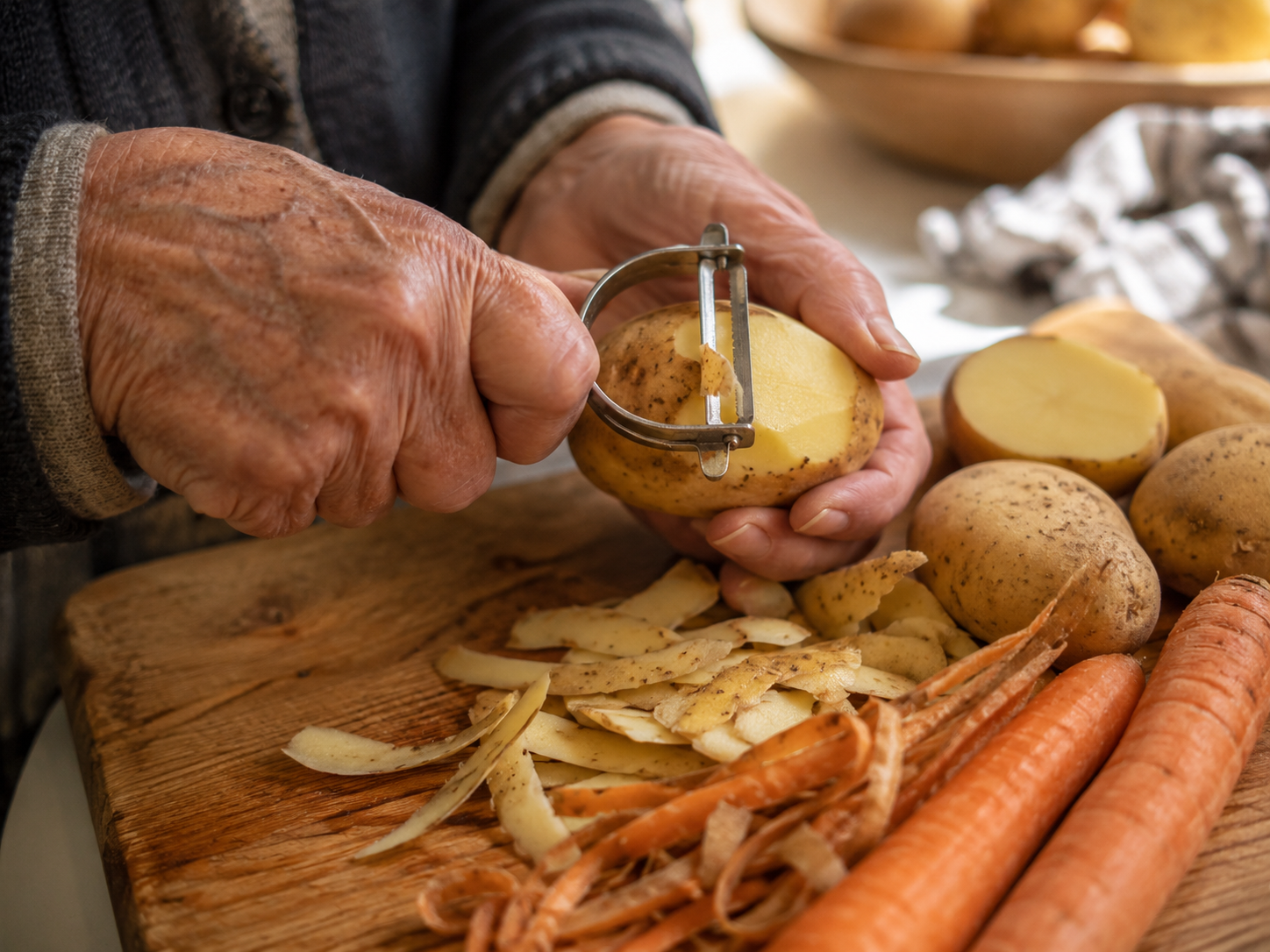
She would arrive early, settle herself at the kitchen table with a peeler and a chopping board, and spend hours peeling and chopping vegetables. She claimed she was the supervisor.
Now, whenever I cook for yom tov (the holiday), I still find myself looking toward the kitchen table, expecting to see her there.
Instead, I peel alone.
The first time you instinctively reach for the phone before remembering there is no one to answer.
Each milestone that once seemed unimaginable somehow arrives, and then passes.
The purpose of the year is not to stop missing the person you loved.
It is to discover that you can continue living while carrying that love with you.
By the end of the year, I had proved something — not to anyone else, but to myself.
I was old enough to deal with it.
Not because I had stopped grieving.
Not because I loved her less.
But because she had spent a lifetime preparing me to live in the world without her.
When the 11 months ended, I expected relief.
Instead, I felt unmoored.
For almost a year, my days had been shaped by this ritual. Kaddish had become the place where I met my mother. It had given structure to grief and purpose to longing. It had marked the spaces where our conversations used to be.
Then suddenly, there was silence again.
It was like climbing out of the swimming pool after months in the water.
Your body still expects resistance.
Your breathing feels wrong.
You wonder whether you have forgotten how to breathe on dry land.
In the beginning, I thought Kaddish was teaching me how to mourn.
I was wrong.
It was teaching me how to live without my mother.
For 11 months it stood in place of the conversations we no longer had. It carried me through every season, every holiday, every ordinary day until I no longer needed it to remind me that she was gone.
It had done something far more important.
It had taught me that love does not end when the conversation does.
My mother used to end every phone call with the words, “So that’s that.”
For a long time after she died, I couldn’t imagine the conversation ending.
Now I understand.
The phone calls ended.
The Kaddish ended.
The conversation never did.
So that’s that.