


So they found the ‘Altalena’…
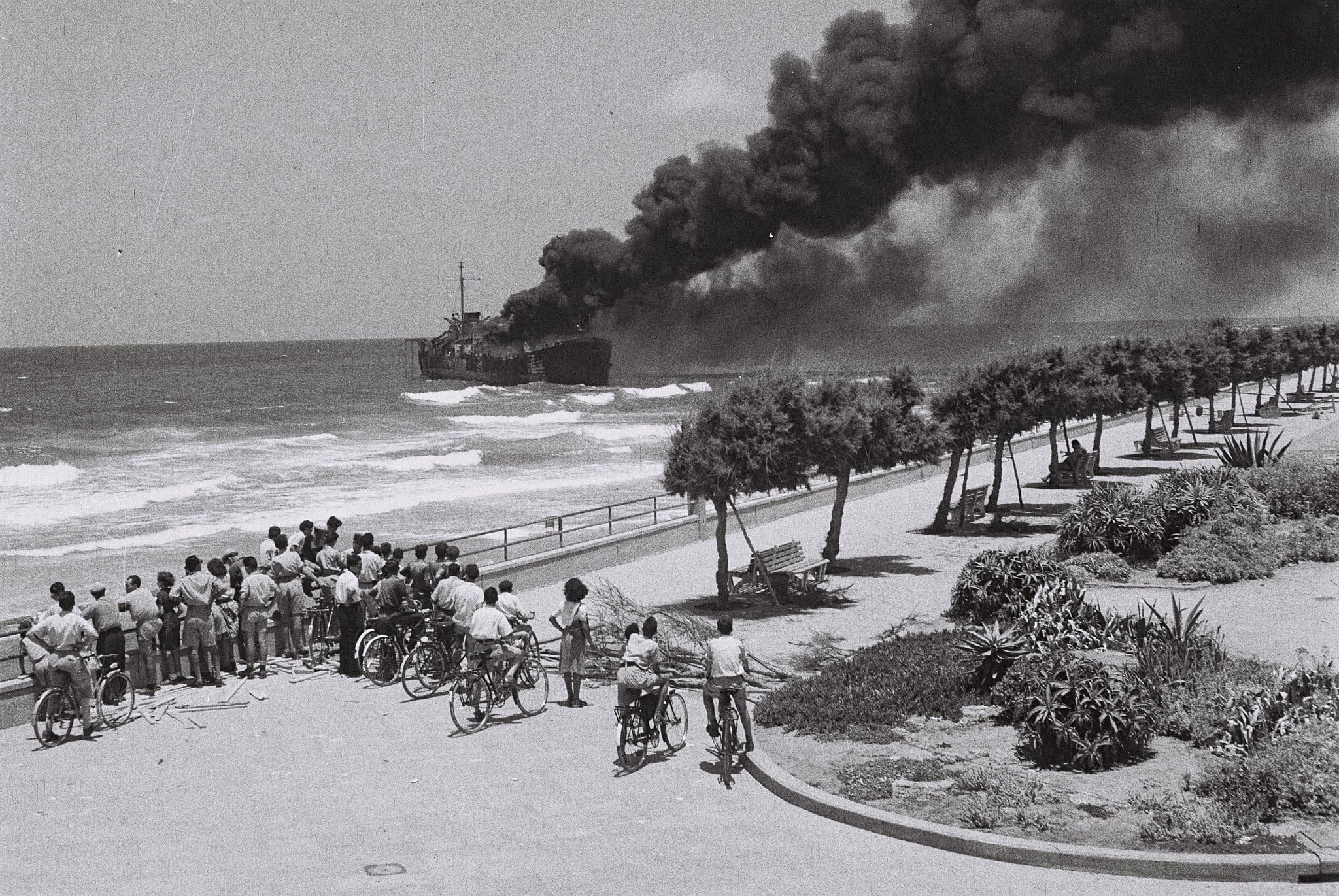
Alamo, meet the Titanic.
That’s about the stretch of it. To right-wing diehards in Israel, the so-called Altalena Affair was a battle that, like the one at the Alamo, should always be remembered: a day of heroic defeat – and at the hands of fellow Jews yet.
Okay. It took the white-settler Texians barely a month and a half to get their comeuppance on Mexico’s Santa Anna for their March 6, 1836, defeat. For Israel’s political Right, it took significantly longer – some 29 years – until they won a national election and took control of the country from the political heirs of David Ben-Gurion.
The Altalena was a decommissioned American tank-landing ship (LST). On June 16, 1947, it was sold as war surplus for conversion to a civilian transport and cargo ship. The new owner was the Three Star Line, a maritime service said to be based in Lake Charles, Louisiana.
With Israeli agents prowling North America for war surplus materiel, it was from there just a hop, skip and jump to ownership by the Irgun. The vessel was renamed in homage to a pen name used by the late Irgun founder and Zionist-Revisionist leader Vladimir Ze’ev Jabotinsky. The plan was to use the vessel to bring Irgun volunteers to fight against the Arabs, as well as carry arms that the militia planned to keep for itself.
This represented the sometimes hodgepodge effort to integrate the pre-war militias into the nascent Israel Defense Forces, an effort that often led to high levels of unease and mistrust among soldiers and entire units.
After several delays, the Altalena sailed on June 11 from a port on the French coast, making landfall on June 20 at Kfar Vitkin, some 20 miles up the coast from Tel Aviv. There, the Irgun volunteers disembarked and were taken to an IDF induction center. But when the weapons began being unloaded, Ben-Gurion demanded that they, too, be handed over to the IDF.
Ultimatums and counter-offers flew back and forth, and of course, because of the inherent tensions and the heavily armed figures on both sides, shots eventually rang out. This led the captain of the Altalena to raise anchor and cruise south toward Tel Aviv, where, it was said, many angry veterans of the Irgun and the even more extreme Lehi militia waited on shore. Menachem Begin, a future prime minister and the man who had assumed leadership of the Irgun upon Jabotinsky’s 1940 death, was now on board.
Ben-Gurion had navy corvettes tail the Altalena and take up positions that would block its way to open seas. He also sent heavy weapons and their crews to the Tel Aviv shore along with senior IDF commanders. After a lengthy standoff, he ordered the heavy guns to open fire.
Some of the gunners refused. One was said to have a brother aboard the vessel. Others said that firing on fellow Jews was not what they signed up for. Yet the firing became intense enough to set the Altalena ablaze and leave several dead. At one point, Begin ordered those on board to refrain from firing back, and soon the vessel’s captain raised a white flag.
On the evening of June 22, a ceasefire was put in place. Begin refused to leave the ship until the last of the casualties was sent ashore, and he eventually made his own way to the local broadcast studios of the Irgun, where he repeated the order he gave aboard the Altalena: that no one among his soldiers should return fire, even if fired upon. He later called this perhaps the most important order he had ever given in public service, believing it had helped avert a civil war.
The final death toll was 16 Irgun members and three IDF soldiers. The military arrested hundreds of Irgun fighters and sympathizers, releasing most within weeks; the senior-most members in custody were held for several months. There were courts-martial for the IDF gunners who had refused to open fire. And the army dispersed pockets of former Irgun and Lehi members to other units to minimize their impact on troops.
As for the Altalena, it remained a burnt-out hulk just yards off Tel Aviv’s popular Frischman Beach until it was refloated a year later and towed out to sea, where it was scuttled.
Today, the country in general looks upon the Altalena Affair as a tragedy, and at its aftermath as a milestone toward national unity – grudgingly or not. Unfortunately, though, the grudge has remained, and Remember the Altalena is still more than just a battle cry among members of today’s Likud – a party once led by Menachem Begin, who prided himself on having averted a civil war.
Yet the episode now seems to have been commandeered by the hard Right, with Heritage Minister Amichai Eliyahu, of Itamar Ben Gvir’s Otzma Yehudit (Jewish Power) party, announcing that the wreck of the Altalena had been found by the marine department of the government agency for mapping and surveying.
What did Eliyahu have to do with this, you ask? Turns out his Heritage Ministry – one of several created out of thin air to convince Otzma Yehudit and other rightwing parties to join Likud leader Benjamin Netanyahu’s coalition – underwrote the maritime search to the tune of NIS 1 million, or about $330,000.
Okay. The Altalena Affair certainly falls under the rubric of heritage. But why now, when every social-based ministry – and even the Defense Ministry! – is begging for funds?
Yet Ben Gvir, the man-child who is Israel’s minister for national security and had absolutely nothing to do with the search for the sunken vessel, could not let a less-senior minister and party member steal the limelight. So he elbowed Eliyahu out of the frame and took command of the press conference.
“We are closing a historic circle on one of the most painful and formative events in the history of Israeli society,” said Ben Gvir – who is perhaps the most viscerally divisive politician now on the scene. But there was more: “The Altalena,” he stated, “is not just a ship. It is a symbol of the national [right-wing] camp that for years they tried to boycott, silence, and push beyond the bounds of legitimacy.”
Netanyahu had to get in a statement of his own, and apparently in an effort not to be seen alongside Ben Gvir, he recorded his message later while standing near Tel Aviv’s seaside Etzel (Irgun) Museum, the Mediterranean at his back.
“I commit to raising the Altalena from the depths of the sea to serve as a tangible symbol for us and future generations – never again a civil war,” he stated with the gravitas for which he is known far and wide.
But wait. Underwriting the search for a sunken ship when other government ministries go hungry? And now people want to raise a vessel with a gross displacement weight of 1,820 tons from 500 meters of water some 12 miles off the coast?
Who will pay for this? What will happen to it? Will the Altalena become a shrine for grievances? Or one for the basic national unity that grew – painfully – out of the affair, a unity we so desperately need today?
With the Altalena episode still burning hot and deep in the resentful bellies of many right-wingers here, if the vessel is going to be raised, it had better be an ecumenical effort. Or perhaps we should just let sleeping ships lie.