

Somaliland: Isolated by Muslims, Engaging Israel
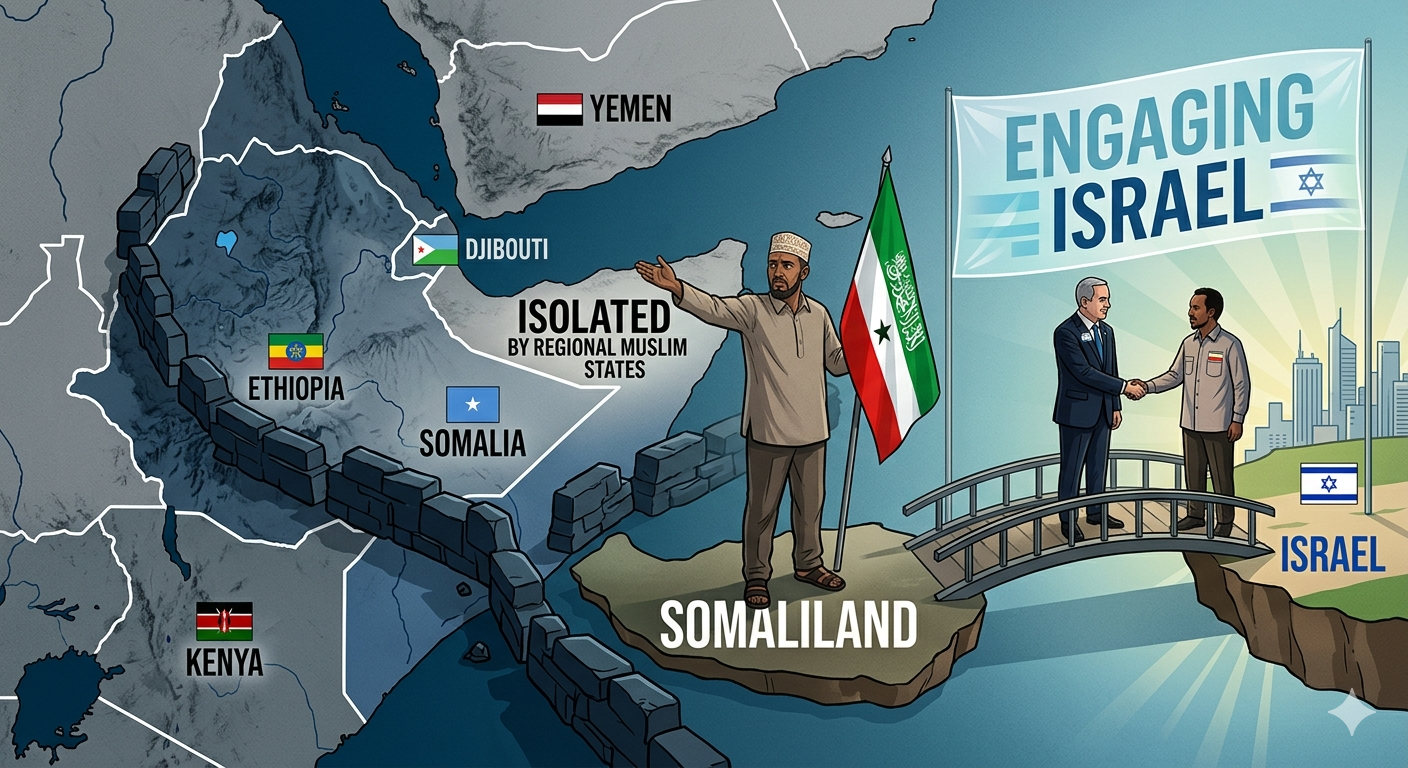
In the complex and often paradoxical landscape of international relations, the case of Somaliland stands out as both unique and revealing. A self-declared Islamic state with a relatively stable political system, Somaliland has spent more than three decades seeking international recognition. Yet, despite its Islamic identity and democratic credentials, it has remained largely isolated—particularly by many Muslim-majority countries that might otherwise be expected to support its aspirations. At the same time, its quiet and evolving engagement with Israel introduces a striking diplomatic contradiction that deserves deeper reflection.
Somaliland’s isolation cannot be understood without considering the broader geopolitical context. Many Muslim nations, particularly within the Arab League and the Organization of Islamic Cooperation (OIC), have consistently supported the territorial integrity of Somalia. For them, recognizing Somaliland would be seen as endorsing secession—something they fear could set precedents within their own borders. As a result, Somaliland’s appeals have often been met with silence or cautious distance, rather than solidarity based on shared religious identity.
However, Somaliland’s approach to diplomacy has increasingly been shaped by pragmatism rather than ideology. In a world where recognition is driven less by cultural or religious alignment and more by strategic interests, Somaliland has begun to diversify its external relations. Engagement with Israel, therefore, should not be viewed simply through a religious lens, but rather as part of a broader recalibration of foreign policy priorities.
Israel, for its part, has historically pursued relationships with non-Arab and strategically located actors, particularly in regions of geopolitical importance like the Horn of Africa. Somaliland’s location along the Gulf of Aden—near one of the world’s busiest maritime corridors makes it a potentially valuable partner. Cooperation in areas such as security, trade, and technology could serve mutual interests, especially in an era defined by shifting alliances and regional competition.
For Somaliland, engaging with Israel may also signal a willingness to break away from traditional diplomatic constraints. It reflects an understanding that international recognition is not granted on the basis of identity alone, but through calculated partnerships and strategic relevance. This shift, however, is not without risks. Closer ties with Israel could further complicate Somaliland’s relationship with Muslim-majority countries and potentially deepen its diplomatic isolation in certain circles.
Yet, this situation also exposes a broader reality about international politics: shared religion does not automatically translate into political support, just as differences in identity do not prevent cooperation. Somaliland’s experience challenges the assumption that the Muslim world operates as a unified bloc in foreign policy matters. Instead, it reveals a system driven by national interests, internal security concerns, and geopolitical calculations.
Ultimately, Somaliland’s diplomatic journey reflects the tension between principle and pragmatism. As an Islamic state seeking recognition, it has found limited backing from the Muslim world. At the same time, its openness to engaging with Israel underscores a strategic shift toward partnerships that may advance its long-term goals, even if they challenge conventional expectations.
The question moving forward is not simply whether Somaliland will gain recognition, but how it will navigate this delicate balance between identity, legitimacy, and strategic necessity. In doing so, it may well redefine what small, unrecognized states can achieve in an increasingly multipolar and interest-driven world.