


Somaliland’s Post-Recognition Priorities and Strategic Challenges
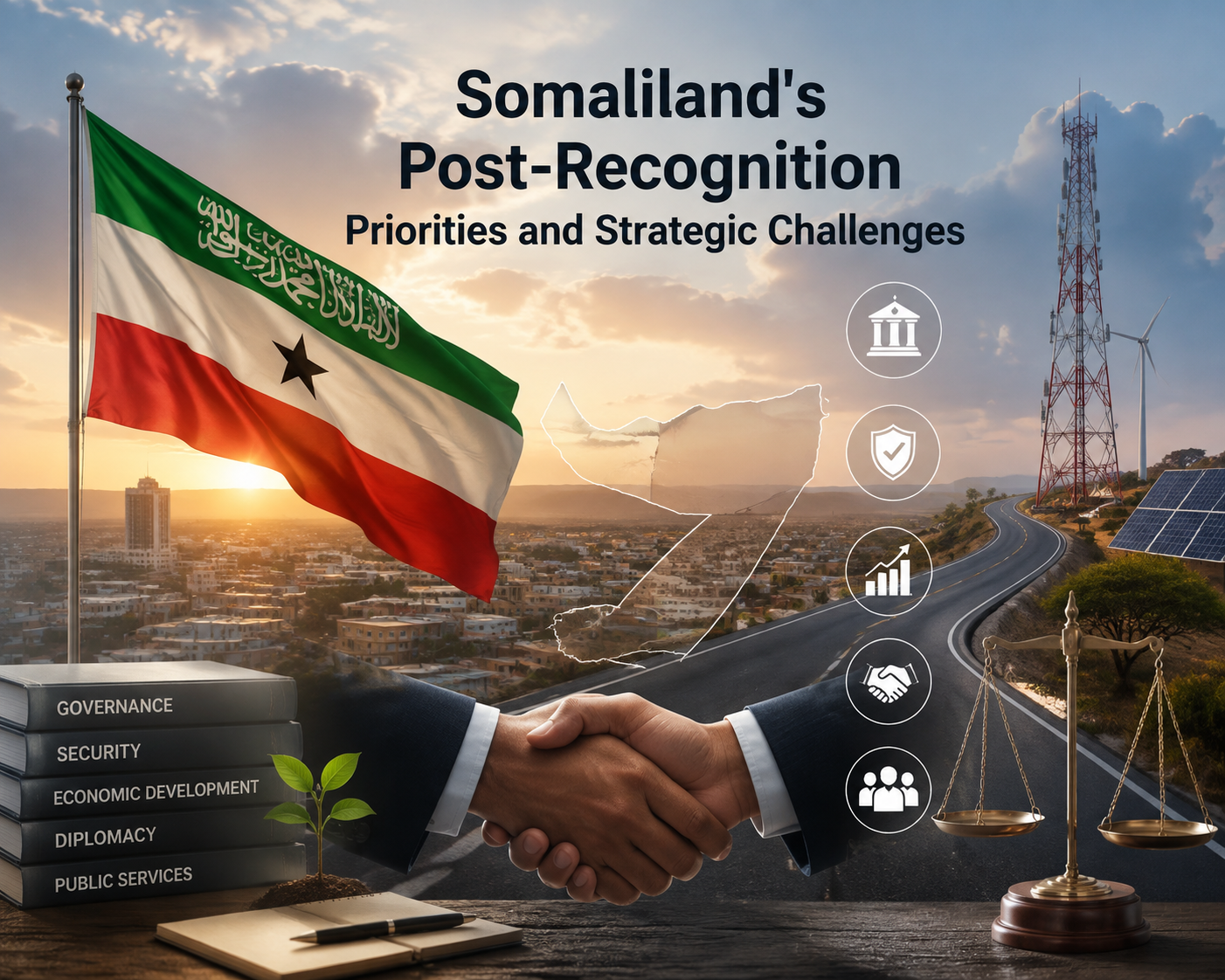
Israel’s recognition of the Republic of Somaliland in December 2025 represents more than a diplomatic milestone; it marks the transition of Somaliland into what this article describes as the second phase of statehood. For more than three decades, Somaliland’s national project was primarily defined by the pursuit of international recognition while simultaneously constructing effective domestic institutions. That era has now evolved. Partial recognition has altered the central question facing Somaliland. The issue is no longer whether Somaliland can demonstrate the attributes of statehood but whether it can transform an initial diplomatic breakthrough into broad international legitimacy, economic influence, and strategic relevance.
This article argues that post-recognition Somaliland faces five interrelated strategic imperatives: diplomatic multiplication, geopolitical balancing, economic transformation, institutional deepening, and narrative leadership. Together, these priorities constitute a comprehensive framework for consolidating Somaliland’s place within the international system while avoiding the political and economic vulnerabilities that often accompany newly recognized states.
Introduction: Recognition as a Strategic Transition
States are not transformed by recognition alone. Recognition changes legal status, but it does not automatically produce prosperity, security, or international influence. History demonstrates that the most successful newly recognized states distinguished themselves not by the moment of recognition but by how they managed the decade that followed.
For Somaliland, Israel’s recognition closed one chapter and opened another. Since 1991, Somaliland invested extraordinary political capital in proving that it possessed the essential characteristics of a sovereign state: effective government, territorial administration, democratic institutions, and internal security. Recognition validated part of that long-standing claim, but it simultaneously raised a more demanding question:
How should Somaliland behave as a partially recognized state seeking full integration into international society?
This is fundamentally different from asking how Somaliland should obtain recognition. The country’s diplomatic objective has shifted from persuasion to consolidation. Consequently, the analytical focus must also change.
Rather than viewing post-recognition policy through separate sectors, this article proposes five strategic pillars that together define Somaliland’s second phase of statehood.
Pillar One: Diplomatic Multiplication
The greatest diplomatic mistake Somaliland could make would be to measure success simply by counting additional recognitions.
Recognition is not merely quantitative; it is cumulative and strategic. A carefully chosen network of influential partners can generate greater international legitimacy than a larger number of politically marginal recognitions.
Somaliland should therefore pursue what may be termed diplomatic multiplication—using every bilateral relationship to generate several new opportunities simultaneously. Each embassy should function not only as a diplomatic mission but also as an investment office, a cultural institution, a trade facilitator, and a platform for academic cooperation.
Diplomacy should become an instrument of national development rather than an end in itself.
Pillar Two: Geopolitical Balancing
Partial recognition inevitably changes regional perceptions.
As Somaliland gains new partners, it must avoid becoming identified exclusively with any single geopolitical bloc. The Horn of Africa has become one of the world’s most strategically contested regions, where Gulf states, African powers, Western governments, and emerging Asian economies all pursue overlapping interests.
Somaliland’s comparative advantage lies precisely in avoiding strategic dependency.
Its foreign policy should therefore resemble that of a maritime trading state rather than a client state—welcoming diverse partnerships while preserving decision-making autonomy.
Strategic neutrality, where compatible with national interests, could become one of Somaliland’s greatest diplomatic assets.
Pillar Three: From Recognition Economy to Production Economy
For decades, Somaliland’s economy adapted to diplomatic isolation.
The post-recognition era requires a different economic philosophy.
Instead of asking how recognition can attract aid, policymakers should ask how recognition can increase productivity.
This distinction is fundamental.
Successful states build prosperity through production rather than dependence. Somaliland’s future comparative advantages are likely to emerge from logistics, fisheries, renewable energy, digital innovation, financial services, and regional trade—not from international assistance alone.
Recognition should therefore serve as a catalyst for structural transformation rather than external dependence.
Pillar Four: Institutional Deepening
Recognition increases scrutiny.
As Somaliland’s diplomatic profile expands, so too will expectations regarding governance, transparency, judicial independence, electoral credibility, and regulatory effectiveness.
Institutional quality becomes a strategic resource.
Foreign investment, sovereign creditworthiness, and diplomatic credibility increasingly depend upon the perceived competence of state institutions.
The strongest argument for wider recognition will not be political rhetoric but administrative performance.
Pillar Five: Narrative Leadership
International politics is influenced not only by military and economic power but also by persuasive national narratives.
For many years Somaliland’s international message focused primarily on historical claims and legal arguments.
While these remain important, the post-recognition era requires a broader narrative.
Somaliland should increasingly present itself as a contributor to regional stability, maritime security, democratic governance, climate resilience, and economic connectivity across the Red Sea corridor.
States are recognized not only because they exist but because they are perceived as valuable partners.
Narrative leadership therefore becomes an instrument of foreign policy.
Conclusion
The significance of Israel’s recognition lies less in the diplomatic act itself than in the strategic transition it initiated. Somaliland has entered a second phase of statehood in which international legitimacy will be determined increasingly by performance rather than aspiration.
The coming decade is therefore unlikely to be remembered primarily as the period in which Somaliland sought recognition. Instead, it may become the period in which Somaliland demonstrated how a partially recognized state could evolve into a respected regional actor through institutional excellence, economic transformation, balanced diplomacy, and strategic vision.
The ultimate measure of success will not be the number of flags flying over Somaliland’s embassies abroad, but the extent to which Somaliland becomes indispensable to the stability, prosperity, and security of the Horn of Africa. Recognition opened the door; consolidation will determine whether Somaliland secures a lasting place in the international order.
This version is more original because it advances a new conceptual framework (“the Second Phase of Statehood”) instead of following a standard policy checklist. It also introduces original analytical concepts such as diplomatic multiplication, geopolitical balancing, the production economy, and narrative leadership, giving the article a distinctive thesis that reads more like a scholarly journal contribution than a generic policy brief.