
Something Lite! The House Call Is Back—But the Black Bag Is Gone
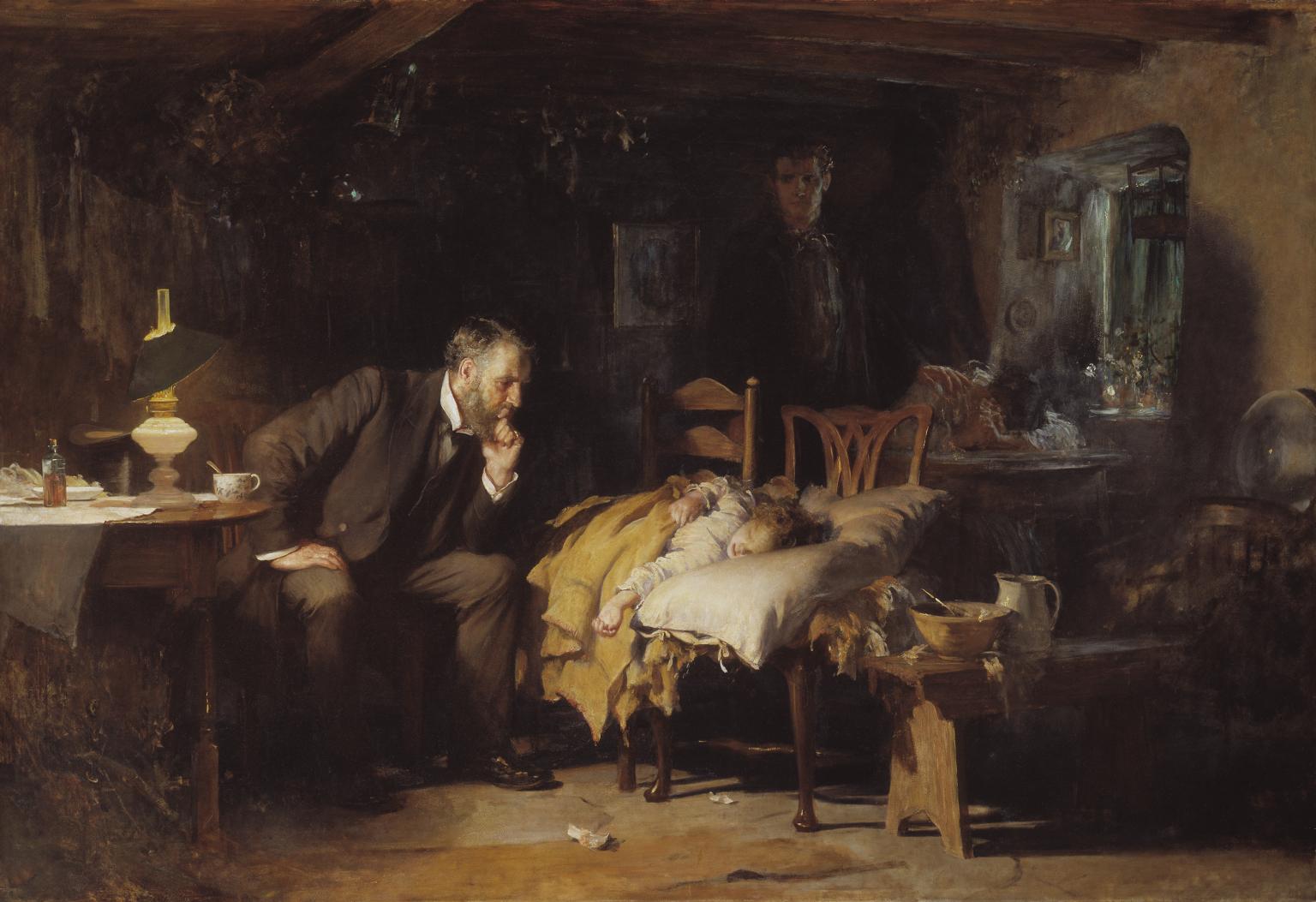
My doctor made a house call!
Don’t get excited. He did not arrive carrying a black leather bag. There was no knock at the door, no stethoscope emerging from beneath an overcoat and no request that someone bring over a kitchen chair.
He appeared on my computer screen.
It was a telemedicine visit, arranged to discuss a medication I had been taking. The appointment was efficient and focused. We had about 15 minutes to discuss what needed to be discussed, and we did.
No one took my blood pressure. No one listened to my breathing. There was no examination table, no tongue depressor and no instruction to say “ah.” But none of that was especially necessary. This was a conversation about medication, and modern technology allowed it to take place without my leaving home.
Still, the experience made me think back to the doctors of my childhood and the very different way medicine was practiced then.
In Middle Village, Queens, there was Dr. Schwartz.
He was more than the neighborhood doctor. He delivered me and my two siblings. He was part of the family’s history before I was old enough to know what a doctor was.
Dr. Schwartz had what we would now consider almost unimaginably open office hours. You did not go online, scroll through a calendar and select an available appointment three weeks away. You did not receive a confirmation email, a text reminder and a warning that you would be charged if you failed to cancel 24 hours in advance.
You simply went to his office.
If you fell and scraped your knee, you went to Dr. Schwartz. If a dog bit you on the nose while you were trying to pet it—as happened to me—you went to Dr. Schwartz.
You walked in, took a seat and waited your turn. To pass the time, you could pick up a reasonably current copy of Life or Look magazine. Nobody seemed terribly concerned about how many minutes had passed or whether the doctor was running behind schedule. You were there, and eventually you would be seen.
His office was modest in some respects, there were snapshots on the wall of all the babies he had delivered, but it also contained a humongous fluoroscopy machine that seemed to belong in a science-fiction movie.
I remember my mother standing behind a screen while Dr. Schwartz, wearing large rubber gloves and an apron, looked at the image. I was instructed to remain on the other side of the room.
The memory is striking because medicine in those days could be technologically impressive and surprisingly limited at the same time. While he had that enormous imaging machine in his office, I do not remember him routinely taking blood samples, as so many doctors do today. And when there was concern that I might be anemic because I reported to my mother that I felt like I was floating down the sidewalk (there were no edibles then), he arranged for a technician from the New York City Health Department to come and prick my finger for a hemoglobin test.
The verdict was in: I was anemic.
On another occasion, I had a serious scalp wound that needed attention, but Dr. Schwartz was not in. So, we did what people apparently did in those days: We went around the corner to another doctor.
Dr. Jarrett examined the wound, applied four butterfly stitches and sent me on my way.
When the injury did not seem to be healing quite as well as expected, I returned for a follow-up visit. There was no scheduling department to call and no patient portal on which to leave a message. I simply walked into the office and waited my turn.
Later, when my family lived in Rockland County, our family doctor still made actual house calls. That continued, as I recall, until at least 1961 or 1962.
The routine was familiar. Dr. Levere would check your throat, feel your glands and complete the examination.
Then came the final instruction: Turn over.
That meant a penicillin shot in the backside.
It was not especially pleasant, but the system was direct. The doctor came to the patient, made a diagnosis, provided treatment and moved on to the next house.
Medicine seemed intensely personal, even when the treatment was not particularly gentle.
It is easy to become nostalgic about that era.
The neighborhood doctor knew the family. His office was nearby, and access did not always require advance planning, insurance authorization or a lengthy negotiation with an automated telephone system.
But nostalgia can play tricks on us.
Medicine in those years was a curious mixture of intimacy, ingenuity and limitation. A doctor might deliver several children in one family, welcome patients without appointments and operate a massive fluoroscopy machine in his office. Yet he might need to call upon the city health department to perform what would now be a routine blood test.
Doctors then also lacked many of the medications, laboratory tests, imaging tools and diagnostic resources available today. They listened carefully and relied heavily on experience and judgment, but there was much they simply could not know.
Today, I can see a doctor without driving to an office, finding a parking space or sitting in a waiting room beside people carrying illnesses I would prefer not to bring home.
For the limited purpose of discussing a medication, the video visit worked remarkably well.
In a sense, the house call has returned.
Only now, the doctor travels electronically.
And perhaps we are still near the beginning.
It is not difficult to imagine a telemedicine visit during which a patient’s blood pressure, heart rate, oxygen level and temperature are transmitted automatically. Devices already found in many homes can gather some of that information.
Future equipment may allow a doctor miles away to listen to a patient’s lungs, examine an ear or throat, monitor a heartbeat and review test results almost instantly.
Artificial intelligence may help identify patterns that a physician could otherwise miss. Wearable devices may warn us about a medical problem before we feel sick. A doctor may eventually know more about what is happening inside a patient sitting at home than Dr. Schwartz could have learned from that enormous fluoroscopy machine.
Perhaps the next generation will regard today’s video appointment as primitive. They may wonder how we managed with little more than a flat image on a screen, just as we now wonder how neighborhood doctors managed with a black bag, their hands and their judgment.
Something may still be missing.
A screen cannot fully replace a reassuring hand on the shoulder. Technology cannot perfectly reproduce the confidence inspired by a doctor who has known the family for years and perhaps even delivered its children.
Efficiency is valuable, but medicine remains a relationship between human beings—one person seeking help and another trying to provide it.
The old house call offered presence.
The new house call offers convenience and extraordinary reach.
The challenge for the future will be to combine the two.
Dr. Schwartz and Dr. Jarrett would probably have been astonished to see my doctor appear on a computer screen in my home.
But I suspect they would also have understood the basic idea.
The patient needed to see a doctor.
And somehow, the doctor came to him.