

Rabbi, Economist and Community Builder
Sometimes the Struggle Itself Is a Defeat
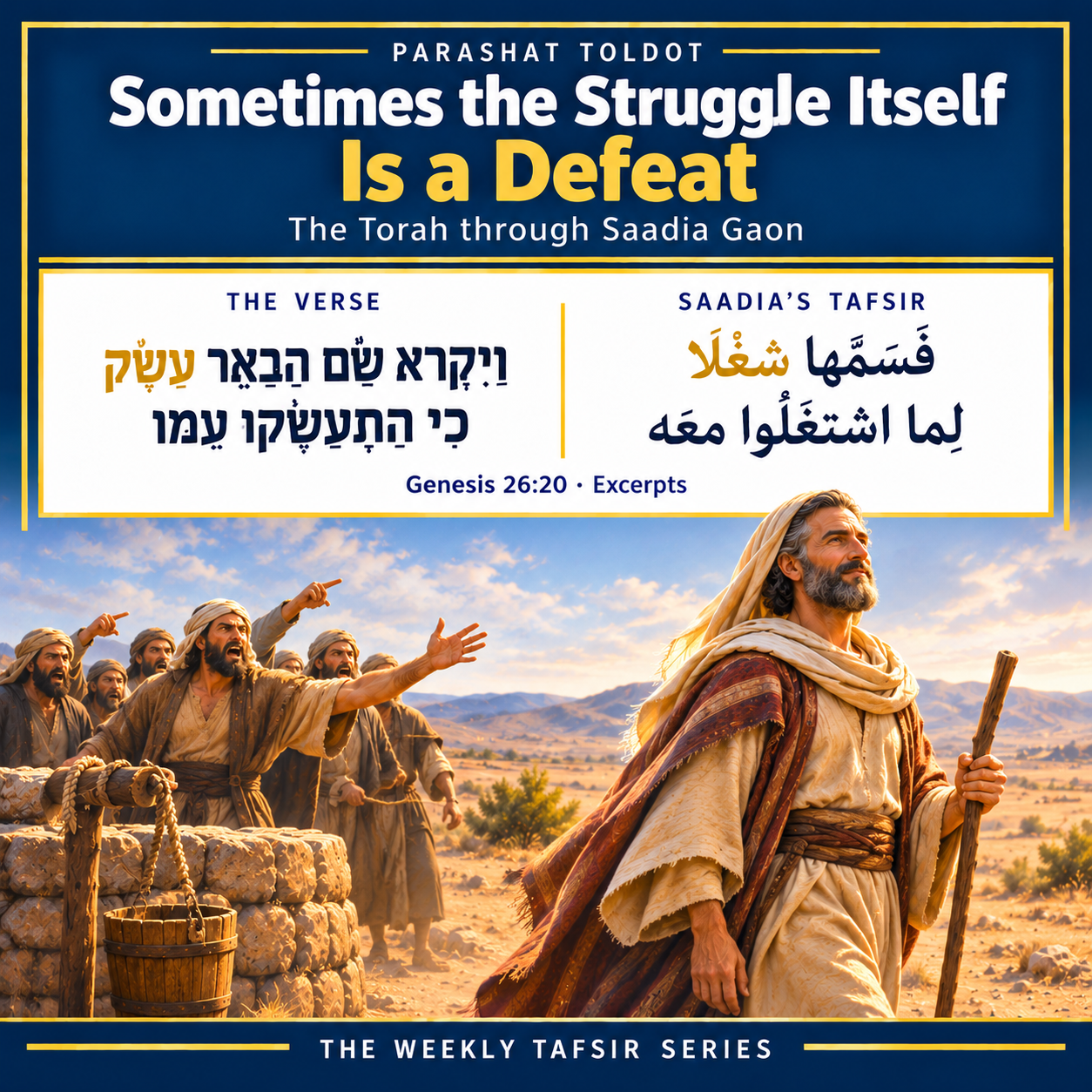
Sometimes the Struggle Itself Is a Defeat
Most of us grew up believing that every struggle must end one way or another: in victory or defeat. But this week, Rabbi Saadia Gaon (Rasag) teaches us that sometimes entering a struggle is itself a defeat, while choosing to avoid it is the real victory.
Over a thousand years ago, Rabbi Saadia Gaon produced his monumental Arabic translation of the Torah, known as the Tafsir (تفسير), meaning “interpretation” or “explanation.” His choice of words allows us to uncover additional layers of meaning in the biblical text and explore how Hebrew and Arabic illuminate one another.
In this weekly series, we select a verse from the parsha and explore what we can learn from Rasag’s translation.
This week, we will focus on a verse describing Isaac’s disputes with the herdsmen of Gerar over water wells:
“And he called the name of the well Esek, because they contended with him” (Genesis 26:20).
Rasag translates:
فَسَمَّهَا شَغْلًا لِمَا اشْتَغَلُوا مَعَهُ
He translates the word “Esek” (עֵשֶׂק) as شَغْلًا (shaghlan). The Arabic root ش-غ-ل (sh-gh-l) conveys meanings such as disturbance, work, or preoccupation. Even today, the word شُغْل (shughl) is commonly used in Arabic to mean work or vocation.
In Biblical Hebrew, the root עש”ק (a-sh-q) is associated with oppression and exploitation, although it also resembles the Hebrew word esek (עסק), meaning “business.” Rasag could have chosen Arabic words denoting injustice or theft, but instead selected a root associated with disturbance and preoccupation. In doing so, he emphasizes not only the dispute over water but also the very act of the herdsmen of Gerar persistently troubling Isaac and stealing his attention.
This point becomes even clearer in his translation of the name of the second well, “Sitnah” (שִׂטְנָה, Genesis 26:21), which Rasag renders as ذَاتِ العِنَاد (dhat al-ʿinad), meaning “the one characterized by stubbornness.”
Perhaps Rasag is suggesting that the herdsmen of Gerar were not merely Isaac’s adversaries, but people determined to oppose him, even after he had already given up the first well.
And what does Isaac do? Contrary to what many of us might instinctively do, he neither fights back forcefully nor insists on having his way. He simply moves on, until he reaches the third well, which he names “Rehovot” (רְחֹבוֹת, Genesis 26:22), translated by Rasag as ذَاتِ السِّعَة (dhat al-siʿa), meaning “the one characterized by spaciousness.” But we will leave that for next year.
For our purposes, Rasag’s careful choice of words allows us to learn an important lesson from Isaac: Not every battle is worth fighting, and not every battle is worth winning.
Sometimes, the other side’s goal is not to reach a resolution, but to prolong the argument itself. They want to keep us occupied, exhaust us, and drain our energy instead of allowing us to devote it to positive and constructive pursuits.
In such cases, merely engaging with a stubborn adversary is already a defeat, regardless of the outcome. The real victory is not to overcome them, but to free ourselves from the struggle and move forward.
Special thanks to Rabbi Yom Tov Gindi of Kfar Chabad, who made the Tafsir accessible in a modern edition using Arabic script, opening the door for us to embark on this journey.
Shabbat Shalom, and see you next week!