Finding Inspiration and Connections Around the World; In America, Africa and the Middle East
Song, Community and Redemption
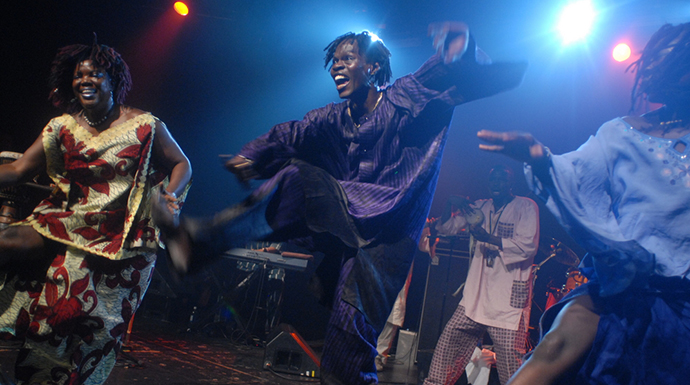
Baba Maal, probably Senegal's most famous musician, dancing (Photo credit: Sergei Bachlakov, Shutterstock)
This coming Shabbat has a unique name – Shabbat Shira – the Shabbat of song. This is because we read the Song of the Sea, the song that the Children of Israel sang upon crossing the Red Sea.
I have been thinking about the role of music in our life a lot here in Senegal. Daily life here is filled with music. While in the West we are used to hearing music on the radio while driving or in our earphones while walking around, music and singing are the background noise for daily life here. Every Thursday night the local mosques come alive with hours of religious poetry-singing in preparation for the Friday prayers. My wife and I joke that these songs are also an accompaniment to our Shabbat preparations, as we cook most of our Shabbat food with this music in the background.
Music is incredibly fundamental to human nature. Rabbi Nachman of Breslov goes so far as to imply that the difference between humans and animals is the uniquely human ability to create music. Playing and enjoying music both defines us as human beings, and allows us to strive for something greater than ourselves as well.
In Dakar, you don’t only hear religious music. People here love to sing and to dance and do not need much of an excuse to begin to sing. My wife is studying the local musical traditions as part of her PhD field research. Occasionally, when she describes her research, complete strangers burst into song just by sheer excitement and joy of being reminded of local music. There seems to be traditional songs here for all aspects of life ranging from bedtime and work songs, to wedding songs and religious songs. People love to sing. The most amazing expression of singing that I have seen here actually happens in the context of big public events.
One of the most unique parts of the musical tradition and culture here is that it is participatory. People are not just passive recipients of the music. People sing along, or they get up and start dancing when they feel inspired. My wife once shared with me a funny story. She was in a graduate class on West-African music at Princeton. The professor played some African music for the class and everyone sat in their seats, quietly enjoying the music. Surprisingly the teacher seemed very disappointed. ‘How can you just sit there and listen in your seats!’ he admonished them. ‘In Africa everyone would get up and start dancing when they heard this music!’ From my experience here that seems to be true.
Why is it, I find myself wondering, that we don’t have more communal and participatory music in our culture? When did music become something that we consume, either watching it on stage, on TV, or in our earphones, instead of something that we participate in ourselves? What do we lose out on as a culture by not having more group singing and performances? Personally, I find myself frequently frustrated in synagogues that rush through Friday night services or chose to mumble the beautiful songs of Hallel on Rosh Chodesh and Holidays. I feel that skipping these opportunities to sing deprives us of the opportunity to become happier, healthier, more complete people.
In this week’s Torah reading however, we see the opposite reaction. Upon realizing that they have successfully crossed the Red Sea and made it to safety, the Children of Israel burst into spontaneous song. Singing, and specifically, spontaneous collective singing is the direct result of being free. Singing in community is perhaps the ultimate sign of freedom. Singing is what makes us human, but it is also what helps redeem us. A healthy spiritual community, the Torah seems to tell us, knows how to respond to great news by singing and being happy together.
The ultimate model of this in our tradition is the night of the seder, specifically when we sing the Hallel, the Psalms of praise, at the end of the seder. Our singing at the night of the seder is the sign of our redemption. The happiness that we feel should mirror the happiness of the Jewish people after being saved from Egypt. It is my hope that we have many more opportunities to have spontaneous, joyous communal songs, and not just once a year at the seder night, but rather as a more integral part of our Jewish practice and identity.
Related Topics
Related Posts