

Southeast Asian Sojourn: Voices From Vietnam
Certain countries evoke specific imagery. Morocco, for example, conjures thoughts of the sweeping expanse of the Sahara desert. For Switzerland, it’s alpine scenery. Greece brings to mind the grandeur of antiquity.
Vietnam, synonymous with one of the darkest periods in American history, sparks imagery of a different sort. Helicopters transporting troops into hot zones. Platoons wading through rice paddies. Napalm fireballs rising high above the jungle canopy. Defiant homefront protests roiling the country.
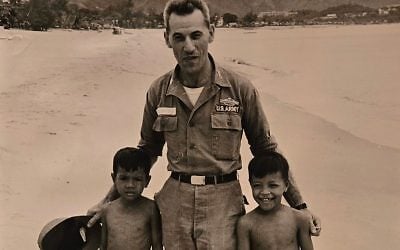
Yet, I was there in October, and what I saw was a very different Vietnam, far removed from the war-torn country where my father, Army Lt. Colonel Allan Galfund, served. Today’s Vietnam is highlighted by the pulsating energy of Hanoi and Ho Chi Minh City; the surreal beauty of Ha Long Bay; and the enchanting “City of Lanterns,” Hoi An. Temples, pagodas and ancestral shrines envelop visitors in serenity. Most especially, interactions with the warm, welcoming and engaging Vietnamese people provide opportunities for unique insights and memorable encounters.
Over the course of four weeks, we worked our way from Hanoi to Ho Chi Minh City. Along the way, we met an array of diverse individuals, from villagers to former Viet Cong fighters to members of Gen Z. What emerged, despite divergent circumstances, was a collective spirit of fortitude and optimism.
And, as I also discovered, there’s even a strong Israel connection.
Following are short vignettes spotlighting compelling voices from a country so far removed from being an adversary that a John McCain monument in Hanoi, originally erected to mark his capture, has evolved into a symbol of peace and reconciliation.
The Undeterred Red Dzao Villager
I met May Linh during the first week of our journey, spent in Vietnam’s hilltop tribes region. May, our local guide, was a member of the Red Dzao tribe, one of Vietnam’s 54 recognized ethnic peoples. She grew up in the humble home built by her grandfather, making May the third generation of her family to live to live there.
“There were five boys and four girls,” she said, “and it was very crowded. We worked in the garden every day – rice, sweet potatoes, pumpkins, beans, cucumbers and more. It was hard, but we were happy working together.”
What was fascinating about May, a highly intelligent woman who speaks flawless English, was the fact that she is illiterate. Her tribe does not allow girls to learn reading and writing skills. Undeterred, she learned English while selling her family’s goods – fruits, vegetables and embroidery – in the marketplace. “As a street vendor, I just kept talking to people, especially tourists.”
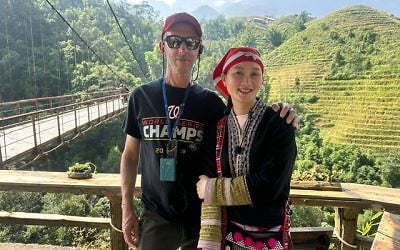
When she was 20, “I started thinking about becoming a tour guide to get extra income to help my family and live a better life.” Fourteen years later, she has a family of her own and, in addition to English, May speaks the language of four other hilltop tribes. “Most people know little to nothing about this region,” May asserted. “It is very important to connect people from different parts of the world to our local culture and daily lives.”
The Guerilla Fighter
Hang, a member of the Red Ti people, also lives in a village in the hilltop region. He became a Viet Cong guerilla at age 20. “I spent 11 years as a fighter,” he said, as translated by Thai, our guide. “I was a student, and everyone in my class volunteered. I was a rifleman. We trained with AK47s for three months to become professional soldiers.”
He added, “We were told American soldiers were forced to come. We didn’t want to fight either, but we believed in the unification of Vietnam.” Decades later, Hang still has shrapnel in his body.
Tragically, Hang has been impacted by the dire effects of Agent Orange. Two of his children died, and a surviving daughter was born with mental disabilities. Nonetheless, he is not bitter.
“During wartime, we are enemies. If you try to kill me, I will kill you. Now, we have learned from our mistakes. Both sides suffered. I bear no hostility towards Americans.”
The Returning Veteran
It was by chance that I sat down with Merle Headington on the 61st anniversary of his enlistment in the U.S. Air Force. Although he did not plan his trip to Vietnam to coincide with the anniversary, the coincidence was clearly meaningful for him.
His enlistment date was October 28, 1965. In January 1968, just a few weeks prior to the Tet Offensive, Merle arrived in Vietnam. Now a crew chief, he was responsible for the maintenance and airworthiness of the C-130 Hercules, the workhorse of the U.S. Air Force. “It was my responsibility to get planes turned around as quickly as possible.”
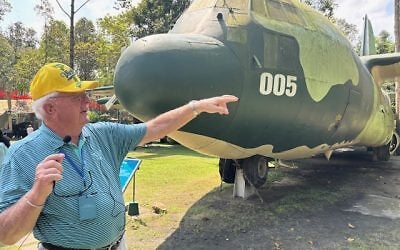
It was harrowing, frenzied and traumatic. He cited an episode in February 1969 when a C-130 was hit by North Vietnamese fire, and, Merle said softly, “everyone was killed.”
Looking back on the stated purpose of his mission, Merle grew contemplative. “At first, I felt it was part of a cause to stop communism. As time went on, I realized it was stupid and uncalled for. We shouldn’t have been there. We inflicted a lot of pain on their country, and they inflicted a lot of pain and grief on us.” He continued: “We thought they were little people, but no one measured the size of their heart and determination. That was a big mistake.”
When asked if he felt remorse, Merle nodded. But, he added, “I thought it was important to come back and see Vietnam. I call it cleansing the soul.”
The Trip Leader: Proudly Introducing Visitors to His Country
Merle’s resonated with trip leader Dang Thai Hoa. Over the course of 25 years as a guide, Thai, as he likes to be called, has shown many veterans the country in which they fought. “They were very emotional, and not open at the beginning. After a few days, they began sharing and starting conversations. Many were in major battles, including the Tet Offensive. They conveyed their experiences to local people. Everyone spoke openly. No one reacted like either side was the enemy.”
Born in 1975, the year of Vietnam’s reunification, Thai was the sixth of eight children. “I grew up in a very small village of about 200 people, five hours north of Hanoi, and the family grew rice and tea.” His father, a truck driver for the North Vietnamese Army, hauled supplies along the Ho Chi Minh Trail. He lost a leg in the conflict.
After school, Thai worked in the restaurant business and began learning English. He started taking visitors on tours of the region’s villages. He eventually moved to Hanoi, gradually evolving from local guide to taking tourists throughout the country.
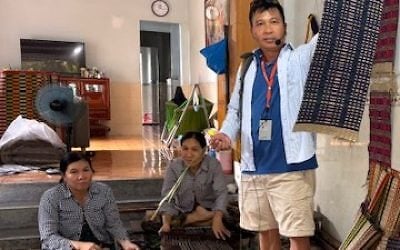
“I’m very proud to introduce the culture and people of Vietnam to visitors,” said Thai. “I’m lucky to have learned so many things in my life. Every day I work hard to learn more.” He emphasized, “It’s great when you hear different opinions. It opens opportunities for more discussion.”
The Gen Zer
Winding through Vietnam, we spent a couple of days in Da Lat, located northeast of Ho Chi Minh City. It was there that I met Bo, a Gen Zer who, in flawless English, welcomed us into the home of his aunt and uncle. Unlike the humble villages we visited during the initial part of our trip, the spacious home seemed comfortably middle class, with a big flat-screen TV, tasteful furniture, and dozens of plants circling the house.
I discussed this with Bo, noting that while I was in Hanoi, I saw some of the same high-end stores someone strolling along New York’s Fifth Avenue would see. He agreed with my assessment of Vietnam as a quasi-capitalist country, laughing, “It’s certainly not North Korea. In Vietnam, the government’s policies have opened vast opportunities for the country.”
When asked about Vietnam’s current president, he confessed to not knowing the president’s name. “But,” he added with a smile, “everyone knows the name of your president.”
Bo was born 26 years after the U.S. left the country, and I wondered how the American War – as it is referred to in Vietnam – is taught in schools. “There is no anger or hatred,” he explained. “Instead, it is more of a neutral approach.”
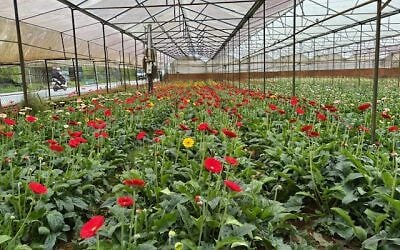
I also learned there is an Israeli connection in Da Lat. Known as “The City of Flowers,” the sprinkler systems used in greenhouses were developed in, and imported from, Israel.
And, speaking of Israel . . .
The Warm Israel-Vietnam Relationship
A small pleasure of being in Vietnam is wearing T-shirts bearing the names of my favorite sports teams written in Hebrew, unconcerned about someone screaming in my face and accusing me of genocide. Throughout the four-week trip, there was not a Palestinian flag or keffiyeh in sight.
Sara Friedman, CEO of the World Jewish Congress, Israel and North America, told me, “Israel and Vietnam have maintained friendly diplomatic relations since 1993, with cooperation developing across agriculture, water management, technology, education and trade. Israeli expertise in irrigation and agricultural innovation has greatly contributed to Vietnam’s efforts to strengthen agricultural productivity and food security.”
She added, “People-to-people connections are also fostered through tourism and educational exchanges, with Vietnam a popular destination for Israeli travelers.”
I saw this for myself when, sitting in the lobby of my Ho Chi Minh City hotel, a group of Israelis arrived for their first day in Vietnam. They looked at me warily when I asked if they were Israeli, no doubt wondering if I was going to yell “Free Palestine!” I assured them I was Jewish, and that they were in for an amazing experience.
Vietnam is also a go-to destination for the Tiyul Hagadol– Big Trip – the traditional adventure Israeli backpackers take following mandatory IDF service, and prior to college or other post-Army pursuit.
And, of course, there is the ubiquitous Chabad presence, with four outposts in Vietnam ready to provide a warm Jewish welcome and kosher meal.
A Poignant and Lasting Memory
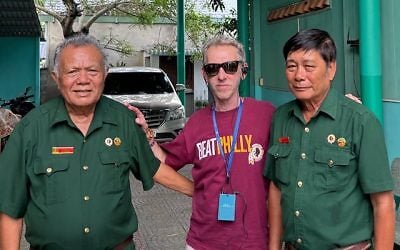
The final day of our Vietnam journey took us to the infamous Cu Chi tunnels, which Viet Cong fighters utilized to launch surprise attacks, store supplies, transport weaponry, set deadly booby traps and more. After exploring a small section of the tunnels, we were joined for lunch by two former VC officers, dressed in the same uniforms they wore into battle over half a century ago.
Following lunch, as the officers prepared to leave, I asked Thai to tell them my father served as an Army officer in Vietnam. I expected, at best, a perfunctory nod as they moved on to their waiting car.
Instead, they turned around, clasped my hand and embraced me. It was an unforgettable moment – a poignant, lasting memory of today’s Vietnam.
(Photos: James S. Galfund/the Galfund family)