The views expressed herein are solely mine.
Southern Eyes: Crushing Iran’s Western Terror Hub
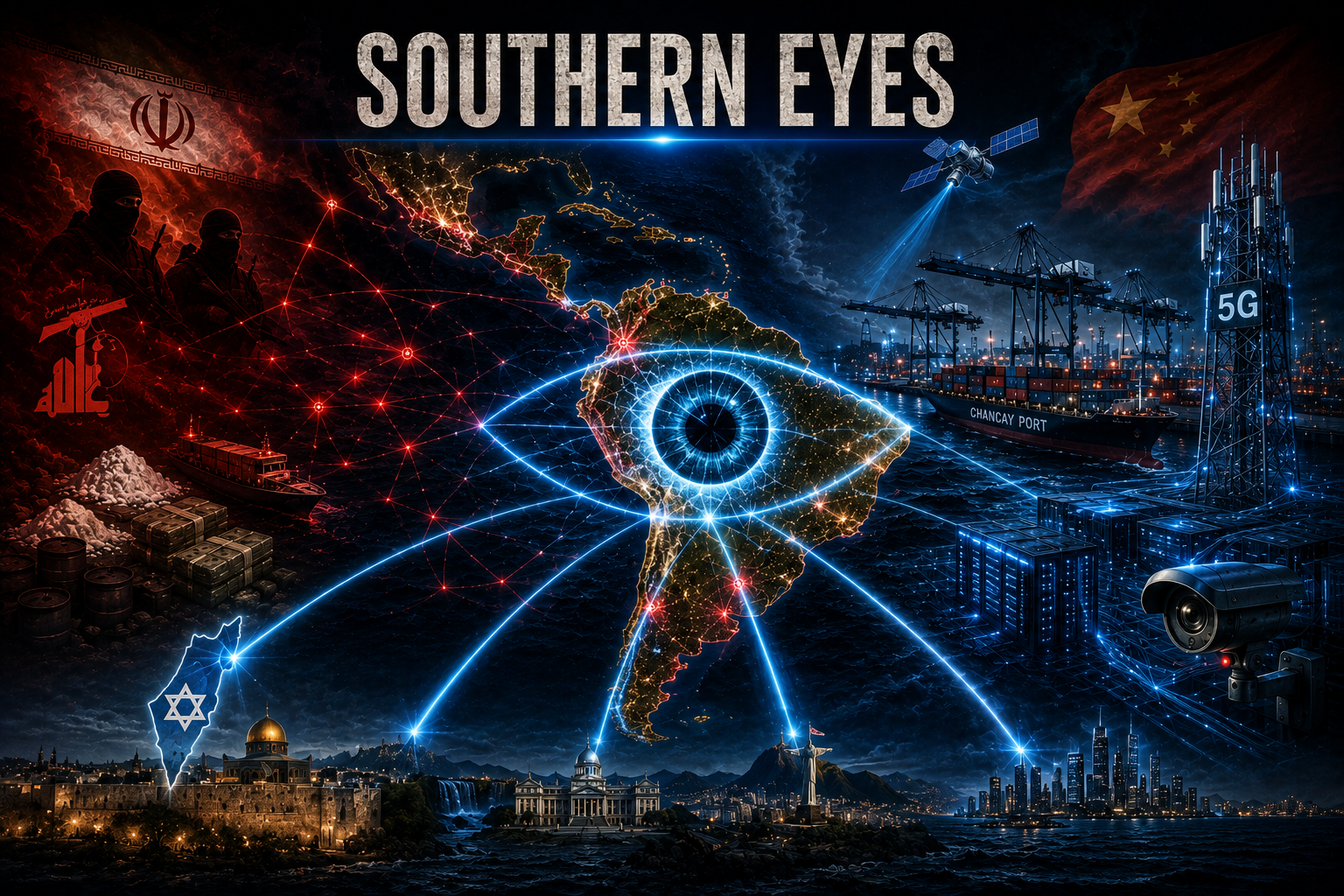
Credits: AI-Generated Image.
Long before the State of Israel woke up to the threat, the Islamic Republic of Iran recognized Latin America as its ideal strategic depth. The timeline of Tehran’s unchecked penetration is a damning indictment of regional security. In 2008, investigators exposed a Hezbollah-linked cocaine-for-cash pipeline in Colombia. By 2023, the terror group was plotting strikes against Jewish targets in Brazil. The rot deepened in 2024 when Peruvian authorities nabbed a Quds Force operative targeting Israelis, followed by a foiled 2025 Quds Force assassination plot against Israel’s ambassador in Mexico. These are not isolated incidents; they form a blatant, seventeen-year pattern of Iranian state-sponsored terrorism operating unhindered in America’s backyard.
But Tehran is only half the equation. While Iran provides the frontline terror threat, the Chinese Communist Party builds the structural trap. Beijing has weaponized economic dependence, exploding its regional trade from $12 billion in 2000 to a staggering $515 billion in 2024. China is now South America’s dominant trading partner. In Brazil, Huawei controls nearly 45 percent of the 5G infrastructure, handed over by complacent regulators in May 2024. More alarming still is Peru’s Chancay megaport. Inaugurated in November 2024 after a $3.5 billion investment, this strategic asset is 60 percent owned and exclusively operated by a Chinese state-owned conglomerate. Xi Jinping openly boasts that Chancay is the pivot point for Beijing’s maritime-land corridor into the region.
Let’s be clear: economic dependence is a counterintelligence nightmare. When rogue states control a nation’s ports, telecommunications, and strategic assets, sovereign control evaporates. Tehran and Beijing have forged a potent symbiosis. China constructs the opaque infrastructure that blinds local law enforcement, while Iran utilizes the shadows to build a distant sanctuary. Just as Tehran turned the Bekaa Valley (Lebanon) and Syria into launchpads against Israel while shielding the Iranian mainland, it now uses Latin America as a zone of deniability. Cocaine routes, money laundering, and dual-use ports are the new tools of asymmetric deterrence, replicating Hezbollah’s northern Israeli border strategy across the Atlantic.
This operational audacity is not new. In the mid-1990s, master terrorist Imad Mughniyeh orchestrated a chilling plot from the Tri-Border Area to poison Paraguayan beef exports bound for Israeli supermarkets. Though intercepted, the plot proved that Hezbollah possesses the logistical imagination to weaponize everyday commerce.
Today, Latin American intelligence agencies remain fractured by bureaucratic silos and uneven capabilities, leaving gaping seams for adversaries to exploit. Israel possesses the exact battlefield-tested tools these governments desperately need, yet Jerusalem’s strategic neglect is glaring. In 2024, Israeli defense exports skyrocketed to $14.795 billion, yet a pathetic one percent went to Latin America.
The Abraham Accords proved a vital truth: shared threats bridge geographic divides. The April 2026 Isaac Accords between Israel and Argentina offer the right political framework. But diplomacy without teeth is useless. Jerusalem and its Latin American partners must immediately leverage this agreement. They must launch an operational, joint intelligence apparatus: “Southern Eyes.”
To defeat Tehran and Beijing’s axis in the Western Hemisphere, the “Southern Eyes” initiative must operate on cold realism, not bureaucratic boilerplate. Forget a Latin American “Five Eyes” overnight; deep trust is grown through operational performance, not empty diplomatic declarations. The alliance must begin with a fiercely vetted bilateral core and expand only after participating services prove they can run ruthless counterintelligence and protect shared secrets.
The initial frontline must comprise Israel, Argentina, Paraguay, Ecuador, and Colombia. Argentina leads by example: President Javier Milei has rightly junked years of leftist appeasement, designated the IRGC a terrorist organization, and signed the Isaac Accords. In Paraguay, President Santiago Peña has matched this resolve, blacklisting Hamas and Hezbollah while keeping his embassy in Jerusalem.
Furthermore, Ecuador and Colombia are critical to cutting off Pacific narco-pipelines and monitoring Venezuela’s lawless frontier. In Quito, President Daniel Noboa is actively taking the fight to prison gangs, while Colombia’s newly inaugurated president, Abelardo de la Espriella, is taking office with a robust security platform. Even as Bogota manages the fallout of a devastating 7.4-magnitude earthquake, De la Espriella must immediately reverse past failures of leftist appeasement and rebuild Bogota’s defense ties with Jerusalem. By boldly recognizing Israeli sovereignty over the strategic Golan Heights, his administration has already set a critical baseline for clear-eyed, realistic regional security.
Conversely, Brazil belongs in the penalty box. Size is no substitute for security. Until Brasília demonstrates its intelligence services can operate free of political interference, dismantle Hezbollah networks, and purge Chinese vendors from its state apparatus, it must be denied entry. Membership must carry steep consequences. Southern Eyes requires aggressive counterintelligence audits, absolute transparency on foreign technological dependencies, and the total exclusion of untrusted vendors. Any state that leaks, shields a terrorist front, or drops its guard faces immediate expulsion.
The alliance’s first imperative must be bankrupting the Iran-Hezbollah terror syndicate. Tehran funnels upwards of $700 million annually to Hezbollah, supplemented by a $400 million global narco-empire. To choke this cash flow, a Financial Fusion Cell in Buenos Aires must deploy advanced Israeli AI platforms—like ThetaRay’s Unit 8200-derived anomaly detection—to map shell companies, dark money, and illicit cargo manifests across jurisdictions in real time, giving human analysts ironclad evidence to target.
Second, the alliance must neutralize China’s Trojan Horse infrastructure. A classified registry should map Beijing’s grip on regional ports and telecom. Instead of waiting for full national network overhauls, partner states can utilize combat-tested Israeli hardware fingerprinting and side-channel analysis tools to isolate backdoor pathways or malicious remote-maintenance privileges embedded in Huawei 5G or Chinese port systems. Simultaneously, Magal perimeter systems must physically harden critical maritime nodes against subversion.
Third, South Eyes must sever the nexus between transnational cartels and hostile state actors. By deploying Israeli biometric multi-spectral authentication at Tri-Border checkpoints and locking down Pacific maritime traffic with geospatial container tracking, isolated border enforcement transforms into actionable strategic data.
This intelligence front must be backstopped by battle-hardened Israeli hardware. Ecuador needs Elbit Hermes 900 maritime drones and Controp optics paired with Skystar aerostats for persistent coastal surveillance. On Colombia’s porous Venezuelan border, Elbit unattended ground sensors and passive RF detectors must feed continuous tracking data to regional commands. Let’s face it: it is time to forget about trendy offensive cyber gimmicks; victory requires bulletproof hardware security modules and unceasing intrusion monitoring.
Strategic resources like Brazil’s niobium or the copper corridors of Chile and Peru represent the next battleground. Once proven, Southern Eyes must mandate strict multilateral vetting whenever a hostile foreign power seeks an equity stake, board seat, or processing control over the hemisphere’s critical minerals.
Iran spent decades burrowing into Latin America. China systematically bought up its infrastructure. Still, Jerusalem pathetically directed just one percent of its $15 billion defense budget to the region. This is no longer just benign neglect; it is strategic malpractice. Southern Eyes does not manufacture a new conflict; it finally forces Jerusalem—alongside Washington—to fight in the theater its enemies already built.
Related Topics