
Freshman at UC Berkeley's Haas School of Business
Featured Post
Space lasers, juice boxes, and my generation’s blind spot
Gen Z Jews are drowning in so much internet irony that we have lost the ability to recognize hate when it's staring us in the face
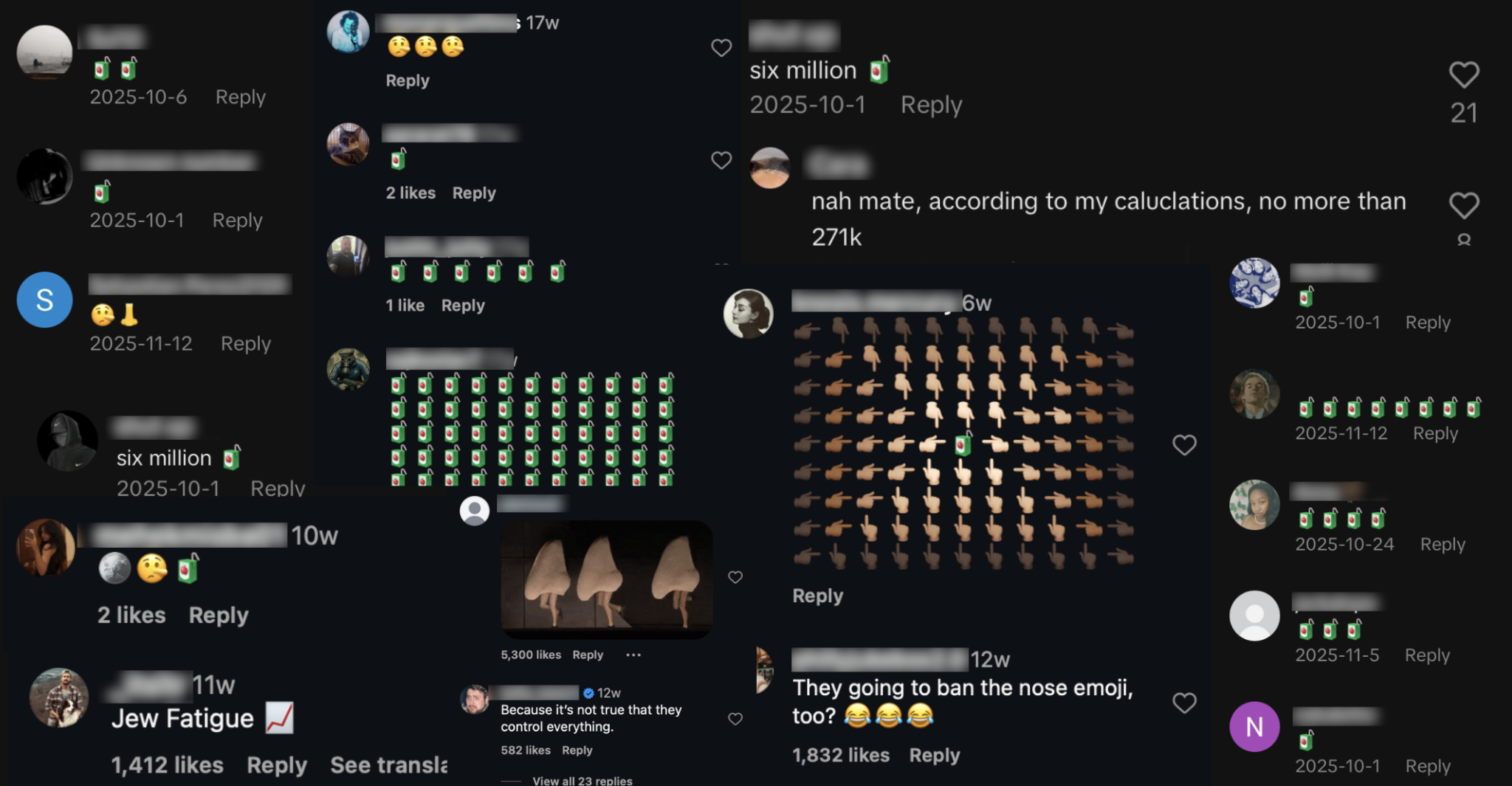
Internet trolls spamming 'juice box' emojis in a comment thread to bypass hate speech filters.
“Yeah, I control the weather. In fact, I’m feeling Thursday would be great for a storm.”
Admittedly, I’ve said versions of this sentence a few times to rescue myself from an uncomfortable conversation. I’ve joked about the “space lasers” and the “global banking cabal.” When you are a Jewish teenager in 2026, you learn quickly that the easiest way to survive the internet is to beat the trolls to the punchline. If I say it first, and if I make it absurd enough, I take the power away from them. I turn their hate into my comedy routine.
For a long time, I thought this was resilience. I thought I was winning.
But recently, I’ve started to wonder if I’m actually just providing the laugh track for my own alienation.
Should I laugh?
I found myself freezing up recently, looking at an Instagram account unaffiliated with my school. It’s a “meme” page followed by over 40 percent of the student body. In between jokes about bad cafeteria food and student couples, there was a post “joking” that various teachers were “controlled by AIPAC money” and were thus “evil.”
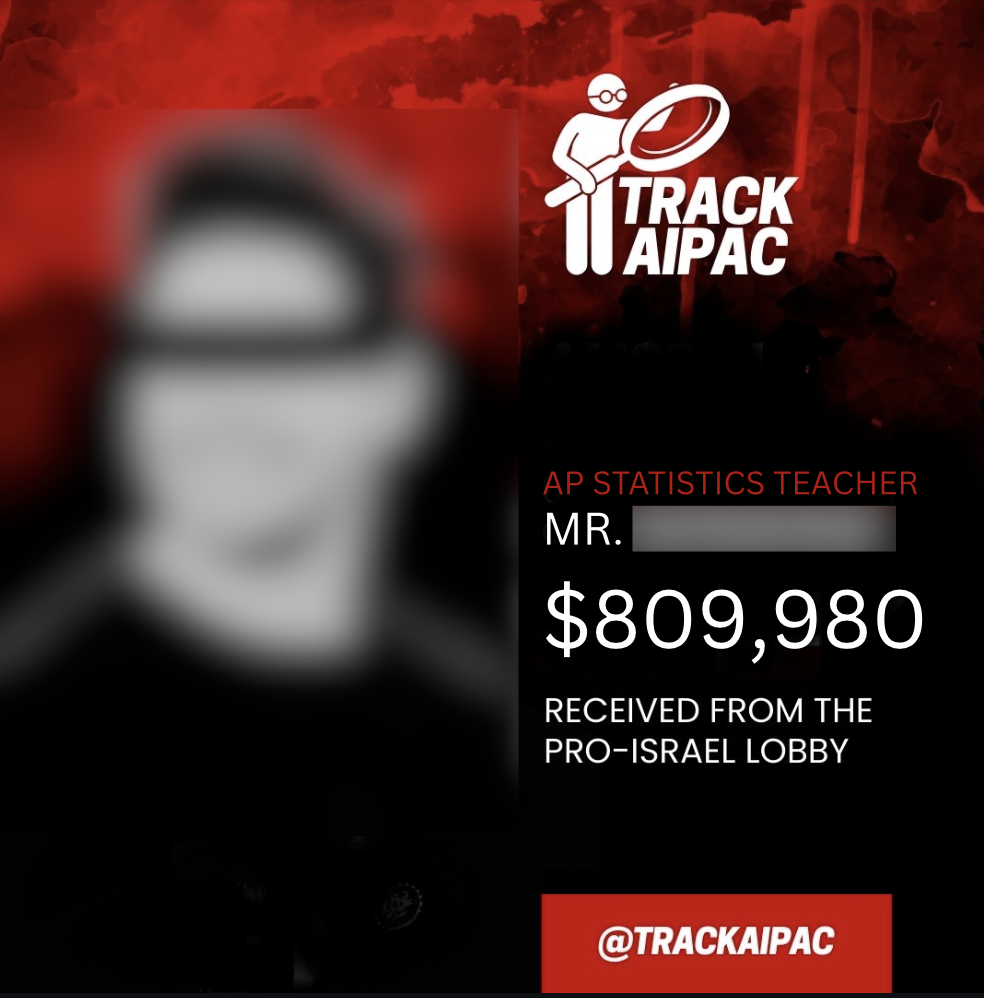
I stared at the screen and waited for the punchline. But there wasn’t one. This wasn’t a joke about space lasers. This was a specific, conspiratorial accusation against real people in my community, laundered through the format of a meme. And hundreds of my peers were double-tapping it. These are kids I sit next to in calculus and kids I will be graduating with.
It isn’t just that one account. It is everywhere. I will be scrolling on TikTok or Instagram, watching a video about literally any problem like inflation, the housing market, or a celebrity scandal, and I will check the comments section.
It is just rows of the apple juice box emoji:
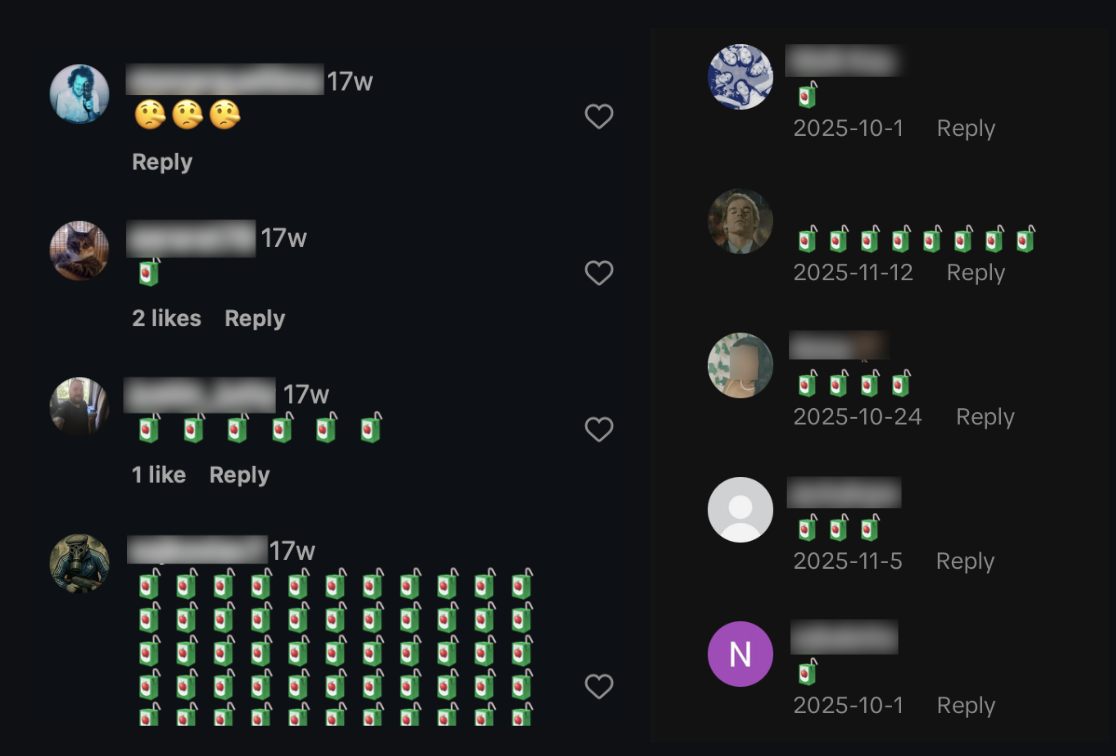
Get it? Because “juice” sounds like “Jews.”
It is a code. It is a wink. It is a way to say “The Jews are responsible for this” without triggering the content moderation filters. To my peers, it is just normal. It is funny. It is just an emoji, right? Why are you taking it so seriously?
But this normalization is exactly what terrifies me. We often look at history in black and white and imagine that the atrocities of the past appeared out of nowhere. But the rhetoric that led to genocide a few decades ago didn’t begin with violence. It started with jokes. It festered in cartoons found in newspapers and children’s books like The Poisonous Mushroom, where colorful illustrations taught a whole generation in the late 1930s that just as a toadstool can kill a family, a Jewish neighbor was a hidden danger waiting to poison the community. Casual comments in cafes followed, making the “othering” of Jews socially acceptable.
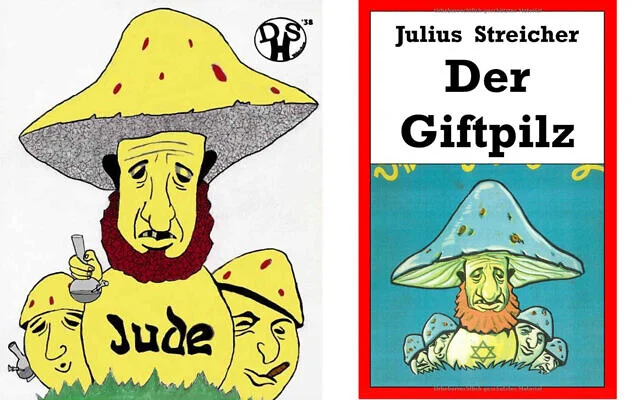
Eventually, this normalized the idea that one specific group was the root of every societal problem. When we reduce a group of people to an emoji punchline in a comment section, we aren’t being “edgy.” We are practicing the same dehumanization that happened in the 1930s. We are simply doing it with better WiFi. We are training ourselves to see a scapegoat instead of a human being.
This is the crisis of the Gen Z landscape. We are drowning in so much irony that we have lost the ability to recognize hate when it is staring us in the face. We have created a culture where nothing is serious, which means everything is permissible.
The data suggests that this digital diet is having real-world effects. Unlike previous generations, where antisemitic beliefs tended to fade as people got older and more educated, Gen Z is charting a different path.
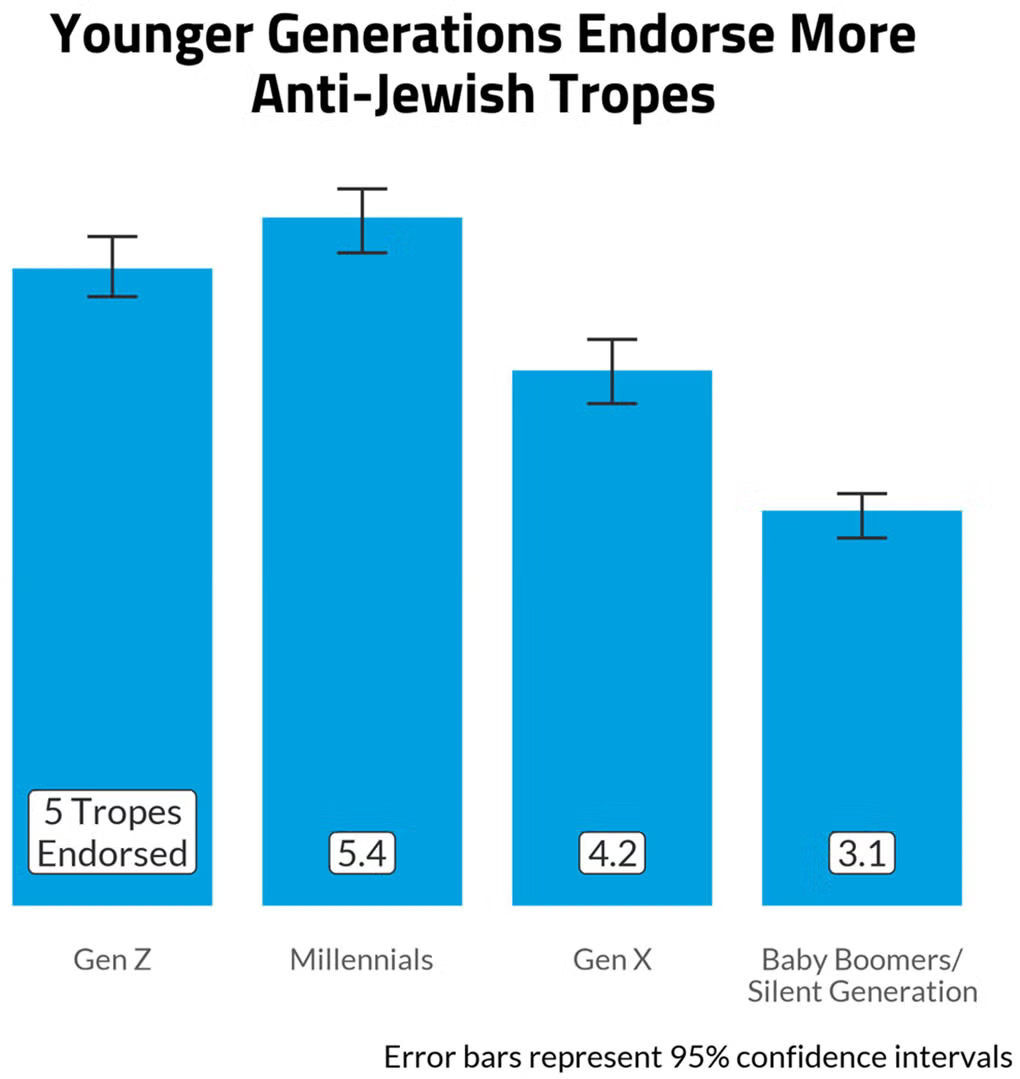
As the graph illustrates, recent ADL data shows a disturbing generational divide. While Baby Boomers and the Silent Generation endorse an average of only 3.1 anti-Jewish tropes, Gen Z respondents endorse 5. But the specifics are even more alarming. A poll by The Economist and YouGov found that 20% of adults aged 18-29 agree that “The Holocaust is a myth”. Compare that to Americans over 65, where the percentage who believe that conspiracy theory is zero.
We are also the generation most susceptible to tropes about control. The same poll found that 28% of young adults believe Jews have “too much power” in America, compared to just 6% of the older generation. We are statistically the most likely demographic to believe the lies our great-grandparents fought to destroy.
Why? Because we consume our worldview in 15-second bites. Antisemitism is the original conspiracy theory. It is a simple story for a complex world. Why is your life hard? Check the comment section: apple juice emoji. When that narrative is packaged in a deep-fried meme or a casual TikTok comment about a teacher, it bypasses our critical thinking filters. We laugh, we scroll, and subconsciously we absorb.
That is why I am conflicted. I don’t know where the meme ends, and the ideology begins. When I make a joke about “controlling the banks,” I know I am mocking the absurdity of the bigot. But when my classmates post juice boxes, are they mocking the bigot? Or are they becoming the bigot?
I fear that by embracing the tropes and laughing along to show we are “cool” and unbothered, we have given others permission to weaponize them. We have allowed the line to blur so much that when genuine hate speech appears on a student timeline, it looks just like another “shitpost.”
We need to look in the mirror.
We pride ourselves on being the generation of accountability, the ones who call out microaggressions, check our privilege, and demand social justice. We believe we are immune to propaganda because we know how to use the internet. We assume we are smarter than the generations before us who fell for hatred.
But the statistics prove we are failing.
We are sleepwalking into the same trap as our great-grandparents. We are letting an algorithm feed us the same lies that used to be printed on pamphlets. If we can’t scroll past a juice box emoji without recognizing the history of blood and violence behind it, then we aren’t “based” or “red-pilled” or “edgy.” We are just gullible.
We have to decide what our legacy will be. We can be the generation that finally breaks the cycle of hate. Or we can be the generation that memes it back into existence.
Right now, we are clicking “like” on our own destruction. And I am done reposting that notion.
Related Topics
Related Posts