Lawyer, Blogger, Jewish Advocate, Podcast Host
Spain 2025: A Journey Through History and Faith
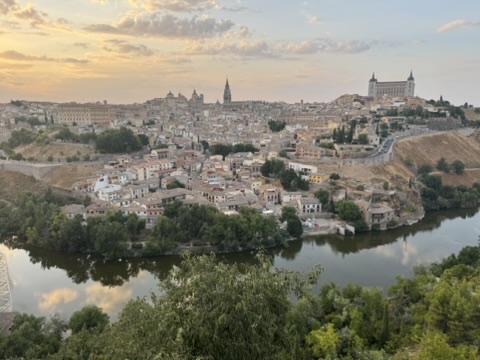
Toledo at sunset
Author’s Note
In August 2025, my wife and I traveled in Spain for our 10th Wedding Anniversary — from Madrid to Toledo, Córdoba, Sevilla, and finally a week in Mallorca. What began as a trip filled with hesitation — given the Spanish government’s current hostility toward Israel — became an encounter with the grandeur of Jewish history, the fragility of Jewish life across centuries, and the resilience of Jewish communities today. These are my reflections.
Chapter 1: Toledo — A Cradle of Civilization
Our trip to Spain began not with rest, but with immersion. After landing in Madrid, we drove straight to Toledo and immediately began a tour with Sonia, a Catholic woman whose knowledge and appreciation of Jewish history is both extraordinary and deeply heartfelt. For two and a half hours she guided us through Toledo’s winding streets and ancient synagogues, weaving together the Jewish story of this medieval city.
What struck us most immediately was the sheer antiquity of that story. Jews were present in Iberia long before the arrival of Romans, Visigoths, Christians, or Muslims. For over two thousand years, Jewish life has been part of the fabric of what is now modern Spain — and Toledo, like so many Spanish cities, was built on those ancestral foundations.
Toledo was not merely a city where Jews lived; it was a vibrant center of Jewish civilization. Scholars debated Torah and philosophy, poets and translators shaped European thought, and merchants helped knit together the cultures of the Mediterranean. Yet with rare exception, Jewish synagogues throughout Spain were required to be smaller than the smallest church — a constant reminder of Christian dominance and a way to enforce Jewish subordination within society.
That evening, we dined at a magnificent restaurant overlooking the Tagus River, the city glowing in the sunset. It was unforgettable — not only for its beauty, but for an encounter that reminded us of how precarious Jewish existence remains today.
At the next table sat a seemingly lovely couple from Bristol, UK. Our conversation flowed easily until they asked for our opinion of Donald Trump. When we noted that we did not share their hostility, they quickly made clear that one of their reasons for despising him was his support for Israel, which they insisted was committing genocide in Gaza. In an instant, their warmth shifted to hostility.
These were not radicals but ordinary, everyday people — yet wholly certain of Israel’s guilt. It was a jarring reminder that centuries-old blood libels have resurfaced in modern form, amplified by media and accepted by so many in the West. That first night in Spain, overlooking the beauty of Toledo, we felt the echo of history: how easily acceptance turns into accusation, how fragile belonging has always been.
Chapter 2: Córdoba — Rabbinic Brilliance
The next morning, we drove to Córdoba, where we met Gershon, a Moroccan Jew who has lived in Sevilla for twenty years. Energetic, wise, and deeply passionate, he brought Jewish Córdoba alive for us.
He led us through the Jewish quarter’s narrow whitewashed streets and into one of the oldest Sephardic synagogues in the world — a modest space that testifies to centuries of Jewish life. Córdoba was not only a hub of commerce and culture; it was the seat of great rabbinic scholarship. Giants like Maimonides studied and taught here, leaving a legacy that continues to shape Jewish law and thought today.
Chapter 3: Sevilla — Power, Precariousness, and the Layers of Conquest
The following day we joined Gershon again in Sevilla. He showed us how the Jewish quarter was not on the periphery but inside the royal district itself — evidence of the community’s closeness to the seat of Spanish power. Sevilla was less about rabbinic scholarship and more about political influence. Jews here were tied to the royal family and governance, positioned at the intersection of privilege and vulnerability.
Sevilla also reveals another layer of Jewish history: displacement through conquest. One of its original synagogues was converted first into a mosque under Islamic rule and later into part of the great Cathedral of Seville. That transformation underscores a painful truth — Jewish civilization was deeply rooted here, but with each new empire or religion that gained control, Jews were pushed aside, their sacred spaces overwritten.
Our guide reminded us that Jewish influence was always conditional. Jews were valued when useful, but easily scapegoated when convenient.
His reflections on the Inquisition were especially chilling. It was not only about religious persecution but also about systematically stripping Jews of their wealth. By coercing confessions, turning Jew against Jew, and confiscating assets, the Inquisition drained Jewish families of their fortunes.
At the same time, it was unimaginably cruel. Standing near the remnants of its prisons, one can almost hear the cries of those humiliated, tormented, and broken by torture. Even Jews who had converted to Christianity — the conversos — were never free of suspicion. Accused of secretly practicing Judaism, they endured ordeals that ended, all too often, in execution. Some were decapitated. Many more were burned at the stake, condemned by forced confessions extracted under unbearable torment. The Inquisition was not only an assault on wealth; it was a campaign of terror meant to annihilate dignity, faith, and life itself.
Chapter 4: Lessons of the Past, Mirrors of the Present
He also gave us a framework for understanding Jewish life under Islam, one that many Westerners overlook. Traditional Islamic society was divided into three classes: Muslims at the top, non-Muslims who paid the jizya tax (the dhimmis), and those outside the system altogether. Jews who paid the tax could live, work, and even prosper — but always as second-class citizens, never equals. That hierarchy helps explain both the flourishing and the fragility of Jewish life under Muslim rule.
Walking through Toledo, Córdoba, and Sevilla, we saw two truths at once. Spain was a cradle of Jewish civilization, producing towering contributions in philosophy, poetry, science, and rabbinic scholarship. Yet Jewish life here was always conditional, never secure. That duality — brilliance and precariousness — remains a sobering lens through which to view Jewish life today.
Just as synagogues in medieval Spain were forced to remain smaller than churches, Jewish flourishing has too often been circumscribed by invisible ceilings. And just as we felt the warmth of strangers at dinner in Toledo turn suddenly to hostility, so too do we see how quickly suspicion and accusation can take root in our own time.
Chapter 5: Why Spain Still Matters
We were, in truth, hesitant about coming to Spain at all. The Spanish government today is one of the loudest voices in Europe accusing Israel of genocide — an accusation we regard as a modern blood libel. We questioned whether it was right to bring our resources to a country that promotes such a stance. We wondered: why does the Jewish community even remain here? And should world Jewry continue to invest in small, precarious communities in hostile environments?
But what we learned is that this is our world. We are not guests here. Our ancestors lived, built, prayed, and dreamed in these very streets. To retreat because of hostility would be to cede ground that is rightfully ours. The lesson is not to cower, but to stand strong and proud as Jews everywhere.
This was made clear by Gershon, who inspired us deeply. He spoke of the thriving Jewish community in Barcelona today — Jews who live openly, proudly, and vibrantly. He reminded us that most ordinary Spaniards are not anti-Semitic; the hostility comes primarily from government policies, often driven by the political left. And he insisted that the Jewish presence in Spain is not only a remembrance of the past, but a statement of strength in the present.
Related Topics
Related Posts