


A Moroccan Journalist
Spain Condemns Israel While Occupying Moroccan Land
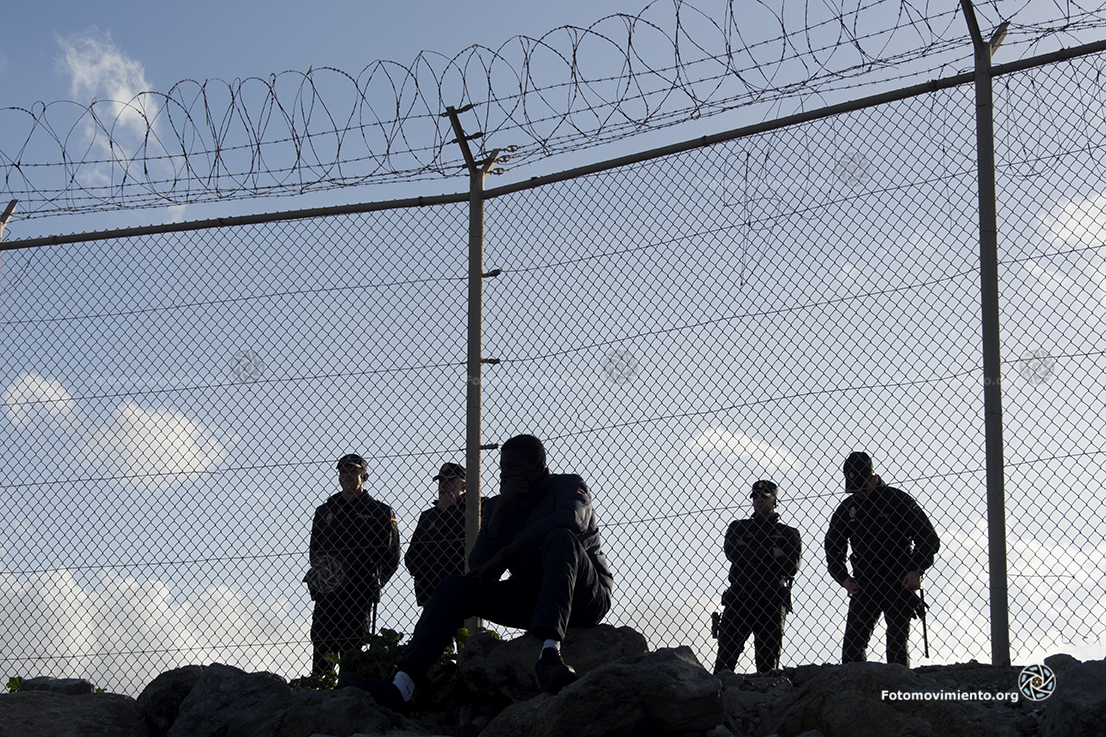
The separating fence between occupied Ceuta and Morocco, a steel scar across African soil, witnesses each year waves of desperate migration and tragedies at Europe’s gate. (Fotomovimiento/Flickr)
Spain today parades itself as a champion of Palestinian liberation, a voice of conscience in Europe, and a state that dares to lecture Israel on morality, sovereignty, and the rights of peoples under occupation. Prime Minister Pedro Sánchez’s government has recognized Palestine as a state, imposed a full arms embargo on Israel, canceled defense contracts with Israeli companies, banned refueling operations for Israeli aircraft in Spanish ports, and even called for Israel to be barred from international sporting events.
Madrid summoned its ambassador from Tel Aviv after Israeli sanctions on Spanish ministers, condemned “indiscriminate killings” in Gaza, and sought to make itself the spearhead of European outrage against Netanyahu’s war. On the surface, Spain looks like a small European power punching above its weight to defend human rights, waving the banner of anti-occupation politics at a time when others equivocate.
But scratch beneath the surface and the hypocrisy is staggering, for the very same Spain that sermonizes about occupation abroad clings stubbornly to its own colonial possessions in North Africa. Ceuta and Melilla, fortified enclaves on Moroccan soil, remain under the Spanish flag.
The Chafarinas Islands, Peñón de Vélez de la Gomera, Isla del Congreso, Isla del Rey, Isla de Isabel II, and even tiny Perejil Island, wrested back by Spanish commandos in 2002 after Moroccan soldiers briefly raised their own flag there, all continue to symbolize Madrid’s refusal to shed the vestiges of empire.
These Plazas de Soberanía (“territories of sovereignty”), as Madrid euphemistically calls them, are relics of empire: rocky fortresses, garrisoned by soldiers, symbolic outposts of Spain’s refusal to decolonize fully. Spain denounces Israel’s annexations in the West Bank while maintaining its own annexations on Africa’s Mediterranean coastline. It calls for decolonization in Palestine while perpetuating colonization in Morocco.
Justice abroad means nothing without justice nearby
The duplicity is not new. Spain’s presence in North Africa is not the residue of some benign historical arrangement, but the outcome of violent conquest, opportunistic treaties, and the cynical chess of European empires. Ceuta was seized in 1415 by Portugal and only transferred to Spain in the 17th century, while Melilla was captured in 1497 in the wake of Granada’s fall, its seizure justified by the language of “civilization” that European crowns wielded to cloak raw imperial domination.
These were never organic extensions of Iberian identity but garrison towns and bargaining chips in the scramble for Mediterranean influence. Madrid now insists that Ceuta and Melilla are “autonomous cities,” constitutionally equal to Madrid, Barcelona, or Seville. Yet geography betrays the lie: they are fenced-off enclaves on African soil, ringed with barbed wire, double fences, watchtowers, and EU-financed surveillance drones – Europe’s militarized southern border posts where African migrants are beaten back or left to drown.
To call them ordinary parts of Spain is to perpetuate a colonial fiction, one that United Nations principles on the inadmissibility of acquiring territory by force condemn just as clearly as Israel’s settlements. But where Madrid demands Israel comply with international law, it demands silence on its own case. This is not law – it is colonial exceptionalism dressed in democratic language.
The 2021 diplomatic crisis between Morocco and Spain cannot truly be resolved until Madrid confronts the corrosive role of its remaining colonies in Africa. That crisis began when Spain secretly admitted Polisario leader Brahim Ghali under a false identity for medical treatment, provoking one of the worst bilateral ruptures in decades: Rabat recalled its ambassador, froze political contacts, and allowed migratory pressure at the Ceuta border to explode in May 2021.
Trust collapsed entirely, and only after months of tension was dialogue restored in 2022, following Madrid’s recalibration of its position on Western Sahara. Yet while that tactical shift reopened channels, the underlying source of friction – Spain’s colonial hold over Ceuta, Melilla, and the surrounding islets – still festers. Until Madrid confronts that colonial residue, reconciliation will remain partial, fragile, and permanently vulnerable to collapse.
Far from being integral to Spain, Ceuta and Melilla historically carried second-rank status: open-air prisons, military installations, and dens of smuggling rather than cities of civic value. Spanish archives themselves reveal the fiction of permanence. The Lisbon Treaty of 1686 first gave nominal recognition, yet for centuries Madrid considered trading the enclaves to Britain in exchange for Gibraltar or abandoning them altogether. In 1811, the Cadiz Cortes even declared they were not Spanish territories and suggested their return to Morocco.
Only in 1913, in the fever of modern colonialism, did Spain elevate them to “territories of sovereignty,” and not until 1955 – on the eve of Morocco’s independence – were they granted full sovereignty under Madrid’s constitution. Even then, they remained under military administration. In other words, Spain’s claim of “five centuries of uninterrupted sovereignty” is not history but propaganda, a narrative concocted to disguise that the enclaves were for most of their existence bargaining chips and expendable outposts.
Meanwhile, their existence today is a drain on Morocco’s north. Ceuta and Melilla serve as illicit economic hubs: open gates for smuggling that undermine Morocco’s customs revenue by an estimated $1.5 billion annually. Bereft of agriculture or industry, they thrive only through contraband. They are, in practice, parasitic enclaves – artificial anomalies that sap development from Morocco’s periphery and fuel disorder instead of cooperation. When 8,000 migrants surged into Ceuta on May 17, 2021, it was a brutal reminder of the anachronistic status of these “autonomous cities” – relics of colonial occupation that create instability instead of stability.
Spain’s narratives collapse under their own contradictions. Madrid demands Britain return Gibraltar because it is a foreign enclave on Spanish soil, yet in the same breath refuses to apply that identical logic to Ceuta and Melilla. Spanish media shout about “territorial integrity” when Gibraltar is mentioned, but whisper “historical sovereignty” when Morocco raises its claims.
This double standard is not only diplomatic hypocrisy but a reflection of a deeper colonial mentality: what belongs to Europe must be returned, what belongs to Africa must be retained. In reality, Ceuta and Melilla were never regarded as central to Spain until the 20th-century’s colonial scramble. They were military strongholds, prisons for undesirables, bargaining tokens in imperial poker – and only in the age of decolonization did Madrid suddenly rediscover them as sacrosanct.
To claim today that Ceuta and Melilla are equal to Madrid or Barcelona is therefore to perpetuate a dangerous lie, one that international law cannot sustain. Morocco, independent since 1956, has never ceased to demand their restitution, regarding them as an unfinished business of decolonization.
If Spain truly believes in the international order it proclaims so loudly in Palestine, it must abandon its colonial exceptionalism in Africa. Until it does, its voice on occupation is hollow, its rhetoric on international law hypocritical, and its supposed solidarity with oppressed peoples nothing more than a mask for its own imperial residue.
The farce reached grotesque levels this month when Spain invited the NATO Parliamentary Assembly to meet in occupied Melilla. For the first time, a transatlantic security body deliberates inside an African city Spain insists is “European.” This is not about security. It was about staging a spectacle of sovereignty, using NATO to sanctify colonial presence.
Even NATO indirectly acknowledges this uncomfortable truth. Article 6 of the 1949 Washington Treaty does not cover overseas colonies and explicitly excludes territories in continental Africa. Ceuta and Melilla lie outside NATO’s defense umbrella not by accident, but because they are not legitimate Spanish territories. NATO knows it, Europe knows it, Spain knows it, and Morocco knows it.
Yet, Madrid’s maneuver tried to blur that line, embedding Melilla into the Atlantic alliance as if it were a natural part of Europe. For Morocco, the message was clear: Spain intends not just to occupy but to internationalize its occupation, to transform enclaves into fortified symbols of Western permanence on African shores.
It is the same arrogance that mobilized commandos for Perejil Island in 2002, the same arrogance that maintains garrisons on barren rocks, the same arrogance that once unleashed Franco’s Legionnaires with poison gas in the Rif. Colonialism evolves its language but not its essence.
To make matters worse, talk of a possible visit by King Felipe VI to Ceuta and Melilla has resurfaced. If realized, it would mark the first trip by a Spanish monarch to the enclaves since 2007. Far from being a gesture of unity, such a royal appearance would be seen in Morocco as a red line crossed – a direct challenge to Morocco’s sovereignty.
At the same time, Madrid preaches justice abroad. In May 2024, Spain formally recognized Palestine, alongside Ireland and Norway, presenting itself as the European conscience. It imposed a total embargo on arms sales to Israel and revoked defense licenses, including missile contracts with Rafael, Israel’s state arms manufacturer. Spanish ministers called for Israel’s exclusion from global sporting events, drawing headlines during La Vuelta when protesters disrupted races linked to Israeli sponsors.
Spain’s foreign minister warned Israel not to strike humanitarian flotillas sailing for Gaza, and Madrid voted consistently at the UN for resolutions condemning the war and affirming Palestinian statehood. This month, when Israel barred entry to Spanish ministers Sira Rego and Yolanda Díaz, Madrid escalated by recalling its ambassador. To the casual observer, Spain seems like a fearless moral actor, confronting Tel Aviv with a voice of principle. Yet for Morocco, and for any student of history, this is pure theater – selective morality wielded not for justice but for posturing.
Europe’s conscience ends where African soil begins
How can Spain condemn Israel for maintaining settlements in Palestinian land while it maintains European enclaves on African land? How can it denounce annexation when its own annexations date back half a millennium? How can it call Israel’s policies “indiscriminate” when its own border guards in Ceuta and Melilla have been filmed firing rubber bullets at drowning migrants, leaving dozens dead on beaches like Tarajal? Occupation by Israel is condemned; occupation by Spain is ignored. That is not morality – it is hypocrisy institutionalized.
The reason is geopolitics. Spain’s fervor on Palestine is not born of altruism; it is a projection of insecurity. Madrid is terrified of Morocco’s rise – its growing partnerships with Washington, Beijing, and the Gulf; its ascendance in renewable energy, phosphate dominance, automotive and aerospace industries; its modernization of military hardware with Turkish drones, Israeli systems, and American tanks. Morocco’s 21st-century trajectory threatens Spain’s old role as Mediterranean gatekeeper. By weaponizing Palestine, Spain seeks to cloak itself in moral leadership, hoping to obscure the colonial question it cannot answer at home. The louder Spain shouts about Gaza, the quieter it hopes the world will be about Ceuta and Melilla.
This can also be understood through the lens of history: Europe’s treatment of Jews, the evolution of Christian theology, and the interplay of politics and religion. Catholic Spain provides one of the starkest examples. In 1492, under Ferdinand and Isabella (the “Catholic Monarchs”), Spain issued the Edict of Expulsion (also called the Alhambra Decree), which forced Jews either to convert to Christianity or leave the Iberian Peninsula.
This was not merely social prejudice but institutionalized hostility: the Inquisition hounded “conversos” suspected of secretly practicing Judaism, Catholic orthodoxy after the Reconquista fused faith with national identity, and a belief in religious uniformity as essential to political unity shaped state policy. Thus, Catholic Spain turned antisemitism into doctrine and law, embedding it in its very definition of sovereignty.
More broadly, the Catholic Church across Europe carried anti-Judaic teachings for centuries, portraying Jews as guilty of Christ’s death and enforcing ghettos, expulsions, and restrictions from Italy to Portugal, from Spain to Poland-Lithuania. Pogroms and discrimination flourished not only in Catholic lands but also in Orthodox ones. To be clear, this hostility was not unique to Catholics. Protestants also generated antisemitism – Martin Luther himself wrote violently against Jews – yet from the 17th century onward, some Protestant traditions developed a new, paradoxical posture that would later shape modern geopolitics.
In Puritan England, Dutch Calvinism, and later American Evangelicalism, the Bible was re-interpreted to make the return of Jews to the Holy Land a prophetic necessity. This gave birth to Christian Zionism: the idea that Jewish restoration to Israel was a prerequisite for the Second Coming. In Protestant theology, Jews were still seen as needing salvation, but they were simultaneously cast as essential to God’s unfolding plan.
This produced currents of philosemitism in Protestant-majority societies like Britain and the United States. Britain, guided by such theological undercurrents, issued the Balfour Declaration in 1917, promising support for a “national home for the Jewish people” in Palestine. Today, US Evangelical churches stand as some of Israel’s most fervent global supporters – an enduring legacy of Protestant Christian Zionism.
The Catholic Church, by contrast, resisted this current. For centuries, its doctrine treated Jews as a wandering, exiled people – punishment for rejecting Christ. Only after the Holocaust and the Second Vatican Council’s Nostra Aetate (1965) did the Church formally repudiate the notion of collective Jewish guilt and open the door to Catholic-Jewish dialogue. Even then, Catholicism did not embrace Zionism in the same way Protestant traditions had.
Spain exemplifies this divergence. Its Catholic legacy is inseparable from the trauma of 1492, when Jewish life was extinguished from the Iberian Peninsula and only centuries later did Sephardic descendants begin to return. Even in modern times, Madrid’s belated 2015 law granting citizenship to Sephardic descendants was less a full reckoning than a symbolic gesture. Unlike Britain or the US, Spain never developed strong currents of Christian Zionism.
Its political culture – Catholic in heritage, anti-colonial in rhetoric after Franco, and tied historically to Mediterranean and Arab worlds – leans instinctively toward Palestinian solidarity rather than Zionist enthusiasm. That Catholic distance from Zionism, and the memory of enforced Jewish absence, help explain why Spanish discourse today often sympathizes with Palestinians, even as it denounces Israel with fervor not matched by equivalent recognition of its own colonial entanglements in Africa.
But history is merciless toward double standards. When Spain decries Netanyahu’s refusal to return to 1967 borders while clinging to its 1497 borders in Melilla, it exposes itself as a fraud. When it brandishes international law against Israeli occupation while violating the same principle in North Africa, it empties that law of meaning. When it accuses Israel of apartheid while building Europe’s southern wall around Ceuta, it reveals the hollowness of its rhetoric. Justice is not divisible. Liberation is not a menu one can apply selectively.
Either Spain believes in the principle that occupied lands must be returned to their rightful owners, or it does not. If it does, then the first step is obvious: Ceuta, Melilla, the Chafarinas, Vélez de la Gomera, Perejil – all must be decolonized, all must be restored to Morocco. If Spain refuses, then every word it utters about Palestine is theater, every statement about justice a mask for insecurity, every embargo and recognition a performance hiding its own colonial hand.
What truly shames me is seeing Moroccans gather every week in front of the parliament to protest for Gaza, holding up Spain as an example of a Christian country that “supports Palestine,” while ignoring that the very same Spain occupies Moroccan land just a few kilometers away – and all the while they denounce Arab and Muslim regimes for their silence on Palestine, yet remain blind to Madrid’s colonial hypocrisy on their own soil.
Spain cannot teach the world morality while holding African cities under European rule. It cannot wave the Palestinian flag while trampling on Moroccan sovereignty. It cannot demand Israel repent while refusing to confront its own history. If Madrid truly wishes to be a voice for justice, let it begin at home.
Let it end the colonial farce, abandon the Plazas de Soberanía, and recognize that the age of empire is over. Until then, Spain’s moral posturing will remain what it is: the hypocrisy of a state that condemns occupation abroad while sanctifying it in Africa, the duplicity of a European democracy still addicted to imperial arrogance, the hollowness of a conscience that applies justice selectively. Justice, after all, is universal – or it is nothing.