Russian-American-Israeli Palestinian. Palestine is Israel.
Sparks of Eternity
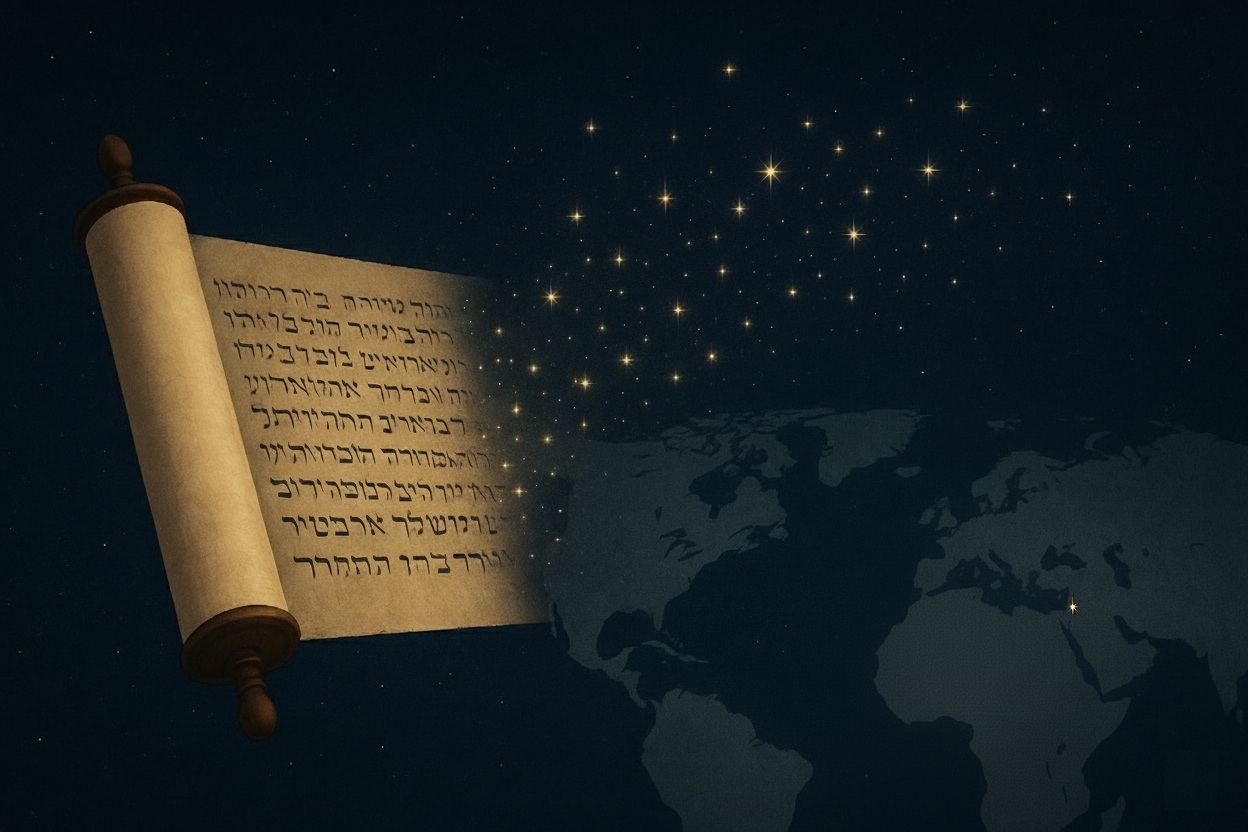
Sparks of Eternity: How Torah Secures Itself through Dispersion, Dissent, and Zera Israel. Image © Ivan Bassov, 2025. Licensed under CC BY 4.0.
How Torah Secures Itself through Diversification
Jewish survival is not an accident of history, nor merely the cleverness of a people adapting to hostile winds. It is a design. A design so vast it appears fractured, a plan so hidden it masquerades as chaos. What looks like weakness—dispersion, disagreement, even denial—may in truth be the very architecture of eternity.
For the Torah to endure, it requires vessels through which it can live and breathe. Its wisdom, its ethical commands, its story—none exist in a vacuum. The survival of the Jewish people is the condition for the Torah’s own persistence. Without the continuity of those who study, debate, and embody its teachings, the sparks of divine wisdom would have nowhere to ignite.
The Torah does not preserve itself in a single vessel. It scatters itself into many, as fire scatters into sparks. Some gather in Jerusalem, others in Brooklyn, and still others in lands even farther from Zion. Some spark as Zionists, convinced that the State of Israel is the vessel of redemption. Others spark as its deniers—Orthodox who reject its holiness, progressives who condemn its existence. To human eyes, this may look like betrayal. In the language of eternity, it is diversification: risk spread across the ages. If one branch falters, another—seemingly opposite—still bears the spark.
After centuries of scattering, the covenant needed a body again—a land, a language, a home. Israel is that body. It is the bold reconstitution of Jewish life in its ancient soil, the visible proof that the covenant has not been broken. Yet paradoxically, it is not entrusted with the whole. Were the endurance of the Torah dependent on Israel alone, it would be too fragile. Should Israel falter, Torah endures elsewhere. Should exile wither, Israel carries the spark. Neither alone suffices; together they form the ecology of eternity.
Even those who walk away are not truly lost. Zera Israel—the descendants of Jews who no longer fit the halakhic mold—may cease to be Jews in the present tense, yet they carry something indelible: a Jewish seed. That seed, hidden among other nations, will one day awaken in their descendants. A child will rise generations later, drawn back, reclaiming what seemed severed. This is not failure but foresight. It is Torah’s survival strategy written in the blood of exile: that even when a line seems broken, it is coiled, waiting to unfold at the appointed time.
And so, even the dissenters, even the apostates, even the seemingly lost are part of the equation. They safeguard the Torah in ways unseen—by existing outside as much as inside, by scattering as much as gathering. In the paradox of Jewish history, the faithful and the defiant alike are instruments of endurance.
Across centuries and continents, Jews have taken root in every land, among every people, yet remain bound by a covenant that transcends bloodlines. From Sephardim to Ashkenazim, from Ethiopian Jews to converts and descendants of mixed lineages, the Jewish soul persists, uniting diverse faces into a single spiritual people. Yet the covenant always points homeward—to Zion, to the land where it was first lived. This covenantal thread—not race, not territory, not empire—forms the true architecture of Jewish survival, ensuring that the Torah endures wherever its sparks may fall.
To see this is to glimpse hidden providence: Israel is the heart, exile the limbs, dissent the armor, Zera Israel the seeds buried deep. The Torah never entrusts itself to a single fate, a single ideology, a single land. It survives in dispersion because eternity itself is its dwelling place—beyond the reach of any enemy, beyond the limits of any moment.
Related Topics
Related Posts