Thinking about 'Resilient Zionism'
Standing at Sinai, Building in the Negev
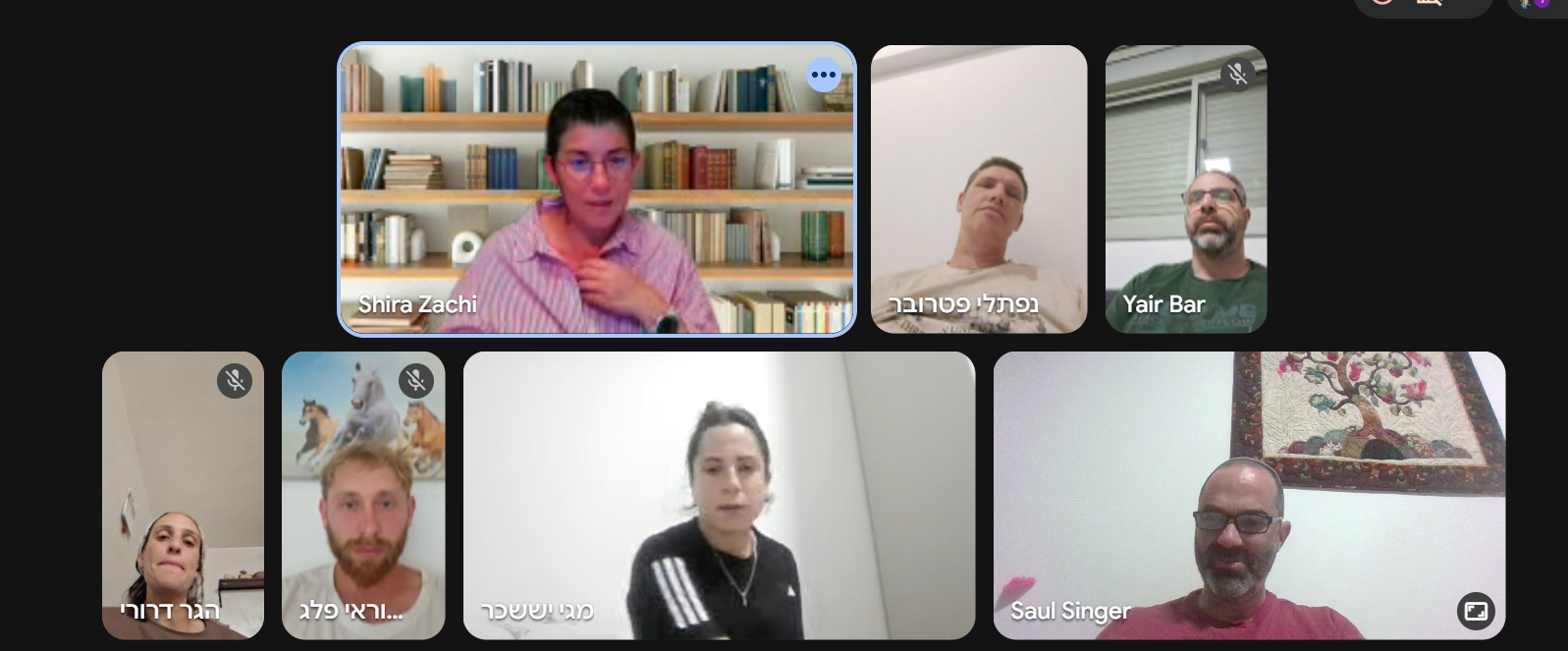
Recent virtual communal Beit Midrash session
Following my previous piece, “From Exodus to Leviticus: Community Building in the Negev”, I find myself continuing to reflect on a question that sits at the heart of the Yachad journey: before building a physical settlement, how do we build the inner world capable of sustaining a diverse community? As we approach the festival of Shavuot, I keep returning to this question.
In rabbinic tradition, Shavuot marks the receiving of the Torah. The Chassidic masters deepen this idea further. Torah is not something once given and then merely preserved. Revelation itself is ongoing. Each year, the giving of the Torah is renewed, and with it comes the possibility and the responsibility of renewing our covenantal relationship with it.
This idea feels deeply relevant to the stage our Yachad community currently finds itself in.
As our diverse group moves closer toward establishing a new physical community in the Negev, we increasingly realize that one of the most important things we are building is not physical at all. Beyond homes, roads, fields and infrastructure, we are trying to cultivate a shared language, a shared seriousness and a shared inner world rooted in Jewish identity and collective responsibility.
One of our earliest communal endeavors, therefore, has been the establishment of a Beit Midrash — a framework for learning together. But from the outset, it has become clear that this cannot simply become another learning program or lecture series. The aspiration is far deeper: to create a voluntary space for personal and communal intellectual and spiritual growth, and perhaps even more importantly, a space where communal dissonance can be held rather than prematurely resolved.
In today’s world, and perhaps especially in Israeli society, there is immense pressure to immediately categorize, define, react, and conclude. A genuine Beit Midrash requires something else. It requires the ability to remain inside complexity together. To listen before responding. To hold tension without immediately trying to collapse it into consensus. And to do all of this through the prism of our shared Jewish identity and legacy.
Over the last few months, I have often found myself imagining what it would look like if great personalities such as Abraham Isaac Kook, Ahad Ha’am, A.D. Gordon, the Admor Hechalutz and Viktor Frankl were to sit on our advisory board and guide us through the establishment of our Beit Midrash. What would they insist upon? What kinds of conversations would emerge? What kind of outcomes would they hope such a Beit Midrash would produce? The more I sit with these questions, the more I sense that our challenge is not only organizational, it is ideological, spiritual and deeply Zionist.
There is something fundamentally expansive about a Torah emerging from Jewish sovereignty and shared national life in Israel. Expansive not in the sense of lacking boundaries or seriousness, but expansive in its willingness to engage the fullness of life: society, labor, culture, psychology, nationhood, military service, responsibility and human complexity. In contrast, “Diaspora Torah” often developed under conditions of contraction: survival, preservation, defensiveness and necessary communal boundaries. That historical reality produced extraordinary depth, resilience, and spiritual creativity. But the return to our homeland creates the possibility — and perhaps even the demand — for a different spiritual posture. A Torah that does not retreat from life, but enters it. A Torah that sees agriculture, economics, military service, culture, and community-building not as distractions from spiritual life, but as expressions of it. A Torah that expands outward instead of narrowing inward.
This aspiration sits deeply within our Beit Midrash.
Ironically, our Beit Midrash currently exists almost entirely online. We have no shared streets, no casual encounters, no physical space where relationships naturally deepen over time. Instead, we meet digitally — through screens, scheduled calls, and fragmented routines. At first, this feels limiting. But over time, I have begun to understand that this format exposes something essential. The real challenge is not curriculum – It is trust.
In a diverse community, words such as “Shabbat,” “Torah,” “religious,” “secular,” and even “sovereignty” arrive carrying emotional histories and assumptions. Before shared learning can emerge, trust must emerge first. Trust to speak honestly, trust to listen seriously, trust to remain present even when conversations become uncomfortable. This, too, is part of “Resilient Zionism”. Month after month, conversation after conversation, something slowly begins to form — not only ideas, but relationships; not only learning, but the foundations of communal life itself.
And maybe this points toward one of the deepest characteristics of Torat Eretz Yisrael: its contradictory dynamism. A Torah that emerges from renewed Jewish life in Israel cannot remain static or one-dimensional. It lives specifically within tensions — the dance between old and new, sacred and profane, tradition and creativity, rootedness and openness, particularism and universality. This tension is not a flaw to overcome. It is the engine itself.
As Shavuot approaches, I find myself returning to the image of standing at Sinai. The nation that stood there were not yet fully formed. They were still learning how to become a people. They had left Egypt, but they had not yet built a society. They were on the way to a land, but they first had to receive a covenant capable of shaping what life in that land would mean.
Before the homes are built, before the roads are paved, before the Negev becomes our shared physical address, we are trying to build the covenantal language that will allow us to live there together. Maybe that is what receiving Torah anew means in our generation. Not only preserving what was given, but renewing our capacity to carry it.