


A peripatetic scribbler
Standing on the shoulders of giants
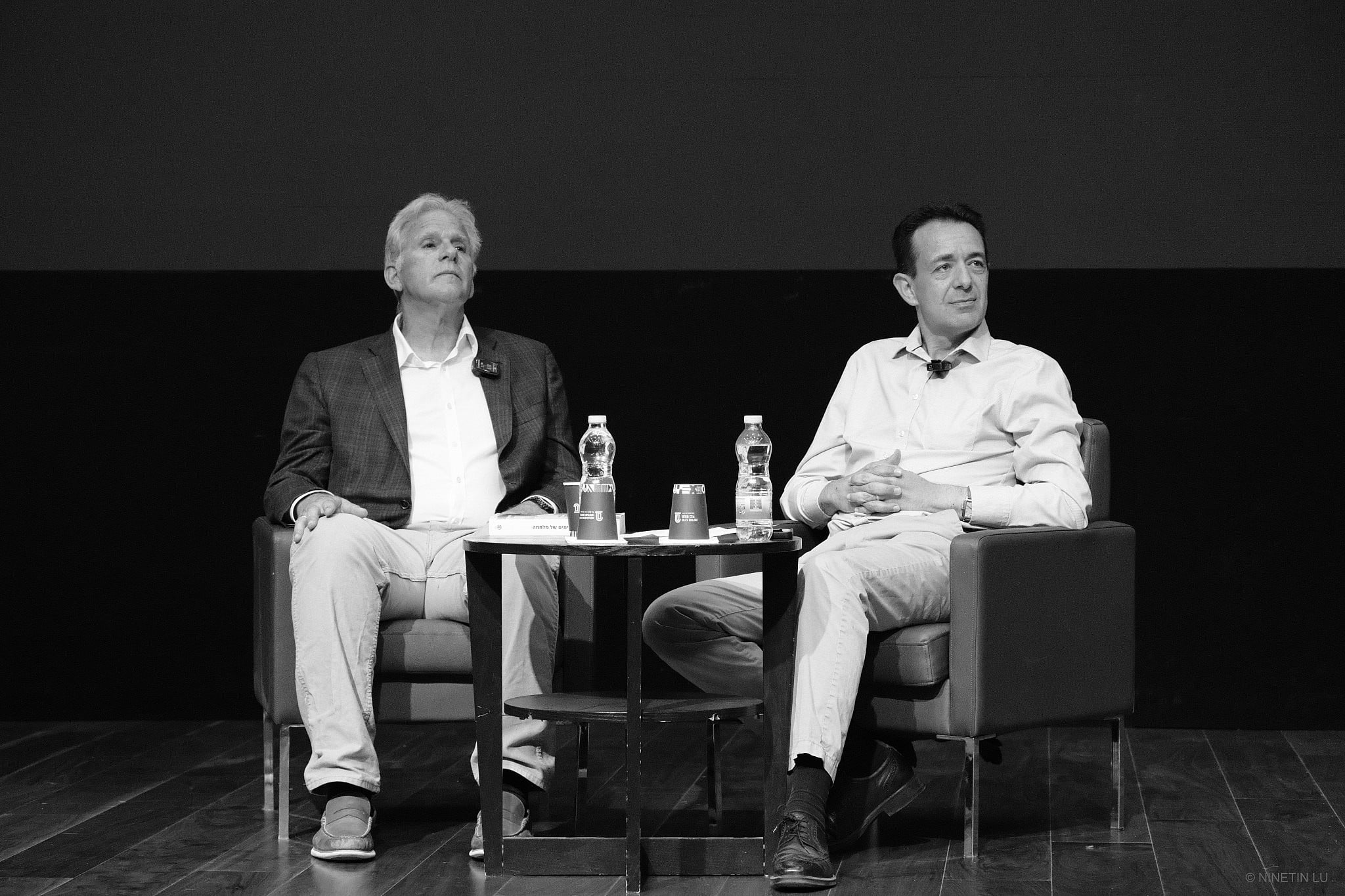
Michael Oren (left) discusses Levi Eshkol with Paul Gross at the Begin Center (Photo by Ninetin Lu)
Generally, when I tell people that I am going to the Begin Center, they pull a face like a campus activist who has just found out his hummus was made in Israel. Heedless of this disapprobation, I have been attending “The Buck Stops Here”, the Center’s program of English language talks on Israel’s past prime ministers.
It is generally assumed, because of the venue, that the events will be “right-wing”. To me, however, the lectures point to the truth of Menachem Begin’s view that left and right are anachronistic terms, based as they are on the seating arrangements of the French National assembly of the 1790s.
Hertzi Markov, the quondam president of the Begin Center, alluded to this point while discussing the curious fact that it was Begin – the revisionist – who opposed many aspects of the Martial Law which socialist Mapai imposed on Israel’s Arab population prior to 1966.
The series is co-organised with the Prime Minister’s Office, but the events are not politically partisan. Rather, they have a competitive feel, with each speaker advocating his candidate for top PM. Michael Oren, author of the definitive history of the Six-Day War, began his talk on Levi Eshkol by describing him as one of the unsung heroes of Israeli history and its greatest prime minister. Incidentally, Oren claims this opinion is shared by Benjamin Netanyahu. I feel like the series should really end with a vote, where the audience gets to definitively decide who was Israel’s Best PM.
The speakers tend to focus on episodes of Israeli history which are, perhaps, receding in the collective memory. In these accounts, one is constantly astounded by Israel’s extraordinary achievements. Dan Meridor, Yitzak Shamir’s justice minister, spoke of Shamir’s management of the 1990s Aliyah. In just a few years, close to nine hundred thousand Jews emigrated to Israel from the former Soviet Union, which amounted to around 15% of the country’s population at the time.
The talks don’t just focus on their subject’s time as premier, the speakers also home in on their earlier achievements. Meron Medzini, the director of Golda Meir’s press office, tells us that Golda’s major contribution to Israel was the social legislation she enacted during her time as Minister of Labor. Medzini also shares his belief that Golda’s own experiences of poverty provided the impetus for her social security policies.
Shimon Peres’ political opponents apparently didn’t allow him to forget that he was never a soldier. Nonetheless Michael Bar-Zohar, Peres’ friend and biographer, credits him as the arch-administrator who built the IDF during the war of independence.
The speakers have been exceptional, and their stories are genuinely captivating. Bar-Zohar‘s account of the chicanery Peres employed to acquire Israel’s nuclear reactor has one spluttering in awe and disbelief at his audacity. Peres arrived in Paris just as, presumably in some fit of Gallic impetuosity, the French were overthrowing their government. Peres couldn’t get an interview with the premier, Maurice Bourgès-Maunoury, until the morning after his ouster. However, the indomitable rascal managed to convince Bourgès-Maunoury to antedate his signature authorizing the sale to the day before.
The speakers are generally political insiders. Most knew and worked with their PM, some were friends. Medzini first met Golda when he was a two years old, his mother and her being great friends. This produces some gossip, for example Bar-Zohar’s account of Peres’ marriage. But generally, what one gets is a much deeper understanding of these titans of Israeli history, and the challenges of office. Nothing illustrates this better than Medzini’s account of Golda’s response to a holocaust survivor who was obligated to play the German National anthem for a visiting dignitary.
It was also interesting to learn that both Golda and Eshkol had cancer and were receiving clandestine treatment for it during their premierships.
These insider accounts illuminate what was going on behind the scenes. Itamar Rabinovich, Yitzak Rabin’s ambassador to Washington and his chief Syria negotiator, explains how Secretary of State Warren Christopher foozled the prospects of a Syrian-Israeli peace settlement, and how this led to Rabin’s pursuit of the Oslo process.
Sometimes the speakers leave out the bad bits. Bar-Zohar deliberately avoided all discussion of the 1956 Suez War, and Markov doesn’t spend much time on the First Lebanon War. It will be interesting to hear what Schlomo Brom says about this in his talk on Ariel Sharon this coming Sunday.
While the talks tend to the hagiographic, this isn’t invariably the case. Rabinovich, a personal friend of Rabin’s, repeatedly corroborates the notorious “break their bones” quotation from the first intifada. Rabinovich is keen to dispel the image of Rabin, presumably arising from the manner of his death, as a peacenik. The title of Rabinovich’s biography of Rabin, Soldier, Leader, Statesman, alludes to Rabin’s hawkishness on defence.
Political rivalries weave their way through the weeks: Ben-Gurion-Begin; Peres-Rabin; Golda-Aban. Medzini tells us how Golda emasculated Abba Eban when he was her foreign secretary by bypassing him in diplomatic relations with Nixon. Getting even in his own inimitable manner, Eban, who himself had a lexicon of 37000 words, once said of Golda “She has a vocabulary of 500 words, why does she only use 300 of them?”
Meridor also recounted an anecdote from 1986, when Shamir asked him to sound out Rabin on the prospects of Peres going along with the agreed-upon rotation of the Government of National Unity. Rabin replied to Meridor by saying, “Dan, what do you think? Whom do I prefer as Prime Minister, Peres or Shamir? Don’t Worry.”
I, for one, greatly appreciate the moderator, Paul Gross’s censure at the start of each event, when he austerely instructs the auditorium to “turn your phones off”. A command which is invariably ignored. Unfortunately, the audience doesn’t generally do justice to the quality of the speakers. Their questions tend to be predictable and cliched. Which contemporary politician is most like this week’s PM? (the answer to which question is, of course, “none”). What would Begin’s position on Haredi conscription be? What would Peres think about October 7th? Would Shamir have been good on social media?
Perhaps I am just bitter that I am never called upon to ask my questions. My wife tells me it is my own fault because I only ever raise my hand in a lacklustre, British way.
The series is almost at an end. The last talk on Sharon will take place this coming Sunday. For those Jerusalemites howling that of all sad words of tongue or pen, The saddest are these: ‘It might have been!’, there is some consolation. All the past lectures are available on YouTube. Also, a follow up series on Israel’s presidents is about to begin this coming September.
I have found something profoundly compelling about these seven wise old men, and one wise old woman. The word which has recurred in my mind over the weeks is depth: depth of character; depth of conviction; depth of belief; depth of struggle; depth of pain… Israel should be proud of its pantheon, irrespective of political persuasion.