


Mathematics Teaching Professor, Author
Standing Strong: The Remarkable Story of Atlanta’s Historic Temple
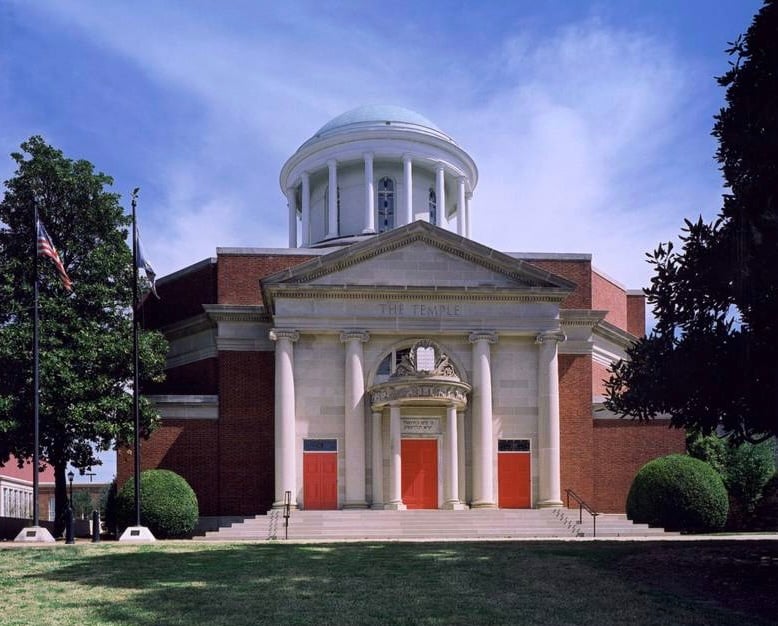
The Temple, Atlanta Georgia (Source: The Temple, Atlanta Georgia)
The Temple, a Reform Jewish congregation located in Midtown Atlanta, is one of the most historic institutions in American Judaism. Founded in 1867, it is Atlanta’s oldest and most diverse synagogue, serving as a cornerstone of Jewish life in the region for more than 150 years. Recognized by Newsweek in 2009 as one of the nation’s most vibrant and dynamic Jewish congregations, The Temple has long been dedicated to expanding access to meaningful Jewish experiences while championing social justice and community engagement.
Today, with more than 4,000 members, The Temple offers a thriving educational program and one of Atlanta’s most respected early learning centers. Its diverse and inclusive community welcomes people from all backgrounds, including multi-generational members, newcomers to Atlanta, interfaith families, Jews of Color, LGBTQ+ individuals, and those with physical or learning differences. United by a shared commitment to faith, learning, and belonging, members of The Temple find a welcoming spiritual home where every story is valued.
I would like to thank the esteemed Kelli Harran, Director of Engagement & Communications, for her support of this article.
Synagogue
Since 1931, The Temple has been located at its current home on Peachtree Street in Midtown Atlanta. The building was designed by renowned 20th-century Atlanta architect Philip Trammell Shutze, whose work has left a lasting mark on the city’s architectural landscape. Reflecting both elegance and historical significance, The Temple’s Sanctuary is recognized as one of Shutze’s notable achievements. Such was his influence on Atlanta’s built environment that many of his structures, including The Temple, have been listed on the National Register of Historic Places, preserving their cultural and architectural legacy for future generations.
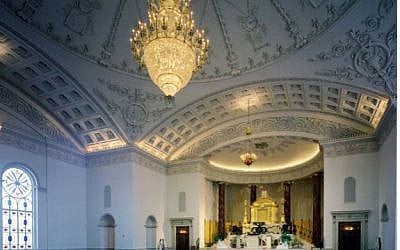
The Temple’s sanctuary was designed by architect Philip Trammell Shutze and modeled after King Solomon’s Temple in Jerusalem. Its layout reflects the journey from the outer courts to the Holy of Holies, represented today by the raised bimah and the golden ark that houses the Torah scrolls. Throughout the sanctuary, Jewish symbols enrich the space, including friezes depicting the Twelve Tribes of Israel, seasonal carvings, and decorative medallions featuring David’s harp, the chuppah, the priestly blessing, the eternal light, and tefillin. These elements blend Jewish tradition, history, and spirituality into a distinctive and meaningful place of worship.
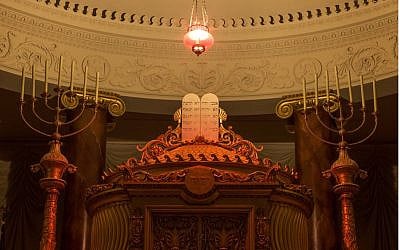
Directly above the pulpit hangs the Ner Tamid, the eternal light that symbolizes God’s enduring presence. This historic lamp was originally displayed in The Temple’s first building, while the chain that suspends it comes from the congregation’s second home. The Ner Tamid is supported by an American Eagle, a unique feature that represents the religious freedom guaranteed by the laws and ideals of the United States.
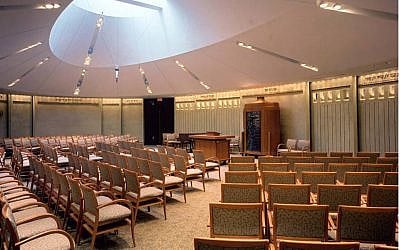
The Temple’s campus has expanded several times since opening in 1931. A major renovation completed in 2004 added the Covenant Chapel, designed by Stanley Daniels. Inspired by the tents of the Israelites in the desert, the chapel features a curved ceiling, a skylight-powered Ner Tamid, and flexible seating arrangements, making it a popular venue for worship services, weddings, and life-cycle celebrations.
Also completed in 2004, Schwartz-Goldstein Hall is a 7,000-square-foot ballroom and social hall that can accommodate up to 450 guests. With movable walls, a permanent dance floor, modern presentation technology, a spacious two-story lobby, and a historic courtyard, it serves as a versatile venue for weddings, receptions, luncheons, and community events.
Religious Events
The Temple fosters Jewish spirituality through an inclusive and welcoming approach to worship. Congregants gather for Shabbat services each Friday evening and Saturday morning, with additional chapel services, family programs, and special celebrations throughout the year. The synagogue also provides meaningful opportunities to observe Jewish holy days, including Rosh Hashanah, Yom Kippur, Passover, and Chanukah, supporting Jewish life, learning, and community for all ages.
Culture
Music is central to Jewish prayer and worship at The Temple, where liturgy and song work together to deepen spiritual experience. Under the leadership of Cantor Tracey Scher, the congregation offers a rich and diverse musical tradition that includes choir participation, instrumental accompaniment, and congregational singing. Rooted in ancient practice dating back to the Temple in Jerusalem, music has long been used in Judaism to support prayer, aid memory, and express devotion.
Today, that tradition continues with instruments such as piano, organ, and guitar used in services, alongside The Temple’s renowned Aeolian-Skinner pipe organ. Originally installed in 1930 and later redesigned by G. Donald Harrison, the organ was restored and rededicated in 2012 and is capable of conveying everything from the sound of the shofar to moments of reflection, celebration, and solemnity.
The Temple offers first-class educational programs designed to support lifelong Jewish learning. These include the Weinberg Early Learning Center for infants through pre-K, a warm and inclusive environment that uses play-based learning to introduce Jewish values while fostering confidence and respect in a diverse community.
The Breman Education Center provides a fully inclusive youth education program and is the only accredited religious school in Atlanta, while robust adult education opportunities extend learning across all ages. Together, these programs reflect The Temple’s commitment to nurturing Jewish knowledge, identity, and pride throughout every stage of life.
Community
At The Temple, meaning and purpose are found through relationship with one another, with Jewish tradition, with the wider Jewish community, and with God. Community life ranges from large gatherings such as the MLK Shabbat with over 1,500 participants to small groups of 8–12 people, where members share opportunities to learn, grow, reflect, and connect.
Programs such as Age & Stage initiatives, Interfaith Family Programs, New Member Programs, Temple Connect small groups, Temple Mosaic, and travel opportunities help deepen engagement across all stages of life. A strong commitment to social justice is central to this mission, rooted in the Jewish value of tikkun olam, or repairing the world. Through the Rothschild Social Justice Institute, members are encouraged to actively participate in efforts that advance justice, compassion, and community responsibility.
Historical Background
In 1845, during the presidency of James K. Polk and an era shaped by Manifest Destiny and rapid westward expansion, the settlement that would become Atlanta was still a young railroad terminus transitioning into a growing frontier town. On December 26, 1845, Marthasville was officially renamed Atlanta, reflecting its emerging role as a key transportation hub in Georgia.
That same year, the first Jewish residents arrived in the city, including German immigrants Jacob Haas and Henry Levi. This small but pioneering community quickly became part of Atlanta’s commercial development; by 1850, Jewish merchants owned roughly 10 percent of the city’s stores, primarily in retail, dry goods, and clothing. In 1860, the community organized the Hebrew Benevolent Society to secure burial grounds at Oakland Cemetery, marking an early commitment to communal support and continuity.
Although Jews had lived in Atlanta since the city’s earliest days and played an important role in its commercial development, they remained a small minority; in 1850, only twenty-six Jews lived in the city, making up about one percent of the population. Their numbers doubled by the start of the Civil War, leading to the creation of a loosely organized communal structure that would eventually formalize into a congregation.
Which brings us to 1867.
The Hebrew Benevolent Congregation, now known as The Temple, was established in 1867 as Atlanta’s first official Jewish institution. It grew directly out of the Hebrew Benevolent Society, formed in 1860 to secure a burial ground and provide assistance to the Jewish poor. That year, 1867, Reverend Isaac Leeser presided over the city’s first Jewish wedding and encouraged those present to form a congregation, which received its charter that same year. The Temple went on to build its first permanent worship space in 1875 and later relocated several times, reflecting the city’s growth.
In its early decades, the congregation shifted between Reform and more traditional practices until the arrival of Rabbi David Marx in 1895, which brought greater stability and helped shape its long-term identity. Rabbi Marx came to The Temple at just 23 years old and would go on to serve for 51 years, until shortly after World War II. During his long tenure, he guided the congregation further into classical Reform Judaism, helping establish The Temple as a leading member of the Union for Reform Judaism. His leadership eased earlier tensions between traditionalists and reformers while also fostering a careful balance between Atlanta’s Jewish community and the broader gentile population.
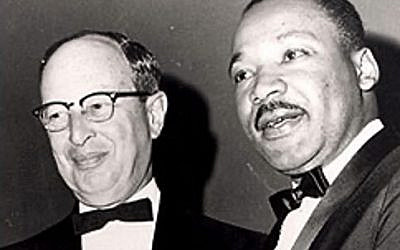
Rabbi Jacob Rothschild succeeded Rabbi David Marx in 1946 and led The Temple into a new era of civic engagement and moral leadership. While he maintained aspects of his predecessor’s outreach to Atlanta’s Christian community, he was notably more outspoken in his commitment to social justice, often speaking out even when it provoked controversy.
Over time, he developed a close friendship with Dr. Martin Luther King Jr., reflecting a shared dedication to civil rights and equality. In 1964, Rabbi Rothschild helped organize a banquet honoring King after he received the Nobel Peace Prize. Following King’s assassination, he delivered the eulogy at a memorial service organized by Atlanta’s interfaith clergy, marking a defining moment in both the city’s and The Temple’s history.
It was The Temple and the Bombing That Shook Atlanta. The climate of moderation at The Temple was shattered on October 12, 1958, when white supremacists targeted the synagogue in retaliation for its outspoken support of civil rights. A group calling itself the “Confederate Underground” placed fifty sticks of dynamite near the Temple’s north entrance, causing nearly $100,000 in damage but, fortunately, no injuries or deaths.
The attack was widely understood as a response to the activism of Senior Rabbi Jacob Rothschild, who had been a consistent voice against segregation and in support of racial equality since the beginning of his tenure. Rather than silencing the congregation, however, the bombing ultimately strengthened its commitment to justice and deepened its resolve to stand for equality for all people.
In the modern era, The Temple has continued to evolve while maintaining its deep commitment to Jewish life, education, and social justice. After Rabbi Jacob Rothschild’s sudden death in 1973, Rabbi Alvin Sugarman served as senior rabbi for more than three decades, leading the congregation through a period of significant growth in both The Temple and the broader Atlanta Jewish community. During this time, the metro Atlanta Jewish population expanded dramatically, and The Temple strengthened its role in civic and communal life, including the establishment of the Zaban Paradies Center in 1985 to provide shelter for homeless couples.
A major renovation and expansion completed in 2004 restored the sanctuary and enhanced the campus, coinciding with the launch of the Weinberg Early Learning Center to support Jewish education from early childhood onward. Today, under the leadership of Senior Rabbi Peter S. Berg, The Temple continues its legacy of growth, learning, and social justice while honoring its historic traditions and sacred artifacts, including a rescued Torah scroll from the Pinkas Synagogue in Prague.
Nowadays, The Temple stands as both a historic landmark and a living, evolving community at the heart of Atlanta’s Jewish life. From its 19th-century origins to its present-day leadership, it has remained grounded in worship, education, and an enduring commitment to social justice. Its story reflects resilience through challenge, growth through change, and a consistent dedication to inclusion and spiritual meaning. As it moves forward under current leadership, The Temple continues to honor its past while shaping a future rooted in faith, community, and the ongoing pursuit of justice and understanding for all.
Contact Information:
The Temple, 1589 Peachtree St., Atlanta, GA 30309
Phone: 404-873-1731
Email: kharran@the-temple.org
Website: www.the-temple.org