Staying Is a Decision Too— Aliyah at Seventy
I have been thinking a lot about history lately. That is not unusual for me. I have been a student of history all my life. I do not mean that I have a degree hanging on a wall. I mean I read it, I follow it, I argue with it. I go backward and forward through it trying to understand why people did what they did, what they saw, what they missed and, most of all, when they knew it was time to act.
Since I announced that I am leaving Montreal and making Aliyah, people have asked me why now.
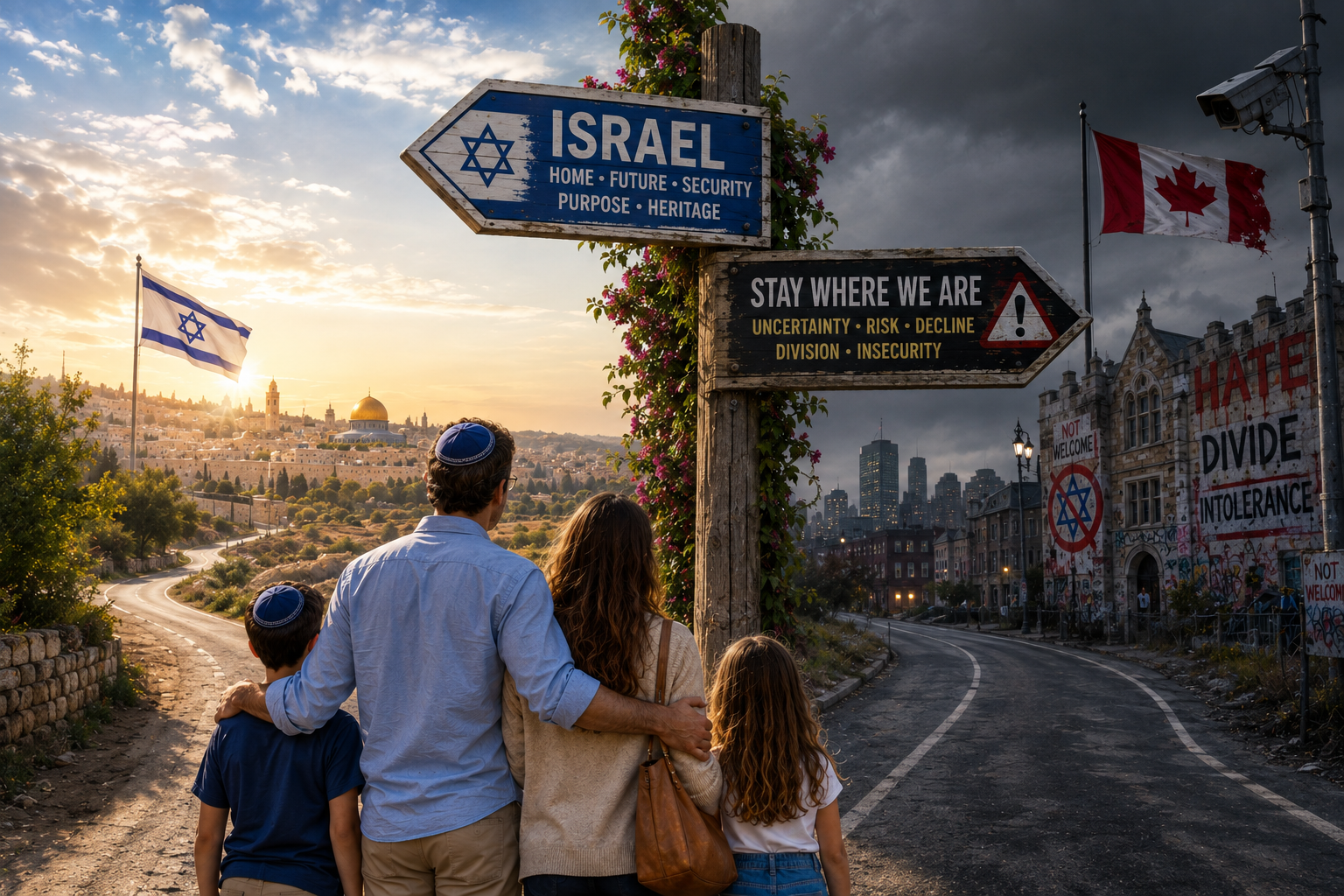
My answer is that there is no single “now.” There are a hundred little things. There is what I see around me and what I hear from other Jews. There is the feeling that something has changed in Canada, and particularly in the way many Jews experience public life here. There is Israel. There is my age. There is the knowledge that if I keep waiting for the perfect moment, I may eventually discover that I waited for the rest of my life.
And there is history.
My father was born in Canada in 1916. My mother was born here in 1923.
Think about those dates. My parents belonged to a generation of Canadian Jews who could look across the Atlantic and watch Europe change in ways that, at first, must have seemed almost impossible. On my mother’s side, the family had come out of the world of Eastern Europe — the Pale, Vienna, the upheavals surrounding the end of the Russian Empire and the years that followed. The stories handed down to me were not stories about catastrophe. They were stories about decisions made before catastrophe fully revealed itself: children sent away, education obtained, lives redirected, people separated by ships, borders and timing.
Some of those details blur across generations. I have learned enough as a researcher to distinguish between what a family remembers and what a document can prove. But the larger truth does not blur. Somebody left. Somebody got on a train or a ship. Somebody decided that the place called home might no longer be the safest place to remain. And because somebody moved, I am here to write this.
People did not wake up one morning and discover that the world they knew had disappeared. It happened piece by piece. That is the lesson that stays with me: the most important decisions are rarely made after everybody agrees that the danger has arrived. By then, the decision is often no longer yours to make.
Let me be careful here. I am not saying that Canada in 2026 is Germany in 1933. It is not, and I am not predicting anything of the kind. Anyone who tells you with certainty what a country will look like ten years from now is selling something.
What I am saying is much simpler. History does not have to repeat itself before we are allowed to learn from it.
Jews have a peculiar relationship with the word “wait.” Wait and see. It will calm down. The election will change things. The universities will settle down.
Maybe. I hope so. I sincerely hope Canada becomes more comfortable for Jews, not less. I have lived my life here. I want the country to do well.
But here is the question I keep asking myself: how long am I required to wait in order to prove that I did not leave too early?
There is an assumption buried inside many conversations about Aliyah — that staying requires no explanation while leaving requires a courtroom brief. If I stay in Montreal, nobody asks me to prove that Canada will be safe, prosperous and welcoming ten years from now. But if I say I am going to Israel, suddenly I am expected to establish beyond reasonable doubt that leaving is necessary.
Why?
Staying is a decision too. It carries risks too.
At seventy, time itself is part of my calculation. I do not have another thirty years to watch events unfold and then decide what I should have done at seventy.
That history is Ashkenazi history, and it is my history. But one of the things I am learning through conversations about Aliyah is that Jewish historical memory is not one story. I have Sephardi and Mizrahi friends whose families carry completely different memories: Jewish communities that existed for generations across North Africa and the Middle East, and lives that changed dramatically in the twentieth century. Their road to Israel was not my grandparents’ road.
Yet when we sit together in Montreal in 2026 and talk about where Jews belong, where our children and grandchildren will be secure, and what “home” actually means, the roads begin to meet. Different history. Same question.
I do not want fear to be the reason I make Aliyah. That distinction matters to me. If I were simply running away, I could find somewhere easier than Israel. Israel is not an escape hatch from history. Israel is sitting in the middle of history.
I am going because I want the remaining part of my life to be there. I want Hebrew around me even when I do not understand enough of it. I want the Jewish calendar to be the calendar outside my front door, not merely the calendar I carry inside my house. I want to argue with Israelis about Israel while standing in Israel. I want to be part of the place rather than watching it from Montreal.
But I would be lying if I said that what is happening around Jews in the Diaspora plays no role in my decision. Of course it does. When Jewish institutions require more security, I notice. When public rhetoric that once would have shocked people becomes ordinary background noise, I notice. And when friends tell me privately that they are uncomfortable and then immediately qualify what they have just said, I notice that too.
Noticing is not panic. It is noticing.
This is where my study of history has brought me. The lesson is not that every unpleasant development becomes a catastrophe. It does not. The lesson is that human beings are remarkably good at normalizing each new thing. Yesterday’s unacceptable becomes today’s irritating and tomorrow’s normal. Then something else happens, and we adjust again.
I do not know where that process leads in Canada. Neither do the optimists. Neither do the pessimists. That uncertainty is exactly the point.
For most of Jewish history, Jews had to make calculations about countries controlled by somebody else. Sometimes they calculated correctly. Sometimes they did not. Sometimes they had somewhere to go. Sometimes they did not.
We live in the first period in two thousand years in which there is a sovereign Jewish country capable of saying: come home. That changes the calculation.
For me, the question is no longer whether things are bad enough that I have to leave. I think that is the wrong question. The question is this: if I know where I ultimately want to be, what exactly am I waiting for?
One hundred and ten years since my father was born in this country. One hundred and three since my mother was. Canada gave my family a life for which I am grateful. I can be grateful and still leave. Those ideas are not enemies.
Countries change. People change. And sometimes home changes too.
I am not telling another Canadian Jew when to leave. I am certainly not telling anyone that my calculation must become theirs. I am saying that we should stop treating the decision to remain as though it is neutral and the decision to leave as though it requires an emergency.
You do not have to wait for an emergency to choose your future.
You do not have to wait until everybody else sees what you see.
And you do not have to wait until history repeats itself.