


"Violence can be justifiable, but it will never be legitimate." — Hannah Arendt
Still the Same Ship
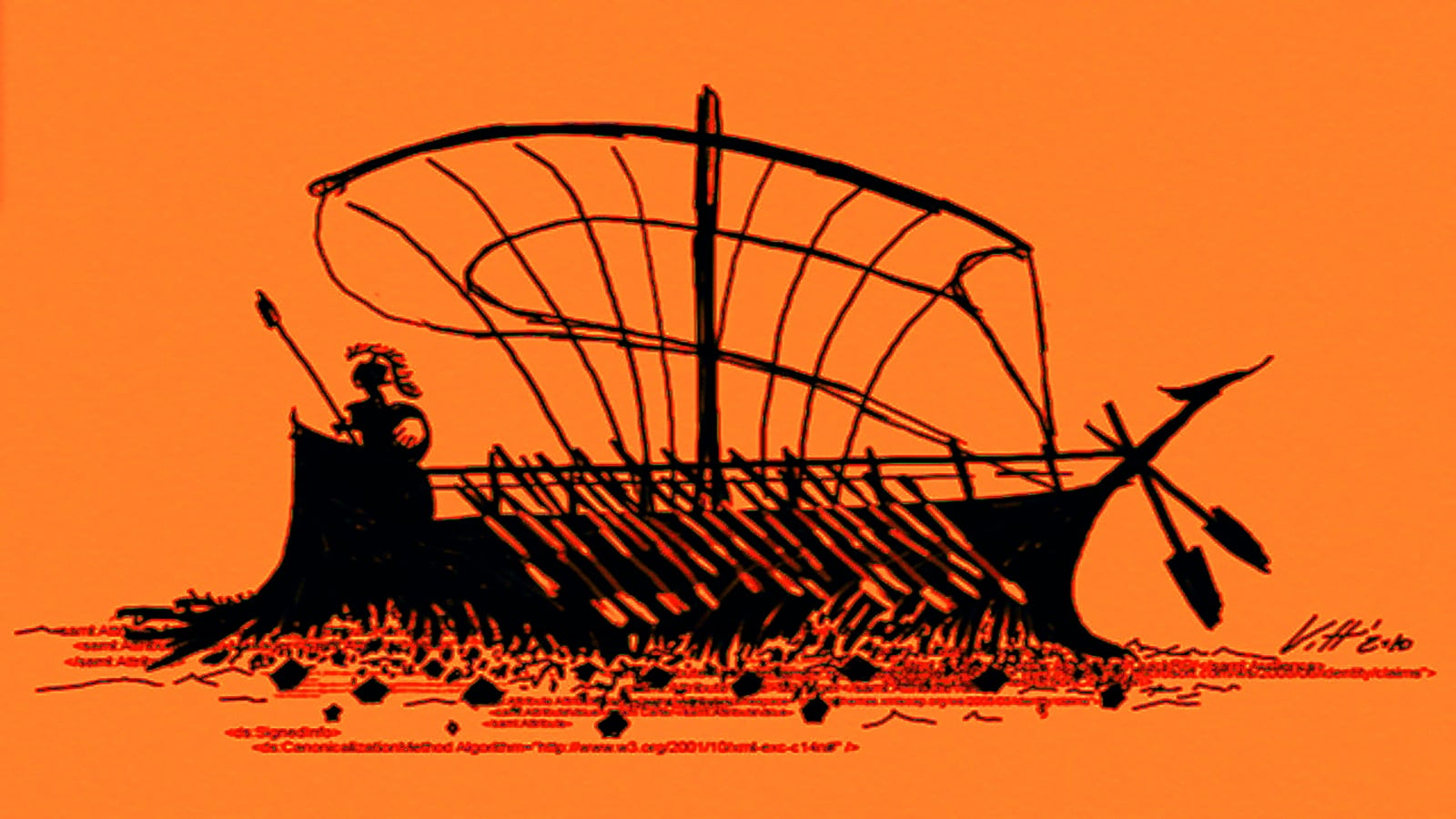
Theseus was the hero the Athenians claimed as their founder, the one who sailed to Crete, killed the Minotaur deep in the labyrinth, and came home alive to spare his city the tribute of blood it owed the island. In his memory they kept the ship that had carried him back, and they kept it alive. Every year they sent it out again, on a sacred crossing to Delos, and one by one they replaced the planks as they rotted, so that it never lost its readiness to sail, until, over the decades, not a single piece of the original timber remained in the hull.
It was Plutarch, late in the first century, who first set down the question, old already in his own day and still asked in ours, of whether that ship was any longer the ship of Theseus. Much later Thomas Hobbes, the seventeenth-century English philosopher who spent his life brooding on what holds a thing, or a whole commonwealth, together, made the puzzle crueler still, imagining that someone had gathered the rotten planks left on the quay and out of them raised a second ship, leaving two hulls to claim the same name, the one rebuilt from the old wood and the one that had never left the water. Hobbes did not solve the riddle. To my mind, that ship went on being the ship of Theseus, through all the wood it lost and replaced, because each generation kept it ready for the voyage that gave it meaning, and it was that duty of returning to the sea, met season after season, that kept it the same.
So it is with us as well. Those who signed our independence, in 1948, handed us a ship fresh from the shipyard, and with it a charter that was, above all, a promise of coexistence, the map of a nation with room for everyone who lived here. It is that promise that decides whether we are still the same country. We can replace every plank of the hull, change our majority and our era, and go on being Israel as long as the pact of living together still stands. On the day it breaks, recovering the oldest wood is worth nothing, for what is lost then is the very dream that gave the ship its reason for being, and a ship with no reason for being is nothing but timber afloat.
The version told by those in charge today presents itself as that of the authentic hull, every plank supposedly faithful to the first design, a vessel they would gladly keep moored forever, gleaming and motionless, with fewer and fewer people allowed to set foot aboard. A nation proves its own name on the open sea, taking on water and being mended, carrying aboard everyone who belongs to it, including the very ones the captains would sleep easier without. The dream of 1948 was, from the moment it was signed, a crossing handed down from one generation to the next, on the course the founders charted in their own hand and asked us never to abandon, the pledge that the State of Israel will be based on freedom, justice, and peace as envisaged by the prophets of Israel, and will ensure complete equality of social and political rights to all its inhabitants, irrespective of religion, race, or sex. Those same men can recite that pledge on cue and still spend their days prying loose the very planks it is written on, having persuaded themselves that a ship is best loved when it is kept flawless and all but empty, a kind of taxidermy performed on a country while it is still, just barely, alive.