London based entrepreneur, cybersecurity analyst doing a PhD in AI
Stop Whining… it literally weakens your brain.
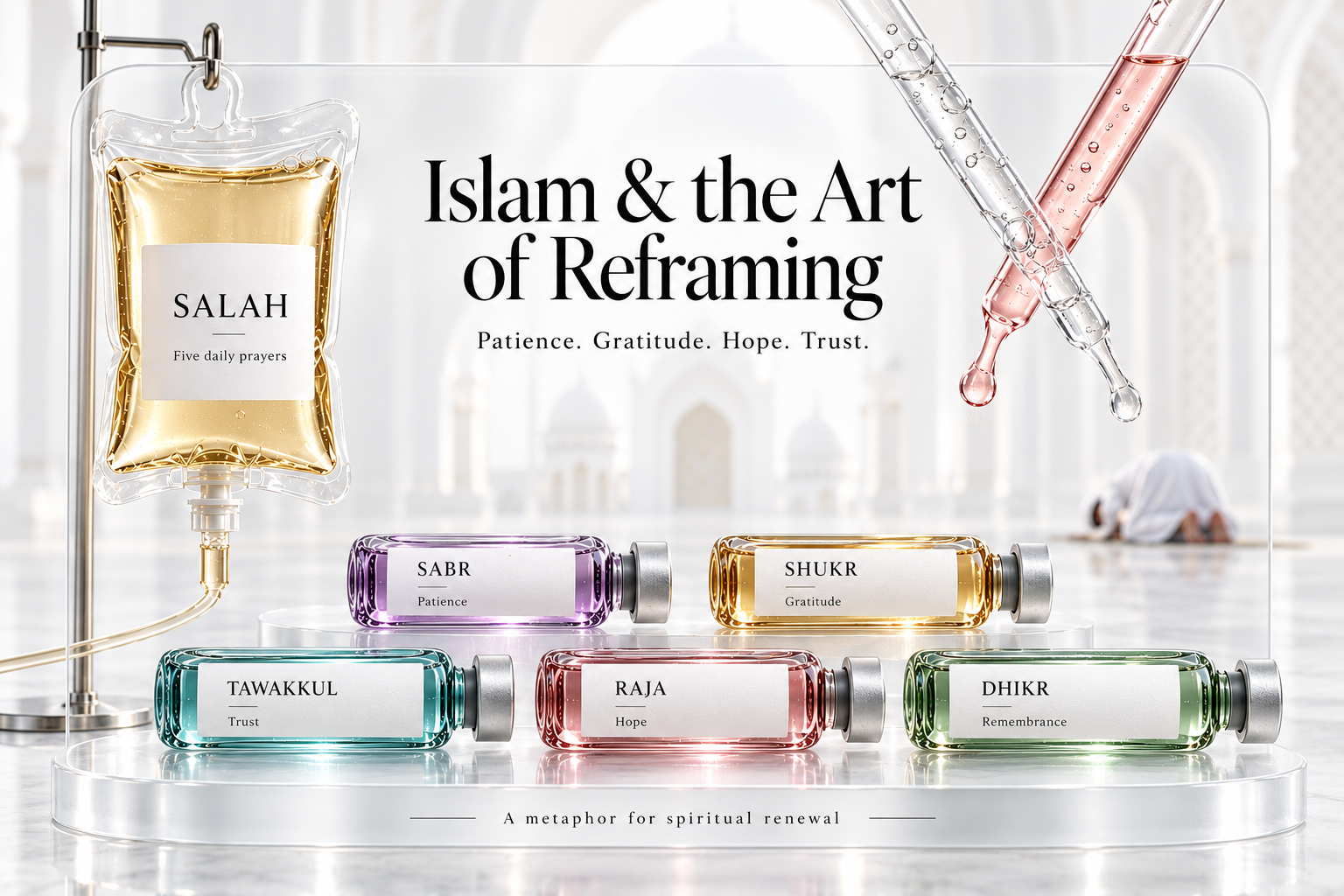
How repetitive negative thinking affects the body—and where psychology, neuroscience and Islamic faith meet.
A difficult conversation ends. In your mind, it continues.
The argument can end while the stress continues
Psychologists distinguish reflection from rumination. Reflection can identify a problem and lead towards understanding or action. Rumination returns to distress, its causes and consequences without necessarily resolving anything. A complaint may express either process; its negative wording alone tells us very little.
Cristina Ottaviani and colleagues’ 2016 systematic review and meta-analysis examined cognition, including worry and rumination. Across experimental and correlational studies, it was associated with higher heart rate and cortisol and lower heart-rate variability. Experimental studies also found higher blood pressure.[17]
The relevance is concrete: stress responses can be sustained by mentally revisiting events, not only by encountering them. These are average findings across studies, however, not evidence that every complaint raises every person’s cortisol. Cortisol is also a necessary hormone, not a substance that becomes harmful merely because it rises.
A separate meta-analysis of repetitive negative thinking and cognitive control found a modest association with difficulty discarding no-longer-relevant material from working memory.[18] It did not establish a general collapse of intelligence or prove that complaining caused the difficulty. The relationship can run in more than one direction: difficulty disengaging may sustain rumination, while persistent negative material can occupy attention.
What warrants concern is the loop: a distressing interpretation stays active, repeatedly directing attention back to the same threat, humiliation or failure. “Why does everything always happen to me?” can occupy the time in which “What would help now?” might have produced a useful step.
What Seligman helps us see
Martin Seligman’s positive psychology asks what enables people to flourish, alongside the task of understanding and treating suffering. His PERMA framework identifies positive emotion, engagement, relationships, meaning and accomplishment.[1]
Religion can involve all five. Worship structures attention. Community supplies relationships. Service gives effort a purpose. Gratitude notices what remains valuable. A larger account of life can keep one disappointment from becoming a verdict on existence.
This is an interpretive comparison, not proof that religious observance automatically produces well-being. Kenneth Pargament’s work distinguishes positive religious coping from patterns of religious struggle, including feelings of abandonment or punishment by God.[4] Religion can support coping, but particular interpretations and communities can also intensify fear or distress.
The useful question is not merely whether someone believes. It is what that belief leads them to rehearse, expect and do.
Step 1: Label the negative emotion
Begin with an accurate sentence: “I feel hurt by that comment.” “I am afraid about the money.” “I feel ashamed about my mistake.” Name the emotion without turning it into a verdict about your identity or future.
Psychologists call this affect labelling. In Matthew Lieberman and colleagues’ 2007 fMRI experiment, labelling emotional images was associated with reduced amygdala responses and increased activity in the right ventrolateral prefrontal cortex, compared with other encoding conditions.[28] This was a laboratory task involving emotional stimuli; it did not directly test prayer or every form of everyday self-labelling.
Does naming an emotion reduce pain? If “pain” means emotional distress, these studies support a qualified claim that labelling can help regulate aspects of the response. They did not establish physical pain relief: neither was an analgesia trial. “Naming a feeling can help regulate emotional reactivity” is better supported here than “labelling negative emotions reduces physical pain.”
The Islamic parallel is permission to acknowledge distress before Allah. Jacob names his anguish in Qur’an 12:86. Job acknowledges affliction in 21:83. Neither has to pretend to feel cheerful before turning towards God.[22,25]
Step 2: Reframe without falsifying reality
Psychology calls changing an event’s interpretation cognitive reappraisal. James Gross and Oliver John found associations between habitual reappraisal and more favourable emotional, interpersonal and well-being outcomes.[8] Reappraisal is not necessarily pretending that an event was good; it can mean revising an exaggerated or incomplete conclusion about it.
“I have failed at this task” need not become “my whole life is worthless.” “I cannot control this outcome” need not become “nothing I do matters.”
Qur’an 64:11 connects adversity, belief and the heart: calamity occurs by Allah’s permission, and He guides the heart of the believer. Ibn Kathir explains this in terms of recognising divine decree and responding with patience and trust.[9]
The event may remain painful. What changes is its place within a person’s understanding of life.
Qur’an 57:22–23 similarly relates divine decree to avoiding overwhelming attachment to what is lost and boastfulness over what is received. Read alongside the Prophet’s grief, this cannot reasonably be made a prohibition on ordinary sadness. It challenges the domination of identity by either loss or success.
The practical religious interpretation becomes: I am responsible for my response, even where I cannot command the outcome.
Jason Buhle and colleagues’ meta-analysis of 48 neuroimaging studies found that cognitive reappraisal consistently recruited regions involved in cognitive control and meaning processing, while modulating activity in the amygdala. Most studies examined reducing negative emotion.[21]
This is evidence that interpreting a situation differently can alter its emotional processing. It is not evidence that the amygdala is simply a “bad feelings centre”, nor proof that a particular prayer changes a particular brain region. The studies did not test Islamic theology.
The connection is functional: psychology investigates how interpretations influence emotion; religion supplies beliefs through which people interpret experience. That overlap deserves examination without pretending the two disciplines answer identical questions.
For a Muslim, Allah’s knowledge means that unseen effort is not overlooked. His mercy means that wrongdoing need not close the future to repentance. His justice means that present impunity is not the final judgement. These convictions can change what a setback means without changing the facts of what happened.
Step 3: Cultivate gratitude, hope and steadiness
The other side of the evidence matters. Positive experiences are not merely decorative additions to an otherwise biological life.
In experiments reported by Barbara Fredrickson and Robert Levenson, positive-emotion films following a fear-inducing film were associated with faster cardiovascular recovery. Subsequent experiments using a stressful speech-preparation task found that films eliciting amusement or contentment produced faster recovery than neutral or sad films.[19]
These studies measured physiological recovery, not simply whether participants said they felt better. Their scope is nevertheless specific: laboratory recovery from induced stress. They do not show that cheerfulness prevents all disease, or that someone can laugh away unsafe circumstances.
Bethany Kok and colleagues’ 2013 randomised study of a loving-kindness meditation intervention reported a pathway linking increased positive emotions, perceived social connection and changes in a measure of cardiac vagal tone.[20] That measure reflects aspects of autonomic regulation; it is not a complete health score. Randomisation strengthens conclusions about the intervention, but does not make every proposed link in the pathway experimentally proven.
Together, these findings support a careful proposition: patterns of emotion and appraisal can have measurable bodily correlates and, in some experiments, measurable physiological effects. “Negative thoughts damage you; positive thoughts heal you” is too crude. Fear may protect us. Anger may reveal injustice. Sadness may accompany love. The question is how these states are understood, regulated and allowed to change.
Robert Emmons and Michael McCullough’s experiments found that gratitude exercises improved several, though not all, measured outcomes; the most consistent benefit concerned positive affect.[2] Seligman and colleagues also tested exercises such as recording things that went well, finding sustained benefits for some interventions.[3]
This provides evidence for deliberate practice, rather than a demand to feel grateful on command. The religious parallel is shukr: recognising a blessing and responding appropriately to it.
Qur’an 34:13 calls David’s family to work gratefully. Gratitude becomes something we do. A person who receives a promotion can thank those who helped, treat colleagues fairly and use the additional income generously. Achievement is understood as a responsibility as well as a success.
During hardship, gratitude need not mean being grateful for mistreatment. It may mean recognising the friend who listened, the ability to seek help or the opportunity to take another step. Acknowledging what remains good does not acquit whoever caused harm.
The psychological and religious ideas meet in widening attention. A painful event is real; it need not become the only fact allowed into our account of life.
In Sahih Muslim 2999, the Prophet Muhammad ﷺ describes the believer’s good response to differing circumstances: gratitude in prosperity and patience in adversity.[10] The good lies in the response; injustice itself is not thereby made good.
Ṣabr involves steadfastness. Qur’an 2:155–157 explicitly names fear, hunger and loss before commending the patient. It recognises suffering before asking how to meet it.
Psychologically, the relevant comparison is the ability to experience distress without letting it dictate every action. Religiously, patience may involve refusing dishonest retaliation, maintaining responsibilities and continuing to seek a lawful solution. It can include leaving danger, requesting support and pursuing justice.
Consider an unfair criticism at work. Endless mental replay may keep the insult active. A patient response might involve recording the facts, considering whether any part is useful, arranging a calm discussion and escalating the matter when necessary. The situation has not been pronounced acceptable. The response has become more deliberate.
C. R. Snyder’s model describes hope through agency—the determination to pursue goals—and pathways, the perceived routes towards them.[11] Hope, in this account, includes finding a way forward.
The Qur’anic story of Jacob makes an illuminating comparison. In 12:86 he expresses his grief to Allah. In the next verse, he tells his sons to search for Joseph and his brother and not despair of Allah’s relief. Sorrow, hope and practical action coexist.
Likewise, Qur’an 39:53 warns against despair of Allah’s mercy, and 39:54 calls people to return to Him. Hope does not remove responsibility; it makes return conceivable.
Tawakkul, trust in Allah, also belongs beside effort. Sahih Muslim 2664 joins pursuing what benefits us, seeking Allah’s help and resisting helplessness, before addressing our response to an outcome already experienced.[12]
Step 4: Visualise the next responsible response
The mind can rehearse a catastrophe before it happens. It can also rehearse a constructive response.
Brain imaging by Giorgio Ganis and colleagues found substantial, but incomplete, overlap between the networks engaged by visual imagery and visual perception.[30] Imagining is therefore an active mental process, but the brain does not simply treat every imagined event as real. Experiments by Emily Holmes and colleagues also found that imagining positive scenarios produced greater increases in positive mood than processing the material verbally.[31] These findings concern specific tasks and outcomes, not a guarantee that visualisation will improve health or make an event happen.
The useful question is what to rehearse. Lien Pham and Shelley Taylor found that students who mentally simulated the process of preparing for an examination studied more and obtained better grades; improved planning and reduced anxiety helped explain the benefit.[32] Rehearsing the steps can be more useful than only picturing the desired result.
Step 5: Use duʿāʾ and dhikr, then act
Duʿāʾ and dhikr give the response a language of worship. The Qur’an describes revelation as healing for what is within the breasts (10:57). In that spiritual sense, these remembrances can be called “medicine” for the heart. The studies above do not establish a particular cortisol effect, brain change or medical cure from reciting these phrases.[23]
Their meanings matter: they turn helplessness towards dependence on Allah, fear towards trust, remorse towards repentance, and distress towards an appeal for mercy. These are suggested applications of the meanings, not additional benefits promised by the hadith.
1. The Hawqala — when the burden of control feels overwhelming
Arabic: لَا حَوْلَ وَلَا قُوَّةَ إِلَّا بِاللَّهِ
Transliteration: Lā ḥawla wa lā quwwata illā billāh.
Meaning: There is no power and no strength except through Allah.
Source: Sahih al-Bukhari 6384: the Prophet ﷺ described it as a treasure of Paradise.[23] This dhikr is from the Sunnah, rather than a Qur’anic verse.
Reframe: “I am not required to control everything. I seek Allah’s help with the effort that is mine to make.” Follow it with one feasible step: ask for advice, complete a task, or seek support. The cited hadith does not promise immunity from hardship.
2. Hasbunallāhu wa niʿmal-wakīl — when threatened or afraid
Arabic: حَسْبُنَا اللَّهُ وَنِعْمَ الْوَكِيلُ
Transliteration: Ḥasbunallāhu wa niʿmal-wakīl.
Meaning: Allah is sufficient for us; how excellent He is as the One entrusted with our affairs.
Source: Qur’an 3:173, spoken by believers in response to a threatening warning.[26]
Reframe: “The threat is real, but it is not the whole of reality. I can take precautions while relying on Allah.” Trust supports a response to danger; it does not require ignoring it.
3. The prayer of Yunus — when distressed and turning back to Allah
Arabic: لَا إِلَهَ إِلَّا أَنْتَ سُبْحَانَكَ إِنِّي كُنْتُ مِنَ الظَّالِمِينَ
Transliteration: Lā ilāha illā anta, subḥānaka, innī kuntu minaẓ-ẓālimīn.
Meaning: There is no deity except You; You are exalted above imperfection. I have indeed been among the wrongdoers.
Source: Qur’an 21:87–88 recounts Yunus’s prayer and deliverance from anguish. Jamiʿ at-Tirmidhi 3505 also reports the Prophet’s teaching that Allah responds to a Muslim who supplicates with it.[24,33]
Reframe: “Where I have done wrong, I can admit it, seek forgiveness and repair what I can. Distress need not end in despair.” This is not a claim that every sufferer caused their suffering, nor a guarantee that a requested outcome will arrive on a chosen timetable.
4. The prayer for anxiety and sorrow — name the burdens and seek refuge
Arabic: اللَّهُمَّ إِنِّي أَعُوذُ بِكَ مِنَ الْهَمِّ وَالْحَزَنِ، وَالْعَجْزِ وَالْكَسَلِ، وَالْجُبْنِ وَالْبُخْلِ، وَضَلَعِ الدَّيْنِ، وَغَلَبَةِ الرِّجَالِ
Transliteration: Allāhumma innī aʿūdhu bika minal-hammi wal-ḥazan, wal-ʿajzi wal-kasal, wal-jubni wal-bukhl, wa ḍalaʿid-dayni wa ghalabatir-rijāl.
Meaning: O Allah, grant me refuge from anxiety and sadness, inability and idleness, cowardice and stinginess, crushing indebtedness, and domination by others.
Source: Sahih al-Bukhari 6369.[34] The Arabic, transliteration and meaning above follow the same ordering.
Reframe: “I can identify the burden instead of calling my entire life hopeless.” The prayer recognises emotional, behavioural and social difficulties. It does not equate depression with laziness. Pair the supplication with a relevant response, such as discussing debt, seeking protection or arranging care.
5. Yā Ḥayyu yā Qayyūm — seek relief through Allah’s mercy
Arabic: يَا حَيُّ يَا قَيُّومُ، بِرَحْمَتِكَ أَسْتَغِيثُ
Transliteration: Yā Ḥayyu yā Qayyūm, bi-raḥmatika astaghīth.
Meaning: O Ever-Living, O Sustainer of all, through Your mercy I seek relief.
Source: Jamiʿ at-Tirmidhi 3524 reports its use by the Prophet ﷺ in distress; the cited edition grades the narration hasan.[35]
Reframe: “I can acknowledge my limits and appeal to mercy.” Let the prayer accompany reaching out to someone trustworthy and accepting appropriate help.
Putting the sequence into practice
Suppose a job application is rejected. The automatic story is: “Nothing works. I am a failure.”
| Step | What it can sound like | What follows |
|---|---|---|
| Label | “I feel disappointed and anxious about money.” | Acknowledge the feeling accurately. |
| Reframe | “This application failed; it does not define my worth or close every route.” | Separate the event from the sweeping conclusion. |
| Cultivate | “Alḥamdulillāh for the person helping me. I can still seek Allah’s mercy and provision.” | Notice a real source of gratitude and hope. |
| Rehearse | “I picture myself asking for feedback and completing the next application.” | Prepare the process, including likely obstacles. |
| Pray and act | “Lā ḥawla wa lā quwwata illā billāh.” | Ask for help, revise the CV and submit the next application. |
References
- Seligman, M. E. P., & Csikszentmihalyi, M. (2000). Positive psychology: An introduction. American Psychologist, 55, 5–14. Penn research bibliography; PERMA framework.
- Emmons, R. A., & McCullough, M. E. (2003). Counting blessings versus burdens. Journal of Personality and Social Psychology, 84, 377–389. https://doi.org/10.1037/0022-3514.84.2.377
- Seligman, M. E. P., Steen, T. A., Park, N., & Peterson, C. (2005). Positive psychology progress: Empirical validation of interventions. American Psychologist, 60, 410–421. https://pubmed.ncbi.nlm.nih.gov/16045394/
- Pargament, K. I., Smith, B. W., Koenig, H. G., & Perez, L. (1998). Patterns of positive and negative religious coping with major life stressors. Journal for the Scientific Study of Religion, 37, 710–724. https://scholars.duke.edu/publication/752176
- Qur’anic Arabic Corpus: d-y-n; Qur’an 1:4; 39:2; 109:6. Root-family counts are not counts of one uniform meaning.
- Qur’an 45:18; Yaqeen Institute: Shariah.
- My Jewish Learning: Halakhah.
- Gross, J. J., & John, O. P. (2003). Individual differences in two emotion regulation processes. Journal of Personality and Social Psychology, 85, 348–362. https://pubmed.ncbi.nlm.nih.gov/12916575/
- Qur’an 64:11 and Ibn Kathir’s commentary; 57:22–23.
- Sahih Muslim 2999; Qur’an 14:7; 34:13; 2:155–157.
- Snyder, C. R., et al. (1991). The will and the ways. Journal of Personality and Social Psychology, 60, 570–585. https://pubmed.ncbi.nlm.nih.gov/2037968/
- Qur’an 39:53–54; 12:87; Sahih Muslim 2664.
- Qur’an 12:86; Sahih al-Bukhari 1303.
- Marx, K. (1844). A Contribution to the Critique of Hegel’s Philosophy of Right: Introduction. https://www.marxists.org/archive/marx/works/1843/critique-hpr/intro.htm
- Qur’an 26:88–89; Ibn Kathir’s commentary.
- Sahih al-Bukhari 52; Sahih Muslim 2564c.
- Ottaviani, C., et al. (2016). Physiological concomitants of perseverative cognition: A systematic review and meta-analysis. Psychological Bulletin, 142(3), 231–259. https://doi.org/10.1037/bul0000036
- Zetsche, U., Bürkner, P.-C., & Schulze, L. (2018). Shedding light on the association between repetitive negative thinking and deficits in cognitive control—A meta-analysis. Clinical Psychology Review, 63, 56–65. https://pubmed.ncbi.nlm.nih.gov/29913351/
- Fredrickson, B. L., & Levenson, R. W. (1998). Positive emotions speed recovery from the cardiovascular sequelae of negative emotions. Cognition and Emotion, 12, 191–220. https://pmc.ncbi.nlm.nih.gov/articles/PMC3156608/; Fredrickson, B. L., et al. (2000). The undoing effect of positive emotions. https://pmc.ncbi.nlm.nih.gov/articles/PMC3128334/
- Kok, B. E., et al. (2013). How positive emotions build physical health: Perceived positive social connections account for the upward spiral between positive emotions and vagal tone. Psychological Science, 24, 1123–1132. https://doi.org/10.1177/0956797612470827
- Buhle, J. T., et al. (2014). Cognitive reappraisal of emotion: A meta-analysis of human neuroimaging studies. Cerebral Cortex, 24, 2981–2990. https://doi.org/10.1093/cercor/bht154
- Qur’an 12:86–87 and 58:1.
- Sahih al-Bukhari 6384; Qur’an 10:57. “Spiritual medicine” is the article’s metaphor; the hadith calls this remembrance a treasure of Paradise.
- Qur’an 21:87–88.
- Qur’an 21:83.
- Qur’an 3:173.
- Qur’an 28:24.
- Lieberman, M. D., et al. (2007). Putting feelings into words: Affect labeling disrupts amygdala activity in response to affective stimuli. Psychological Science, 18, 421–428. Study.
- Kircanski, K., Lieberman, M. D., & Craske, M. G. (2012). Feelings into words: Contributions of language to exposure therapy. Psychological Science, 23, 1086–1091. Full text.
- Ganis, G., Thompson, W. L., & Kosslyn, S. M. (2004). Brain areas underlying visual mental imagery and visual perception: An fMRI study. Cognitive Brain Research, 20, 226–241. Study.
- Holmes, E. A., Mathews, A., Dalgleish, T., & Mackintosh, B. (2006). Positive interpretation training: Effects of mental imagery versus verbal training on positive mood. Behavior Therapy, 37, 237–247. Study.
- Pham, L. B., & Taylor, S. E. (1999). From thought to action: Effects of process-versus outcome-based mental simulations on performance. Personality and Social Psychology Bulletin, 25, 250–260. Study.
- Jamiʿ at-Tirmidhi 3505.
- Sahih al-Bukhari 6369.
- Jamiʿ at-Tirmidhi 3524, graded hasan by Darussalam in the linked edition.
Related Topics