Stop worrying about the apples and honey and ask: Are our children safe?
It’s that time of year again. Parents are scrambling to get kids back into school routines, and holiday planning is stacked on top of it. Who’s hosting? Who is hosting us? How many people are coming? How can we make Rosh Hashanah meaningful and not overwhelming?
After many years in Jewish education and communal work, I’ve learned one question has to come before all the others.
Are our children safe?
Not “are they having fun?” Not “did everyone have a meaningful holiday?” Not even “did everything go smoothly?” Safe. Full stop.
I learned this lesson years ago in summer camp when I was in a staff training exercise as a counselor and put safety as a second priority. I honestly do not even remember what I placed first. I remember feeling an overwhelming sense of shame that I had prioritized anything over safety, and that lesson that safety never comes second was deeply ingrained in me.
When you’re responsible for hundreds of children, safety can’t be something you think about after you’ve planned the fun or transformative Jewish educational immersive experience. You have to build safety into the plan from the beginning. Safety is the foundation. The same is true during the holidays.
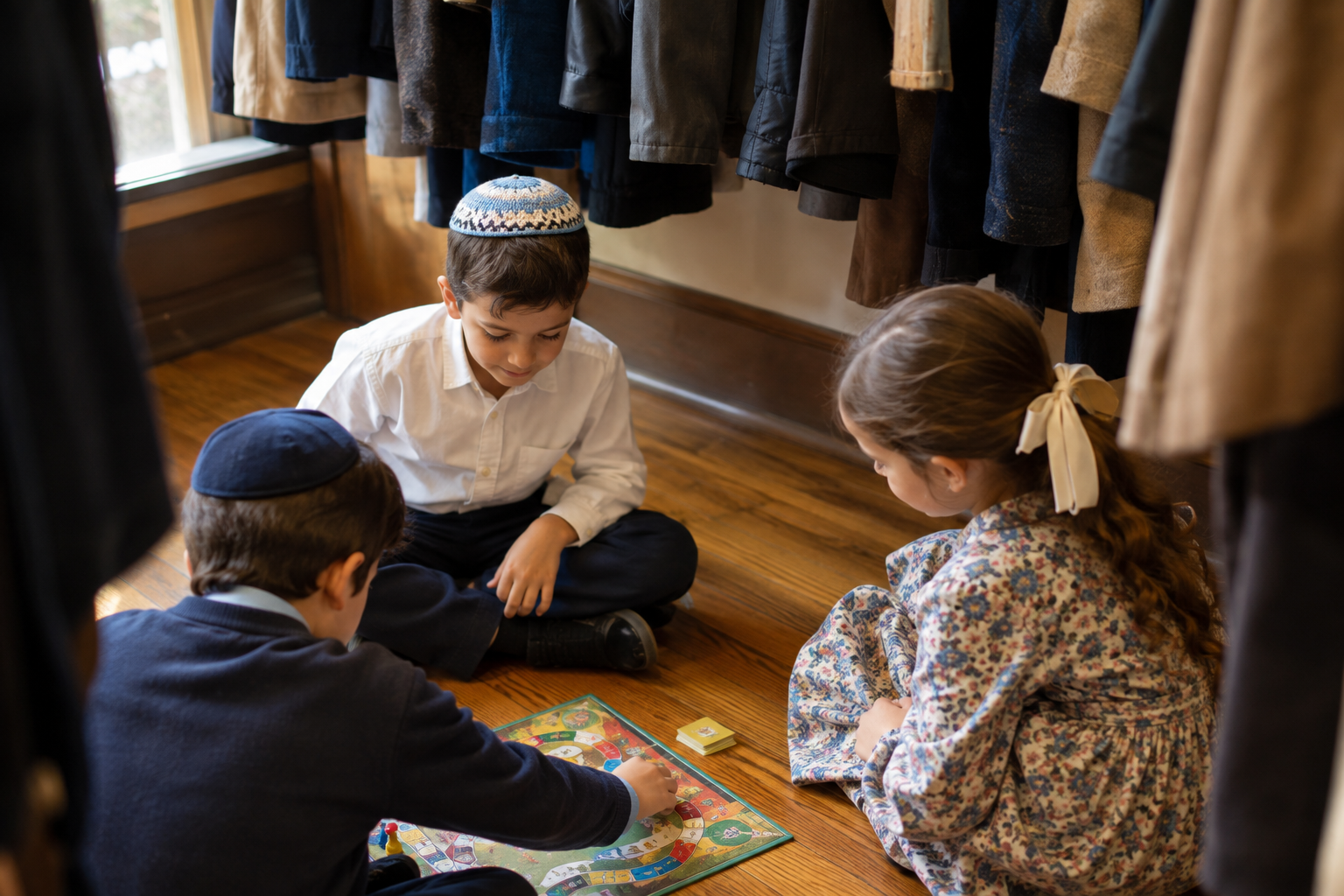
Yes, Rosh Hashanah is about family and community, gathering around tables, hearing the shofar, and reconnecting with people. It’s about whatever a meaningful holiday looks like for your family and your community. None of that happens in a vacuum. Our first obligation, as parents, as adults, and as communities, is to keep the people in our care safe. Our children. The children of our friends. The kids sitting next to us in synagogue. The kids playing in the coat closet, which is a hangout in more shuls than you’d think. The children running around someone’s house while the adults are catching up. Our inner circles. Our village.
Synagogues everywhere are working hard right now on seating, sermons, programming, volunteer training, and security. All of that matters, but there’s a scary question underneath it: what is happening inside those walls?
Rosh Hashanah and Yom Kippur create a particular environment. Adults are sitting in shul for hours, focused on services, perhaps some side conversations, reflection, and let’s be honest, on making it through the service with the kids reasonably happy and themselves reasonably sane. Meanwhile, children may be playing somewhere in the building, wandering from one friend’s house to another, or with a babysitter or another adult we assume is watching them.
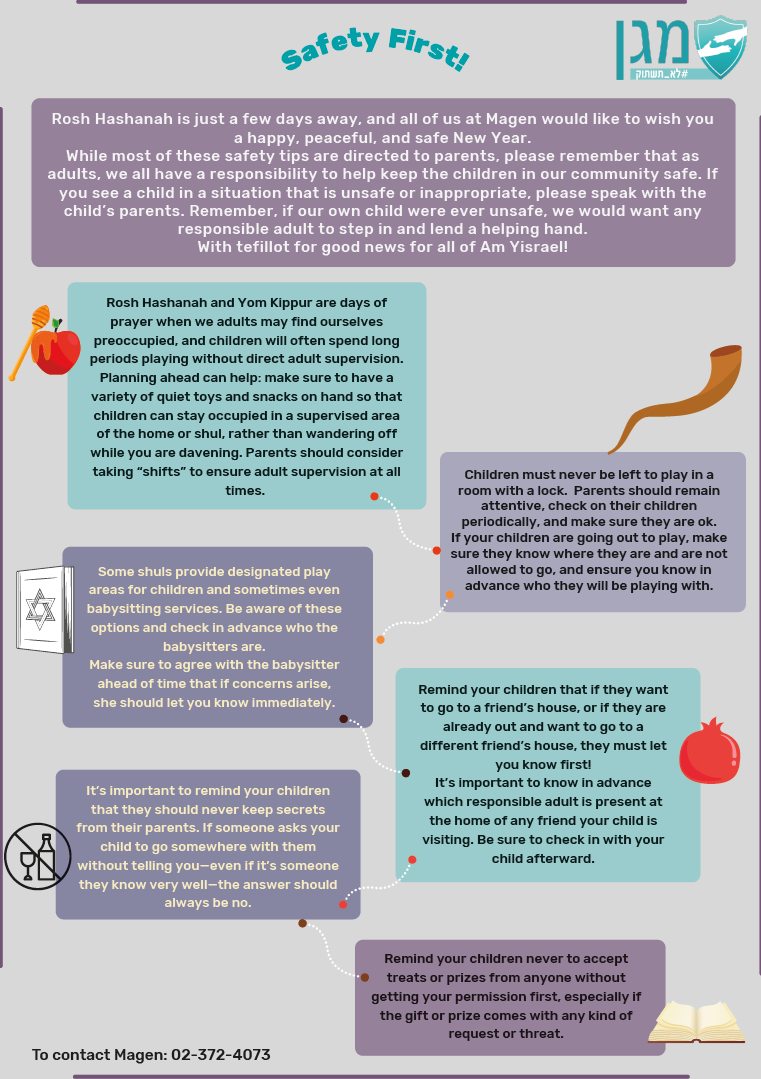
I’ve served on the board of Magen since 2021, and more recently as Board Chair. Magen is an Israeli nonprofit dedicated to preventing child sexual abuse and supporting survivors within Jewish communities, through advocacy, education, and direct support services. Magen has assisted in over 800 cases since last Rosh Hashanah. Ideally, we’re preventing cases, not responding to them. Magen’s high holiday safety materials make a simple point: when adults are occupied for long stretches of prayer, children can delightfully play through significant stretches without direct adult supervision. Planning ahead, building supervised spaces, having parents take shifts – all of it helps.
None of this is meant to make us paranoid. It’s meant to make us adults who prioritize our children first. Magen put together a one-page guide with the basics, the kind of thing you can screenshot, print, or send to a group chat in the next five minutes.
Magen created holiday safety resources in English and Hebrew, built to be shared, not just read. Find them here.
- Send them to your synagogue.
- Post them in your WhatsApp groups and your status.
- Print them and leave them somewhere adults will actually see them.
- Give them to whoever is coordinating children’s programming.
- Talk about them with your family before the holiday begins.
If your community needs these in another language, reach out. We’re happy to help.
This isn’t only a parent’s responsibility. It’s a communal one. If you see a child in a situation that seems unsafe or inappropriate, say something.
We don’t need to be experts. We need to be adults who are paying attention.
We spend a lot of time this season thinking about what kind of year we want. We wish each other שנה טובה ומתוקה, a good and sweet year. We reflect on what we could have done better. Don’t wait until next year. Let’s start doing better now.