Straighten Up and Fly Right: A Torah of Sanctuary
I live in Boston, a sanctuary city. My children attend a public dual-language school. Recently, the neighborhood where their school is located, which has a very large and thriving Latinx population, was targeted by ICE agents, and the school increased security protocols because of concern for the safety of the students.
My kids are proudly fluent in both English and Spanish, as they should be, and even more proud of their multicultural community, where they and their peers can freely express all of their identities. In fact, recently, when flying back from my in-laws’ in Iowa, they helped a man who was not fluent in English negotiate security, as the only fluent Spanish speaker on staff was out sick. Their bilingualism, in this small and intimate moment, helped this man find a port-in-a-storm. And so, I, as their father, a Bostonian, a Jew, an American, and more generally, as a human being, feel a sense of commanded-ness” to dig into the wells of Torah for insight on the importance of sanctuary.
In one of the most memorable and powerful verses of scripture, the Unconditional charges Moses as follows:
וְעָ֥שׂוּ לִ֖י מִקְדָּ֑שׁ וְשָׁכַנְתִּ֖י בְּתוֹכָֽם׃
“Let them build Me a sanctuary that I may dwell in among them”. —Exodus 25:9
Now, reading the first half of the verse, “Let them build me a sanctuary, ” we might logically expect the latter half to read “that I [the Divine] may dwell among it”. After all, the entire last part of the Book of Exodus is preoccupied with the construction of an edifice capable of housing an immanent Divine Presence. However, the text surprises us, engenders curiosity, suggesting that God’s manifesting is less dependent on a structure of walls, planks, and tapestries, than on a co-creative community-building project of formerly enslaved persons.
In fact, many celebrated interpreters of Torah assert, through a close reading of this verse, that the liberating spirit animating the sanctuary is not actually the building at all, but the people who study, worship, grow, laugh, cry, mourn, and dance therein. Moreover, these thinkers teach that we the People of Israel, when reaching spiritual maturity, bear the spirit of sanctuary with us “on on all our journeys” [Exodus 40:35]
One of these interpreters, Nahamides, halakhist, Talmudist, mystic, and physician, claims that when our Israelite ancestors completed the project of the mishkan, or tabernacle, they “returned to the status of their ancestors, becoming a merkavah, a chariot for Shekhinah, God’s most intimately accessible Presence.
But what is this merkavah? How do we pull it, and what is so important about the “status of our ancestors”?
The merkavah is, within the realm of the Hebrew Bible and Jewish thought, a vehicle that transports the Divine throne or footstool. It is viewed as a mobile Sinai, a ritual container through which the people strive to continuously kindle the fire, the cloud, the theophany, the moment when “God came down upon the mountain” [Exodus 19:20].
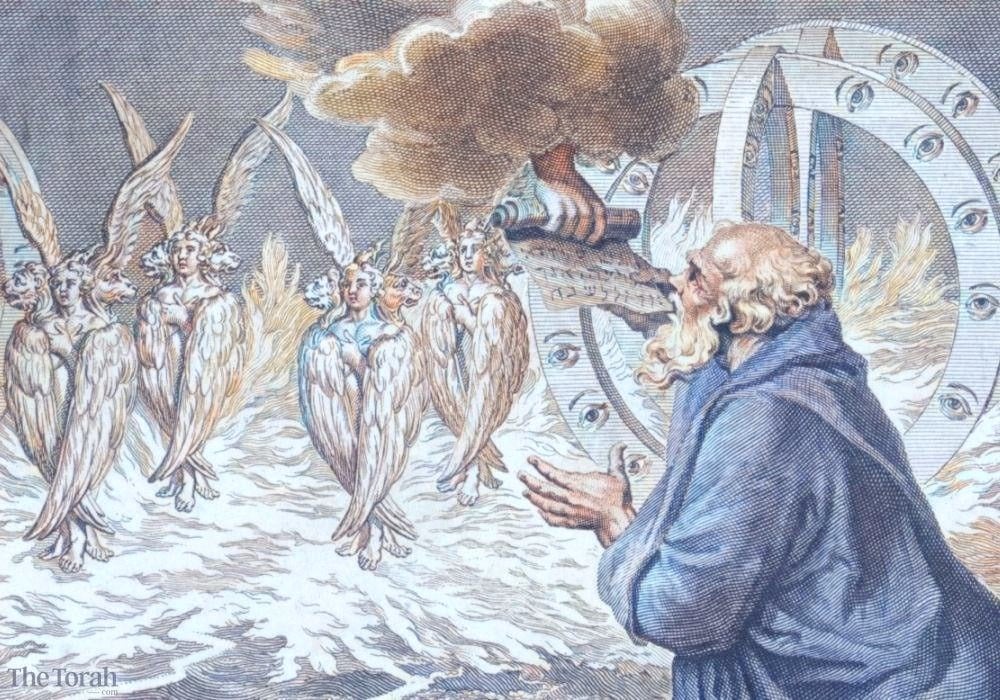
The most vivid envisioning of the merkavah is in the Book of Ezekiel, son of a priest and an immigrant exile, living by the Chebar Canal in 6th century B.C.E. Mesopotamia.
Ezekiel sees an otherworldly vehicle hovering above him, powered by four hayot hakodesh (holy creatures) with human bodies, several pairs of wings, and the heads of four powerful animals: human, ox, lion, and eagle. Accompanying them, yet paradoxically essential to their navigation, are detached wheels, the rims of which are populated by many eyes!
Our interpreters understand these angelic creatures in a multitude of ways including representative of the four cardinal directions, movements of various constellations (Aquarius, Taurus, Leo, and Scorpio), and the mutual interaction of four of the sefirot or attributes of the Divine Organism revealing itself within the cosmos and human beings (Malkhut/ Sovereignty, Gevurah/Power, Tiferet/Balance, and Hesed/Lovingkindness).
However, I’d like to suggest a new interpretation for these beings who animate the movable sanctuary, these engines who power its movement.
Inspired by reading Rabbi Shai Held’s sensitive and timely new work of theology Judaism is About Love, I imagine that these four beings draw upon four vital energies that powered the community of our ancestors and should power ours as well. These four animating energies occur within p three pivotal verses of Torah considered by many to be halakhic or ethical meta-principles.
The first is וְאָהַבְתָּ לְרֵעֲךָ כָּמוֹךָ “you shall love your neighbor/brother as yourself” [Leviticus 19:18], the second, וַאֲהַבְתֶּם אֶת־הַגֵּר “you shall love the stranger” [Deuteronomy 10:19] , and the third,“you shall love Adonai your God with all your heart, all your being, and all your unique essence” [Deuteronomy 6:5]”וְאָ֣הַבְתָּ֔ אֵ֖ת יְיָ֣ אֱלֹהֶ֑יךָ בְּכָל־לְבָֽבְךָ֥ וּבְכָל־נַפְשְׁךָ֖ וּבְכָל־מְאֹדֶֽךָ. Contained within these three meta-principles are four loci or four subjects we are commanded to love: self, people, immigrants, and the Unconditional.
However, in order to really ground my hiddush (my innovative interpretation), I did a deep dive into the Book of Ezekiel. I needed to ascertain whether these four essential threads flow through his vision of a renewed covenantal community, especially as he is the personality most overtly connected to the merkavah.
In my research, I discovered that they are, in fact, essential to Ezekiel’s conception of a renewed community. In fact, in some ways he even augments their importance.
Vis a vis the self, Ezekiel radically pushes back against the corporate theodicy of previous priestly sources, and puts the destiny of the individual front and center. Whereas the Book of Leviticus asserts that the consequences of certain transgressions, fall not only upon the perpetrator, but upon later generations as well, this exiled priest insists that each person is called to account or benefits only from their own deeds, whether righteous or heinous [See Ezekiel 18:20]. Therefore, his love and celebration of individual agency is paramount to his prophetic venture.
With regard to the motives of love of God and peoplehood, they are integrated into an uplifting and strikingly modern passage in Chapter 11. To a community of refugees and exiles, Ezekiel preaches that the Divine is accessible to them wherever they are:
וָאֱהִ֤י לָהֶם֙ לְמִקְדָּ֣שׁ מְעַ֔ט בָּאֲרָצ֖וֹת אֲשֶׁר־בָּ֥אוּ שָֽׁם׃
I will be a little sanctuary for them (mikdash m’at) in the lands wherein they have come.
The same passage also highlights the promise of a return to their ancestral homeland. The Omnipresent, through the prophet Ezekiel, will help this community of refugees whose hearts have been hardened by the trauma of exile and dislocation to find catharsis and healing (“And I shall give them one heart and a new spirit shall I place in their innards and I shall remove the heart of stone from their flesh and them a heart of flesh”). With rejuvenated spirits, they may once again rekindle their vocation, as a kingdom of priests, beloved by the Divine.
Finally, with regard to the stranger, what Ezekiel teaches is even bolder and more inclusive than sources from the Humash. When returning to the land of Israel, these refugees, who know the struggle of the immigrant and exile, will ensure that the ger, the stranger or immigrant in their midst inherit portions of the land along with them and. Furthermore, the ger and their children shall be citizens of the land. Leviticus 19 does command the Israelites “to love the stranger and treat them as citizens”, but nowhere does it delineate a duty to invest the immigrant and their child with a stake in the land! Ezekiel takes these meta-principles and doubles down. The merkavah is now operating in turbo-mode!
But what happens when one of the four enlivening engines of the chariot, our moveable sanctuary falters, when one of the wheels falls off is intentionally jettisoned?
What happens when during a time of trauma, one engine, one focus is fed more fuel than the others?
According to some of our mystical sources, including Rabbeinu Bahya ben Asher and Nahmanides, the grievous error of the golden calf entailed this kind of mistaking the importance of the part for the whole. When our Israelite ancestors saw a very intimate vision of the Divine throne at the Reed Sea, some saw only the ox that pulled one of the four sides and mistook the engine for the Passenger or perhaps the Driver. In Moses’ absence these individuals crafted a visual representation of the ox and worshipped it. The overemphasis on the ox, representative of the attribute of gevurah (power) and din (judgement), threw the entire balance of the Israelite community off, so much so, that it nearly crashed entirely and drove Divinity from its midst!
I’m concerned that during this time, after the trauma of October 7th, that out of fear, not unjustified, some elements of our communities invest all of their animating sparks on behalf of nation and peoplehood, when all 4 loci command us, obligate us. We have steeled our hearts, in understandable deep pain and become stone-faced. We gravitate, through grief, sadness, and anger, once again toward din (judgement) and gevurah (power), not always thinking carefully about the cost.
There are many groups that are currently experiencing fear and being demonized including the LGBTQ+ community and immigrants (both documented and undocumented). Some of these individuals are Jewish as well, and are doubly or triply traumatized. Nahmanides’ and Ezekiel’s understanding of sanctuary enjoins us to reach out, to stand up, and to rebalance the craft. What can we do to right the ship to “straighten up and fly right”?
For my part, I’m writing, I’m teaching a course about our spiritual story, a story of wandering, brave, and persecuted immigrants, whether Abraham and Sarah, Jacob, Leah, and Rachel, or Ezekiel. It is not surprising that he receives his prophetic calling in Ur Kasdim, the land from which Abraham, Sara, Lot, and their brave entourage of sojourners set out to make a better world. I’m supporting organizations like HIAS (The Hebrew Immigrant Aid Society), the National Council for Jewish Women, and JCPA (Jewish Council for Public Affairs), all of which engage in this important and sacred work.
Wishes for a sweet and liberating Pesach