An Aging Jewish Feminist
Study vs. Sacrifice: An Angry Reflection
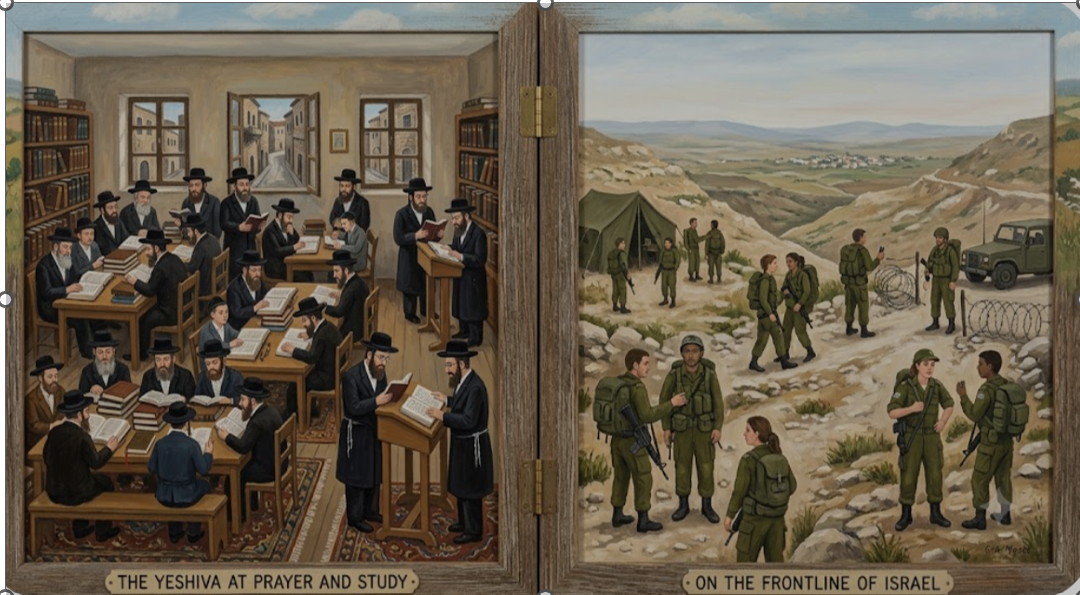
It is now 11:15 p.m. here in Israel. Five minutes ago, I was getting ready to go to sleep, trying to wind down from the day. And then I saw the latest update in the Times of Israel: “Knesset passes quasi-constitutional Basic Law declaring Torah study a foundational value of Israel.” And just like that, sleep became impossible.
Earlier this evening I was teaching one of my Bible classes. We were studying Numbers 4, where the Levites are described in terms that echo military structure—counted, organized, assigned roles. In many ways, they are portrayed as part of God’s “army,” a tzavah. During the discussion, I said openly that this idea has real ramifications for today. I pointed out that parts of the extreme religious community genuinely believe that devotion to Torah study places them in that same category—that they are, in essence, serving in God’s army, and therefore exempt from physical military service.
But the Torah itself is not ambiguous. Elsewhere it states clearly that every male between the ages of twenty and fifty must serve. The expectation of shared responsibility is explicit. And yet today, the Haredi population, in large part, simply ignores this.
I find myself flooded with anger—so much so that I can barely think straight. Dark, reactive thoughts rush in: let them fend for themselves; don’t build them shelters; stop funding them; let our taxes go only to those who actually bear the burden of defending this country. I know these thoughts come from a place of frustration, but they are there, loud and insistent.
And underneath the anger is something deeper: a sense of betrayal. Where are Torah values when we need them most? What I am witnessing feels like a total chilul Hashem—a desecration of God’s name. Not just a political misstep, but a distortion of the very values the Torah is meant to uphold.
It stands in such stark contrast to what we read just last week at the end of Bamidmar. Reuven, Gad, and half the tribe of Menashe stepped forward and offered to be in the vanguard—to serve as chalutzim, to fight on behalf of the collective before returning to their families on the other side of the Jordan. That was responsibility. That was solidarity. That was a model of putting the nation before oneself.
And now? What I see feels like the opposite: a withdrawal into self-interest, a lack of consideration for the soldiers who are carrying unimaginable burdens—physically, emotionally, morally. The gap between those who serve and those who claim exemption grows wider, more painful, more dangerous.
Part of me thinks: this will come back to haunt them. Actions have consequences. But even as I think that, another fear creeps in—one that is harder to shake. The demographics. They are growing. They are the future. And that thought frightens me more than anything else.
Because no matter what happens in the next election, the damage feels deep. Structural. Cultural. Spiritual. The kind of damage that takes not years, but generations to repair—if it can be repaired at all.
Tonight, I cannot find a way to spin this positively. I wish I could. I wish I had some comforting framework, some way to reconcile what I believe Torah stands for with what is unfolding in front of my eyes. But I don’t.
So this is where I am—angry, unsettled, and deeply worried. And wide awake.
Related Topics
Related Posts