
Sukkot in Southern Lebanon
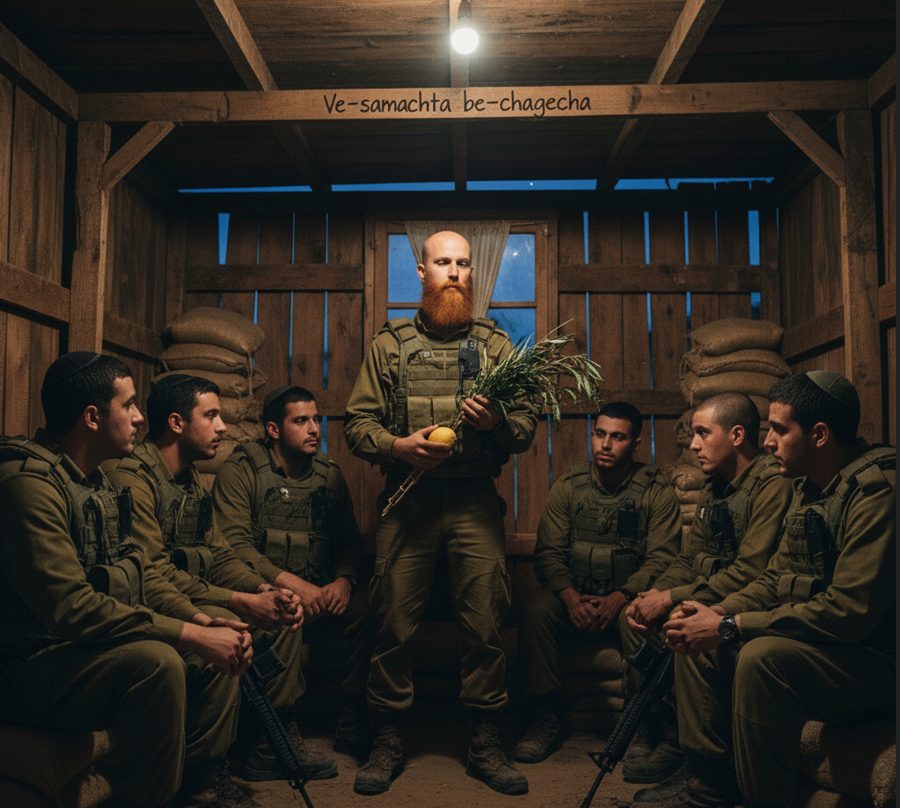
Last year, I had the privilege of welcoming the festival of Sukkot in the village of Rab Thalathin, deep in southern Lebanon. I remember the dusk vividly—that tense quiet before the storm. All the guys from the platoon were sitting together in a dark room, waiting for the night to deepen so we could head out on our mission. The mood was gloomy, and the guys were whispering to one another: “What a drag it was to spend yet another holiday in the army, and under such terrible conditions.”
No matter the circumstances, I made every effort to keep the mitzvot of the holidays—even in the middle of war. On Shabbat, together with my friends, I would lead Kabbalat Shabbat, Kiddush, and Havdalah. On Purim I carried a Megillat Esther for the megillah reading, and on Shabbat Zachor we read from the Torah deep inside Gaza. For Sukkot, too, I came prepare—I had smuggled in the Four Species, tied tightly to the side of my pack, all the way into Lebanon.
At one of those moments before we set out, when everyone was absorbed in their own thoughts, someone suddenly asked me: “Shilo, do you have a d’var Torah for the holiday?”
“Of course,” I answered, and began to speak into the silent room: “A few years ago I heard an idea that feels especially relevant for us this year. As we know, Sukkot is considered a festival of joy—for the Torah commands us: ‘And you shall rejoice on your festival.’”
The guys nodded—most of them liked Sukkot. But then I raised a question: “If Sukkot is truly the festival of joy, you’d expect that we’d be commanded to do things that naturally bring us happiness. Instead, what does the Torah tell us to do? Leave our homes, and sleep outside as if we are homeless. Take a lemon and some branches, and wave them around like lunatics. Go to synagogue and read Kohelet—probably the most depressing book in the Bible, where King Solomon insists again and again: ‘Vanity of vanities, all is vanity.’ How does that make sense? Why is this holiday, with its strange commandments, the one where the Torah commands us to rejoice?”
“Sukkot comes to teach us that true joy doesn’t depend on comfort or on material things. People tend to think: if only I had more money, more possessions, more security—then I’d be happy. But Sukkot tells us the opposite—leave your home, your comfortable bed, your protective walls. Go sit in a flimsy hut, in complete uncertainty. Only then can you discover real joy. Kohelet reinforces this message: if you seek happiness in luxury, you’ll be disappointed. ‘Vanity of vanities’—everything is temporary, everything passes.
And here’s the central point: real happiness doesn’t come from what you have—it comes from how you choose to see the world.”
I turned back directly to the dark room in Lebanon, to the soldiers around me.
“Guys, understand this—specifically here, in a situation so far from our families and our homes, without the ability to fully keep the mitzvot of the holiday—specifically here we can discover the joy of Sukkot. Why? Because we have nothing material to lean on. All we have is each other, our mission, and the knowledge that we are part of something greater.”
Those words echoed. Perhaps we didn’t achieve complete joy that Sukkot evening, but suddenly a sense of calm filled the room—something deeper than the usual holiday cheer.
“Vesamachta bechagecha—And you shall rejoice in your festival.”
It’s not a joy of parties and dancing, but a joy that flows from awareness—from recognizing that we have something deeper than material comfort. Precisely in the moments when we have nothing, we can discover that we actually have everything.
At that moment, deep inside Lebanon, I understood that Sukkot is not just a holiday of a sukkah and four species. It’s a holiday that teaches us how to live a life of joy, independent of external circumstances. May we merit, with God’s help, to find true joy, not only on Sukkot, but throughout the entire year.
Chag Sameach and Moadim L’Simcha!