


"Violence can be justifiable, but it will never be legitimate." — Hannah Arendt
Sun King
The most heavily armed nation on earth is at war, and its supreme commander has lately been obsessed with a tally. According to The Washington Post, the president of the United States has spent the past few months between one war decision and the next counting the trees in Lafayette Square, the park he considers the entrance to the White House. He has decreed there must be exactly 47, the tribute of the 47th president to himself, and that they must be exclusively maples, his favorite.
This preference carries its own peculiar logic. The maple leaf adorns the flag of Canada, a country he frequently and unprompted proposes annexing as the 51st state. The emblem has already claimed the federal lawn; the rest of the territory is just a matter of time. The taste for planting came only after the taste for felling. Constructing the $300 million ballroom had already doomed the magnolias planted for Harding and Roosevelt and leveled the garden of Jacqueline Kennedy, a plot that had survived a century of tenants.
Louis XIV made war through nearly his entire reign and, in the intervals, perfected Versailles. He had fully grown trees uprooted from the provinces and planted before the palace; they died by the thousands and were replaced before dawn, ensuring the king never opened his shutters to a failure. The fountains lacked the water pressure to run simultaneously, so gardeners opened them just ahead of his stroll and shut them behind his back. In the world of the king, the water never stopped. There, the court mastered its primary trade, which was adjusting reality to the desire of the sovereign. Three centuries later, this same pageantry has consumed a republic.
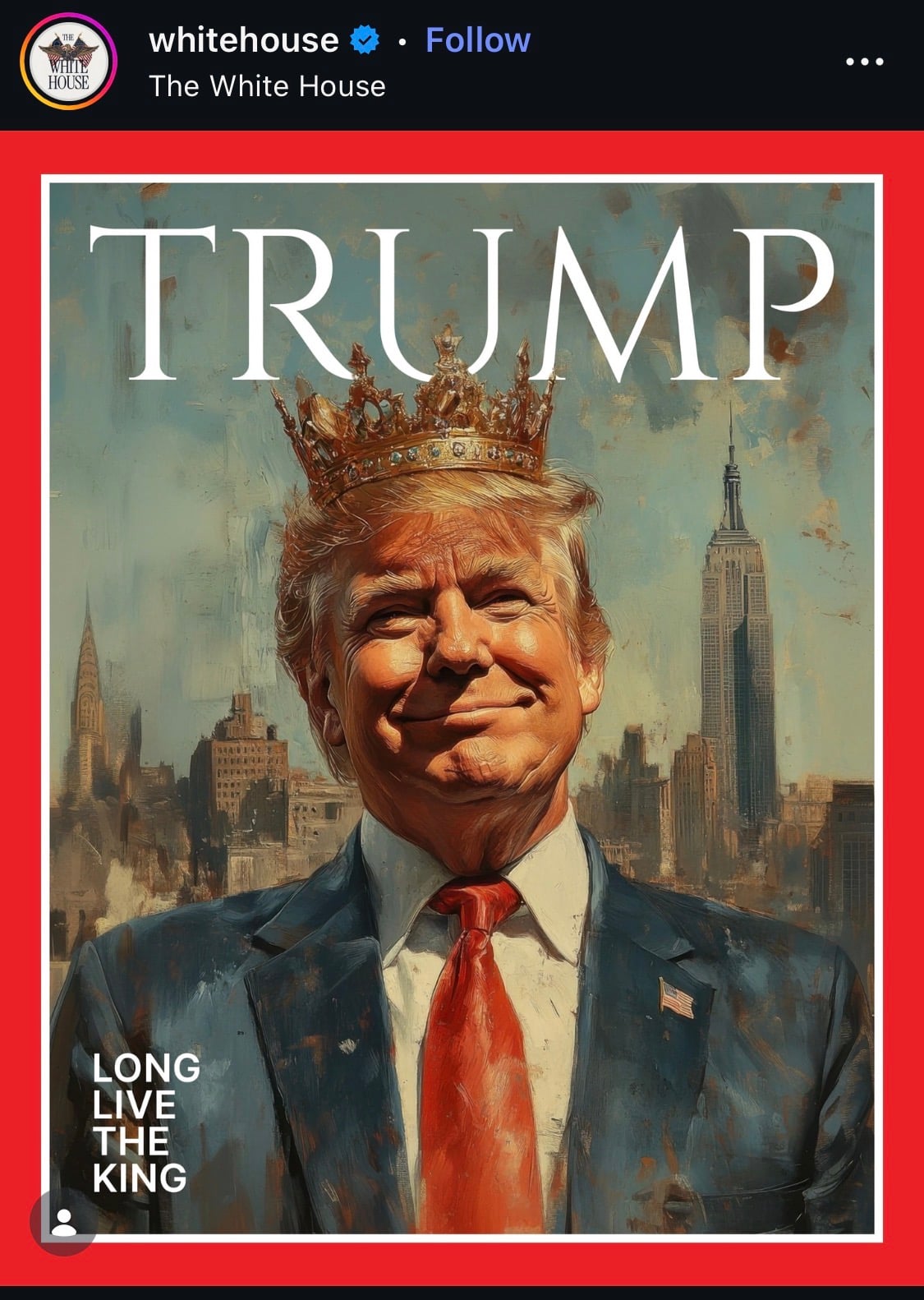
The definitive portrait of that republic has just been published. Regime Change, by Maggie Haberman and Jonathan Swan, arrived in June with a cover bound in gold, a rare instance of honest packaging. The phrase in its subtitle, “imperial presidency”, was coined in 1973 by Arthur Schlesinger as a fire alarm during the twilight of Nixon; the authors redeploy it as a job description. A republic has been remodeled into a royal household, complete with a portrait of the occupant wearing a crown, circulated by the White House itself. Built on over a thousand sources, the book outlines a classic historical irony. The indictments, the convictions, the assassination attempts, and the four years of political exile following his 2020 defeat have produced a president more powerful, more vindictive, and more willing to gamble than any modern predecessor.
Above all, the book dissects the isolation. The generals who used to say no are gone; the lawyers who stayed now pick their own defeats; court rulings are ignored, and prerogatives Congress once guarded have been quietly absorbed. Admission to the inner circle became a strictly dated loyalty test based on where each aspirant stood on January 6 and, crucially, on the morning after. Whoever drifted a millimeter was banished. Flattery, pumped in sufficient volume, becomes the very atmosphere. Inside it, information bows before it rises, and whatever reaches the summit arrives preceded by applause. The imperial whim travels without friction, and the outside world is acknowledged only to be approved without question. Reality still exists; it has merely lost its security clearance. In this climate, the Justice Department became a weapon against private enemies, and the presidency a personal enterprise. At court, enriching the sovereign is the highest form of public service.
This enterprise keeps impeccable books. The mandatory disclosure released this month shows him pocketing more than 2.2 billion dollars in a single year. At least 1.4 billion dollars comes from cryptocurrency ventures of the family, 635 million dollars from coins christened with his name, and 590 million dollars from World Liberty Financial. The remainder is padded by real estate, licensing fees in Saudi Arabia and Qatar, and settlements extracted from ABC, Paramount, and Meta. The public ledger kept by House Oversight Committee Democrats already tracks over 5.1 billion dollars in additional wealth since the inauguration; Forbes has pronounced this the most lucrative presidency on record. Two out of three retail investors who bought the presidential coin lost money, restoring the classic economics of monarchy, where the sovereign glitters and the subjects foot the bill.
The Duke of Saint Simon, who grew old taking notes from inside Versailles, would instantly recognize one particular scene in the book. In the middle of a small, classified meeting on a military question, a contractor walks into the Oval Office with stone samples for the Rose Garden. The host drops the agenda, lifts the stones to the window, and calls a second contractor. The national security of the United States goes into recess, pending the paving. War and landscaping share the same afternoon. Landscaping takes priority.
The war, meanwhile, drags on without its promised conclusion. Swan, who has covered him for over a decade, notes he has not seen the president this cornered since the pandemic, finally realizing the confrontation with Iran unfolded neither as his advisors pitched it nor as his vanity guaranteed. When bad news finds no courier, defeat is always the last item announced. For eighty years, American power was tolerable to the rest of the planet because of the conviction that behind any president stood a system. The bored auditor checking the accounts, the judge overruling a decree, the general pushing back. Allies used to negotiate with institutions; now, they cater to a mood. Foreign ministries quickly learned the new etiquette, offering a spare Boeing from Qatar and Nobel nominations rehearsed like curtsies, and diplomacy began to resemble a line outside the throne room. The view outward has been similarly pruned. A gulf rechristened in his name, Greenland eyed as a future acquisition, Canada reduced to ornamental foliage in the park across the street. From the Resolute desk, the globe looks less like a community of nations and more like an estate waiting for the landscaper.
Absolute power is measured less by grand commands, which any subordinate can issue, than by the petty whims no one dares call ridiculous anymore. A free country is defined by what it consents to normalize. The genuine scandal has changed address and now lives in the Congress that watches, the courts that defer, and the press that prints updates on trees right next to the missiles. Two weeks ago, the republic marked its 250th anniversary. The document celebrated with fireworks and parades is, at its core, a list of grievances against a king who ignored laws, obstructed courts, and elevated soldiers above civilian power. Reread this July, the declaration of 1776 loses the feel of a historical relic and reads like a freshly inked police report. Yet the man who best fits its description presided over the party. The jubilee arrived on schedule, and so did the imperial republic. Madison warned that parchment barriers restrain no one, gambling that the ambition of one branch would check the ambition of another. He never foresaw a day when ambition would learn that flattering the monarch pays better than standing at the rostrum.
But the people were never removed from the equation, and they are not just an audience. Every court requires a mandate, and this one came from the ballot box twice, the second time without any excuse of surprise. Yet this same electorate tells pollsters they cannot afford groceries and blames the man counting trees. Millions have marched through cities under a brief manifesto, “No Kings”, only to be met, in several places, by armed soldiers. Writing in the sixteenth century, Etienne de La Boetie observed that the servitude of the masses is always voluntary.
A tyrant has no eyes but those lent to him, and no hands but those eager to serve him. The cure, he noted, begins the moment people stop lending them. There is a sharp irony in the new Sun King counting his maples in a square named for another Frenchman, Lafayette, who spent his life cutting kings down to size. This is the exact spot where, in June 2020, peaceful protesters were sprayed with tear gas for a Bible photo op. The 47 saplings will be planted on schedule, and the surrounding monuments to liberty will quietly frame the obsession of one man.