Sunrise in a Closed Military Zone
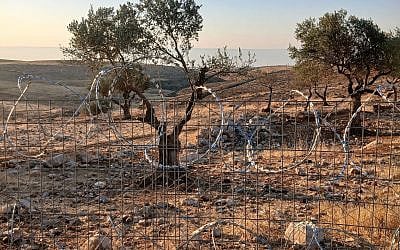 When I arrived at the outskirts of Taybeh it was already dark. Two activists named Ben and Yair picked me up from the bus stop and explained the new reality: The entire town of Taybeh is now a closed military zone. This will remain in place for an entire year.
If the authorities see me, they will give me a warning, and then the next time I could get arrested. Of course, the settlers can still roam free. Will that impact our ability to correspond with the police by phone about incidents that happen during our shifts? No, but it’s not as if the police really took us seriously to begin with.
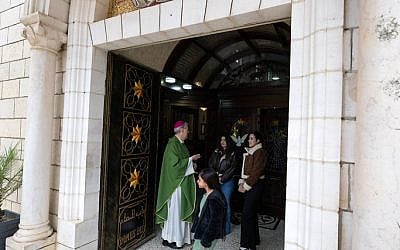
While this was framed as a move to prevent settler attacks, it is actually intended to prevent people like us from protecting the residents from attacks. This will have a severe economic impact. Taybeh, rich in Christian heritage, relies heavily on its tourism industry, which now is officially illegal aside from local Palestinian tourism. If the reason for this move truly was the settler attacks, then why should tourists from Brazil be prohibited from entering? Ultimately, this economic blow, alongside the economic damage done by the town’s people being unable to safely access their olive groves, and the overall security concerns, will cause even more people to leave Taybeh.
© Mazur/cbcew.org.uk
https://www.flickr.com/photos/catholicism/55049374920/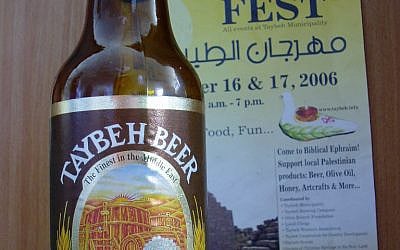
https://www.flickr.com/photos/catholicism/55049374920/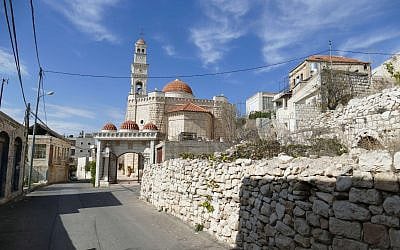
https://commons.wikimedia.org/wiki/File:Tayibe-WB-508.jpg
It’s sad that, assuming they do end up annexing Area C, they don’t even want Christians to be living there.
I spent the night in Anwar’s house. There I met Mark, a young journalist from Russia, and a 20-year-old Bedouin named Jad. I chatted with Jad, using Andre as a translator.
What do you do? I asked
“He says he’s a plane mechanic. He’s just kidding. He doesn’t do anything.”
Later, Jad left and I heard more about Andre’s story. He has Israeli citizenship and he lives in Bethlehem, which is illegal; he officially lives in Tel Aviv. He says that he encountered some unapologetic extremism from his interactions with Israelis. I asked him if he found the people in Bethlehem to be radicalized.
“No, they are chilled out. No one cares that I’m an Israeli citizen.”
It was a quiet night, then in the morning we had some visitors.
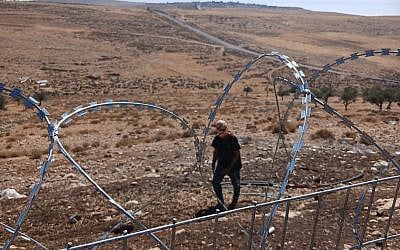
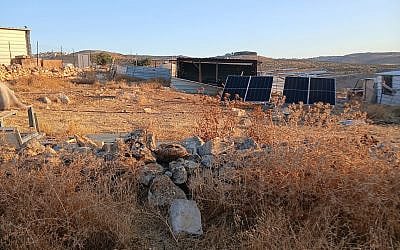
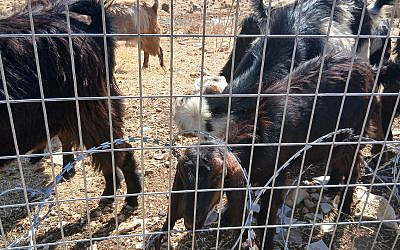 Below is a video I took of a settler pushing around their protective fence, trying to break it. The fact that I was filming him from point-blank range didn’t deter him, but it may have prevented him from pulling out pliers and cutting through the fence.
During my previous shift, a few weeks ago, some settlers had cut open the fence around a different cluster of homes. In this picture, you see a settler, who apparently was the one who cut the fence, standing on the other side of the fence, with nothing standing between him and the Palestinians’ homes.
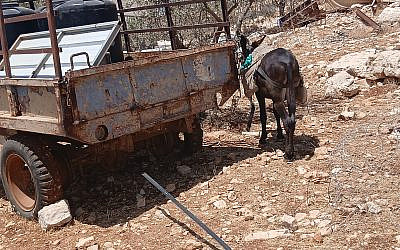
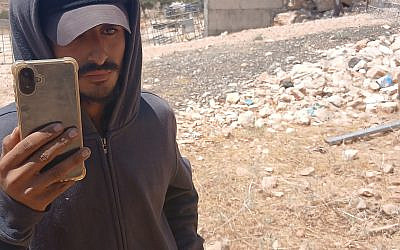 His donkey is tied to a car belonging to a Palestinian, also on the other side of the broken fence.
Doing protective presence is a weird experience. In my normal life, I feel both a desire and obligation to respect other people’s boundaries. Protective presence is the only time when I will put my phone on video-record mode and get all up in someone’s face. They chose the path of terror, so they renounced their right to certain boundaries. But shoving a camera in their faces and blocking their way from trying to get through a fence around someone’s home is about as aggressive as you are allowed to behave. At the end of the day, they are the ones who have the upper hand.
I’m not sure exactly what changed since the area was declared a closed military zone. All of the settlers that I saw had their faces mostly covered with bandanas. That may be a precaution against having their faces appear on camera in a place they aren’t allowed to be. One thing that I have learned from doing protective presence is the so called “number of attacks,” is a very small snippet of the saga that has been unfolding. Behind every incident that classifies as an “attack,” is an insane amount of hours that these kids and young men spend riding their donkeys around people’s property, making them afraid and uncomfortable, and waging a very patient war of attrition until they finally give up and pack their bags.
There was some more drama on a different side of Anwar’s property. I witnessed a settler pushing rabbi Arik Ascherman, the director of Torat Tsedek and former president of Rabbis for Human Rights. The incident was filmed by several people. Around an hour before I left I was informed that the authorities were contacted and the military was “on its way.” I don’t know if they ever showed up.
I received a lift to the bus stop from a fellow activist. He told me to hurry up before the army comes because they might close the entrance to Taybeh and trap us. There is absolutely no logic in closing the road. The settlers don’t use cars; they travel by donkey. So in other words, the entire town could have ended up being sealed off as a punishment for being harassed by settlers. We seriously need to stop calling the police.