
Support for Jewish Survival – If Convenient
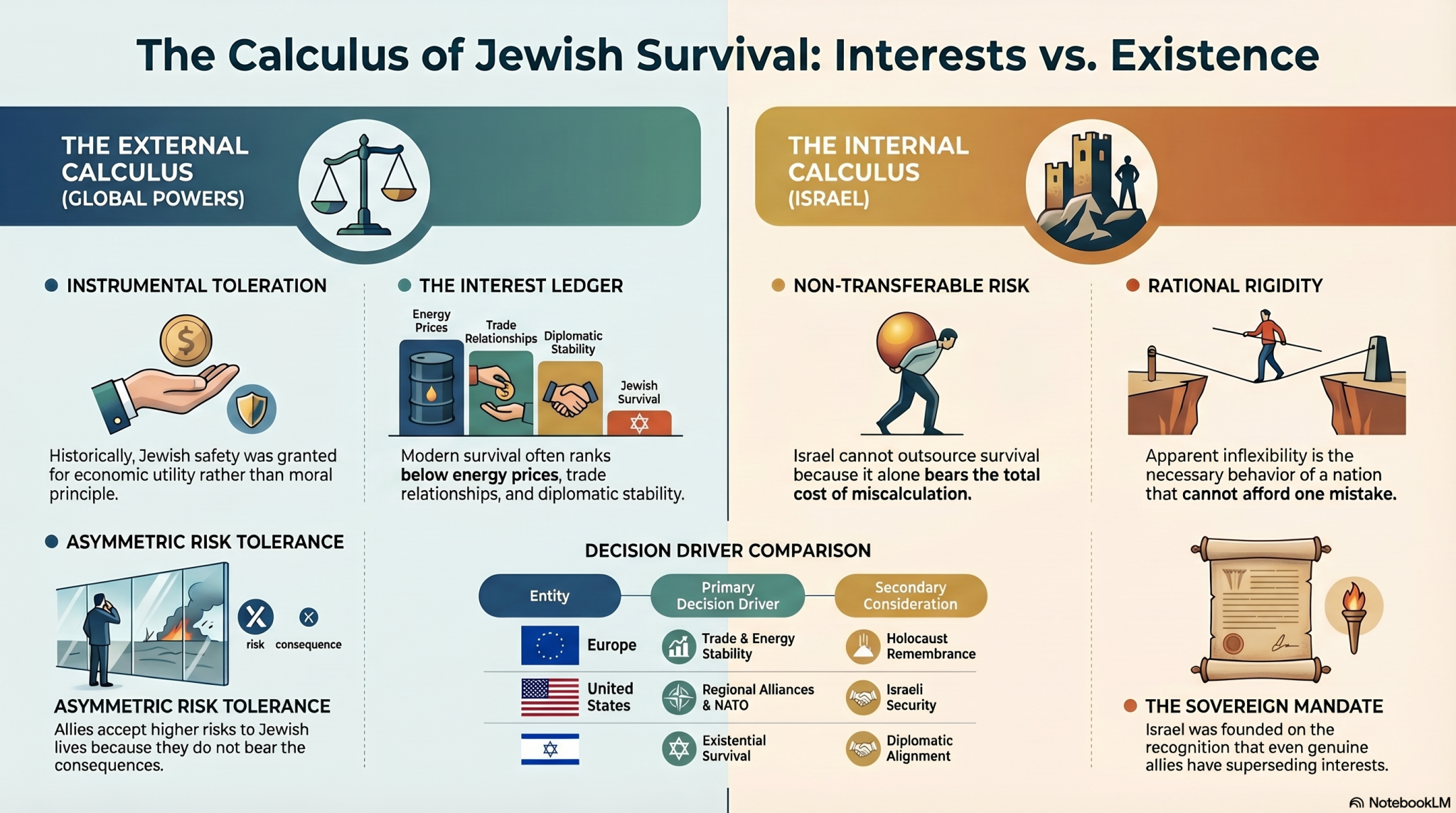
There is a sentence you will never hear spoken aloud in any foreign ministry, any chancellery, or any presidential press briefing. It is nonetheless the operative principle governing the relationship between the Jewish people and virtually every other nation on earth. The sentence is this: We support Jewish survival — when it doesn’t cost us anything.
Everything else is commentary.
The European Record: Toleration as the Exception
Let us begin with the continent that produced both the Enlightenment and the Final Solution, often within the same century.
For more than a thousand years, the default European posture toward Jews has not been hostility punctuated by tolerance. It has been exclusion punctuated by brief intervals of toleration — and those intervals, almost without exception, were granted for reasons of economic utility, political convenience, or tactical necessity, not moral principle.
The Jews of medieval Europe were expelled from England in 1290, from France repeatedly across the 13th and 14th centuries, from Spain in 1492, and from Portugal shortly thereafter. When they were permitted to remain — in certain Italian city-states, in parts of the Ottoman-adjacent Balkans, in the early Dutch Republic — it was typically because they filled a useful commercial niche that Christian law and custom forbade Christians from occupying. They were tolerated as instruments. They were never embraced as equals.
The Enlightenment appeared to change this calculus. Emancipation spread. Jews were admitted to universities, parliaments, professional guilds. And yet the 19th century also produced modern racial antisemitism — the transformation of a religious prejudice into a biological one — precisely because legal equality had failed to dissolve the social hostility underneath it. Europe extended its hand and kept a knife behind its back.
The 20th century resolved the ambiguity. Six million Jews were murdered in the heart of civilized Europe, with broad popular participation and near-universal indifference from the surrounding populations and governments. The nations of the world, informed in real time of what was occurring, chose — with the rarest of exceptions — not to intervene, not to bomb the rail lines, not to open their borders. Jewish survival was not, at that moment, a priority. There were other considerations.
This is the thousand-year record. It does not require embellishment.
The Present: New Language, Same Ledger
Contemporary Europe has, of course, renounced its past. The Holocaust is memorialized. Antisemitism is officially condemned. Israel’s right to exist is formally acknowledged. European leaders attend commemorations at Yad Vashem and speak movingly about “never again.”
And yet.
When Jewish survival in concrete terms comes into conflict with European economic interest — energy prices, trade relationships, diplomatic alignments — Jewish survival consistently loses. When the Islamic Republic of Iran pursued nuclear weapons capability, European nations led the effort to construct a diplomatic framework that, at best, deferred the threat and, at worst, provided Tehran with economic oxygen while it continued its program. The governing consideration was not whether Israel would survive a nuclear Iran. The governing consideration was whether European industry could resume doing business with Tehran.
When Israel conducts military operations to destroy tunnels used to plan and execute massacres of its civilians, European governments issue immediate calls for ceasefire — demands they do not make of any other democracy defending itself against comparable attacks. The calculation is not difficult to read: the cost of angering Arab governments, straining energy relationships, and inflaming domestic Muslim populations outweighs whatever rhetorical commitment to Jewish safety had been offered at the last Holocaust memorial ceremony.
This is not malice, necessarily. It is prioritization. Jewish survival ranks below the price of oil. It ranks below social cohesion. It ranks below the smooth functioning of trade. This has been true for a very long time. The language has modernized. The ledger has not.
America: Better, But Not Different in Kind
The United States is, genuinely, a different case. American philosemitism is real. American Jewish communities have flourished in ways that have no European parallel. The U.S.-Israel alliance has been, across many administrations, a cornerstone of Israeli security. American Jewry has achieved integration without the recurring cycles of expulsion and violence that defined European Jewish history.
None of this should be minimized.
And yet the United States, too, has a hierarchy of priorities into which Jewish survival is inserted — and it is not inserted at the top.
American administrations of both parties have, at various junctures, restrained Israeli military operations, withheld weapons shipments, pressured Israel toward ceasefires on timelines that served American diplomatic interests rather than Israeli security requirements, and extended negotiating frameworks to Iranian and Palestinian interlocutors that Israel assessed as existentially dangerous. The justifications vary — stability in the region, relations with Gulf allies, domestic political pressures, oil markets, alliance management in NATO and beyond. The structure does not vary: American decision-makers calculate what level of risk to Jewish survival is acceptable, and that calculation includes inputs that have nothing to do with Jewish survival.
The crucial difference between the United States and Europe is not that American priorities always align with Israeli security. It is that the floor is higher. The baseline commitment is more durable. But it is still a commitment made within a hierarchy that America controls and Israel does not.
American policymakers can accept a higher level of risk to Jewish survival than Israelis can — because the consequences of miscalculation fall on Jews, not on Americans. This asymmetry is not cynicism on Washington’s part. It is simply the nature of sovereignty, interests, and geography. But it must be named clearly, because the gap between American and Israeli risk tolerance has been, in several historical moments, the distance between a sustainable deterrence posture and a war for existence.
Israel: The Only Committed Party
This brings us to the one nation on earth for which Jewish survival is not a variable in a larger calculation — for which it is the calculation.
The State of Israel was founded on the recognition, purchased in blood, that the Jewish people cannot outsource their survival to the goodwill of others. That the thousand-year European record was not an anomaly. That even genuine allies have superseding interests. That the world does not lack for people who mourn dead Jews while creating conditions that produce them.
Israel is, uniquely, the nation that cannot accept elevated Jewish mortality as a manageable policy outcome. It is the nation that cannot afford to treat Jewish survival as one consideration among many, because there is no version of Israeli strategic miscalculation that results in consequences for someone else. When Israel is wrong, Israelis die. When Israel’s enemies succeed, Jews die. There is no insulation. There is no transfer of risk.
This is why Israeli decision-making frequently appears, from the outside, to be disproportionate, inflexible, or unwilling to accept reasonable compromise. What looks like rigidity from a safe distance is the rational behavior of a party that cannot afford to be wrong — because every other party at the table has, when it came to it, been willing to accept a certain level of Jewish loss in exchange for other goods they valued more.
The question is not whether Israel’s allies are sincere in their support. Many are. The question is whether their support is unconditional in the one condition that matters: that Jewish survival comes first. And the answer, drawn from a thousand years of accumulated evidence, is no.
What Honest Solidarity Requires
None of this is an argument for Israeli isolation or for contempt toward genuine friends. Alliances matter. American military and diplomatic support has been consequential and, at critical moments, decisive. The relationship must be cultivated and maintained.
But honest solidarity requires honest accounting. It requires that Israel — and Jews more broadly — resist the temptation to mistake warm words for structural commitment, to confuse Holocaust remembrance ceremonies with security guarantees, to treat expressions of support as substitutes for the hard-nosed analysis of whose interests align with whose and under what conditions.
The world will support Jewish survival — when it is convenient. When it is cheap. When it does not require difficult tradeoffs with other priorities. When the politics are favorable and the energy markets are stable and there is no election coming and the relationship with Riyadh is not at a delicate juncture.
Israel cannot plan around convenience.
It must plan around the record.