


Sweaty Stains of Sacrifice
After three weeks of training, including an extended stretch in the field, our son came home from the army on Friday.
Three weeks is not, objectively, such a long time, especially when we think of the long, grueling months so many soldiers have spent in miluim over the past three years. Somehow, though, it felt like an eternity since we had last seen him. He had been home for the beginning of Sukkot, which we spent with relatives. Now the chagim were behind us. The days were shorter, the weather had turned colder, and the routines of ordinary life were beginning to settle in again.
As we pulled up to the house, I suddenly realized that he had never actually sat in our sukkah. By the time he returned, it had already been dismantled and packed away for another year. Sukkot, with its temporary walls and its reminders of the fragility of our existence and the shelter of Hashem, had come and gone without him ever experiencing it in our own yard.
For now, though, Shabbat was approaching, and there were practical things to do. First on the list was the laundry.
I opened the two large laundry bags he had brought home, and the smell hit me immediately. Sweat, dirt, the accumulated odors of days spent outdoors in the heat, of strenuous physical exertion and no opportunity to shower or change. I sorted through the clothes, trying to imagine the days and nights that had produced them. I thought about the long hours in the field, the exhaustion, the physical demands of training and the discomforts he had learned to navigate and absorb.
Just then, a mother in the battalion WhatsApp group wrote: “How I’ve missed the smell of those stinky clothes! 🙂 Who would have thought that even this smell could become something you miss?”
I smiled. A smell that would ordinarily send us running had become a sign of something precious – a son home, a brother reunited with his siblings, a familiar presence restored to our family. Knowing we had less than 48 hours before he would have to leave again, we didn’t take even a minute of his time with us for granted. I thought, too, of the parents of his friends who are lone soldiers, for whom a homecoming like this is typically not possible.
Then my son handed me his tzitzit.
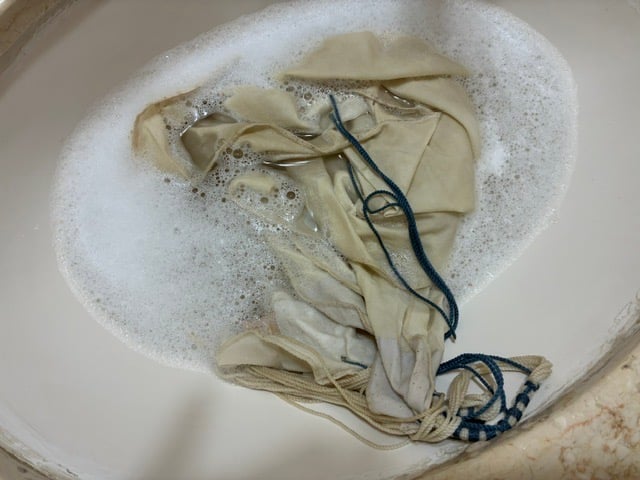
They needed to be washed by hand. Because of the heat, he had worn them directly against his skin, without an undershirt. They had absorbed three weeks of sweat in the field. The fabric, once a soft off-white, had darkened considerably. The stains told a story of the particular demands of the life he was living now.
I filled the bathroom sink with water and detergent and began to scrub.
As I worked at the stains, I thought of the words from the first chapter of Isaiah, so closely associated with repentance and the High Holy Days we have just concluded:
“Though your sins be like scarlet, they shall become white as snow; though they be red as crimson, they shall become like wool” (Isaiah 1:18).
The prophet speaks of stains that can be removed, of the possibility of repentance and renewal. We enter Rosh Hashanah conscious of the marks we have accumulated over the year, the ways we have fallen short, the things we wish we could undo. We hope to emerge cleansed, our sins washed away, our garments white again.
But standing over that sink, I found myself thinking about a different kind of stain.
These were not stains of sin. They were stains of sacrifice.
I wanted to wash the tzitzit clean, to send my son back to his routine with fresh, white garments. And yet I found myself reluctant to erase completely what those stains represented. They were evidence of what he had been doing, of the physical limits he had been pushing himself toward and sometimes beyond, of the demands being made of his body and mind at this stage of his life.
There is something extraordinary about being asked to do what seems almost impossible and discovering that you can. To wake before dawn, march when your legs are burning, carry what feels too heavy, and keep moving when you are exhausted and deeply uncomfortable. To discover that you can endure more than you thought you could. And to do so not simply for yourself, but as part of something beyond you that is much larger.
My son entered the army alongside a group of hesder yeshiva students, young men accustomed to thinking about spirituality in terms of the mind and heart: prayer, the beit midrash, moments of inspiration or transcendence. In that world, the body can sometimes seem like an interruption to spiritual life, demanding food or sleep when one would rather keep learning.
But in the army, the body is not an interruption. It is where the work happens.
The tzitzit hanging beneath their uniforms accompany these young men into that world. The same garment they wore while learning Torah in yeshiva is now with them as they march, sweat, struggle, and test the limits of their capabilities. Their tzitzit bear witness to the physical demands of military service, reminding them that this experience, too, is part of their religious lives. The body that serves is the body that prays. The young man who pushes himself in the field is the same young man who opens a sefer in the beit midrash.
Many of these soldiers carry pocket-sized sefarim wherever they go. Army life involves plenty of waiting around and standing in line for meals, sometimes for long stretches when talking is not permitted. Their secular commander has told them, “You can open your books.”
I am struck by that image. The body’s need for nourishment, the discipline of military life, and the opportunity to learn Torah converge in a single moment. These soldiers can be exhausted and still learn, hot and uncomfortable and still remain connected to mitzvot. Torah does not remain behind when they leave the beit midrash. It travels with them into the field.
This coming Thursday night, these young men will stand at the Kotel for their swearing-in ceremony. The scene might seem incongruous. Soldiers in green uniforms before a wall more often associated with men wrapped in white tallitot. Yet they will receive their weapons alongside a Tanach. In Israel, the sacred is not set apart from the seemingly mundane. It is woven into the same fabric.
By the time I finished washing the tzitzit, the water had turned a dark brown. I rinsed the garment, squeezed out the excess water, and set it aside to dry. The tzitzit were cleaner, but not white as snow, or even the soft off-white they had once been.
I thought again about the words of Isaiah. There is comfort in the promise that what has been stained can be renewed, that we are not condemned to carry every mark of our failures forever.
But perhaps not every stain needs to disappear completely.
These stains are marks of effort and endurance, of young men committing themselves to something greater than themselves: God, our country, our people. They are signs of a young person discovering what he is capable of, learning to do difficult things, and beginning to understand what it means to carry responsibility for others.
A mother naturally wants to wash away the difficulties her child has endured. We want to make things easier, to protect and restore. When our children come home, we want them rested, fed, clean, and safe. We want to give them back some measure of the comfort they have sacrificed. We want their clothes washed and smelling fresh.
And yet, we also want to recognize what those sacrifices mean.
My son was home again, but the stains gave me a glimpse of the world he inhabits when he is away. They made visible the experiences I could not witness, the hardships I could not ease, the limits he was learning to push beyond. In them, I could see not only what he had endured, but something of the resilience he was beginning to discover in himself.
I wanted to wash them away.
I wanted to remember them, too.