


Swedish PressTurned a Tragedy Into an Indictment of Israel
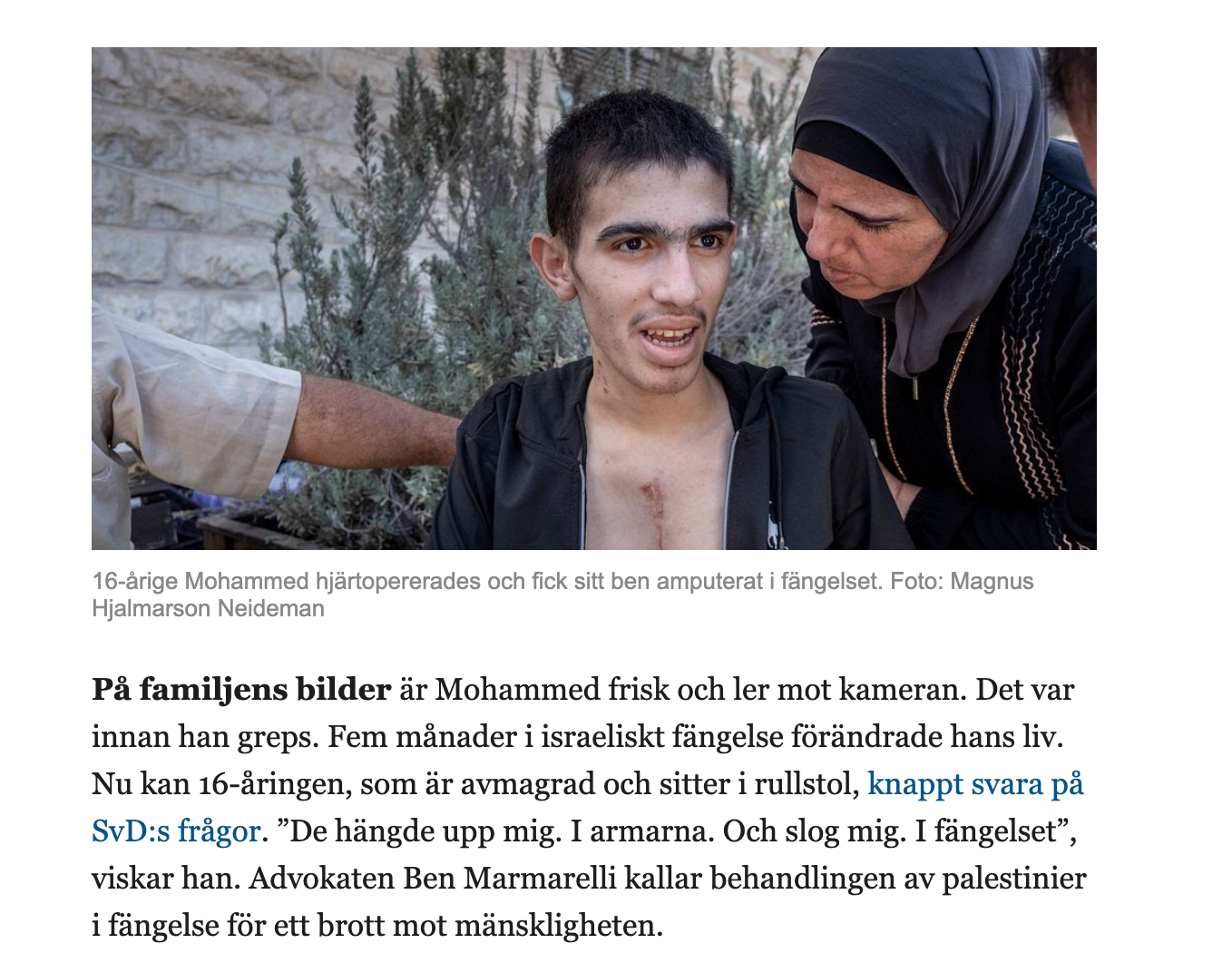
Translation of the text above:
“In the family’s photographs, Mohammed is healthy and smiling at the camera. That was before he was seized. Five months in an Israeli prison changed his life. Now the 16-year-old, emaciated and in a wheelchair, can barely answer SvD’s questions. “They hung me up. By the arms. And beat me. In the prison,” he whispers. The lawyer Ben Marmarelli calls the treatment of Palestinians in prison a crime against humanity. “
Photo Caption: Sixteen-year-old Mohammed underwent heart surgery and had his leg amputated in prison. Photo: Magnus Hjalmarson Neideman
_______________________
I grew up in Sweden trusting its newspapers. Svenska Dagbladet, I believed, understood that moral seriousness begins with separating allegation from fact. Now I wonder whether it still does.
I am asking a lot here but please read the translation of the article in question here:
In the family photos, Mohammed is completely healthy and smiling at the camera. That was before he was arrested. Five months in an Israeli prison changed his life.
It is difficult to understand that this is the same person. The emaciated boy in the wheelchair, sitting in front of SvD’s reporter outside a hospital in Jerusalem, compared with the healthy boy seen in the photos on his sister’s phone. In them, he is sitting on a horse, out with the dog, or spending time with his family.
“They hung me up. By the arms. And beat me. In prison,” he whispers.
Israeli soldiers came to the family’s home after midnight on February 25, in the Palestinian village of Tuqu, outside Bethlehem in the occupied West Bank.
Fifteen-year-old Mohammed Sliman was awake, sitting and doing his homework. He was the one the soldiers had come for.
“They didn’t tell us why. They shut themselves in one of our rooms with him and started beating him. We could hear it — and we could also hear him crying,” says his mother, Sharifa.
Outside, it was raining and cold. She wanted to give her son warm clothes, but she was not allowed to. Mohammed asked whether he could go to the bathroom and received no answer. Instead, one of the soldiers struck him. Then the soldiers took him away.
It is not unusual for Palestinian children to be arrested by the Israeli military. According to a UN report, this happened to 964 Palestinian children in the West Bank, including East Jerusalem, during 2025. Of the boys arrested, 65 percent were taken at night, according to a report by the Global Protection Cluster.
The family tried to find out where Mohammed had been taken. When they received no answer, they hired a private investigator. Two months later they were told that he was being held in Israel’s Ofer Prison, outside Ramallah, suspected of throwing “an object” at Israeli settlers or soldiers.
Tensions in the Palestinian village
After the October 7 attack, tensions increased sharply in the West Bank. Violence between settlers and Palestinians escalated, and the months before Mohammed’s arrest were turbulent in his home village of Tuqu.
Settlers fenced off land belonging to Palestinians and attacked their cars. Young Palestinians threw stones at Israelis. In mid-December, a 16-year-old Palestinian boy was shot dead by Israeli soldiers, and during his funeral an 18-year-old Palestinian was killed by a settler.
Mohammed developed inflammation of the heart valves.
In April, Mohammed’s trial began. The prosecutor sought a one-year prison sentence, which was later negotiated down to eight months. The verdict was to be announced in August.
By July, Mohammed had been imprisoned for five months. Then his lawyer contacted his parents.
“He called and said Mohammed needed emergency heart surgery,” says his father, Musa.
“It came as a shock. We were so worried. We were given no other information.”
They could not understand why their son needed surgery.
“He had no problems with his heart or his health before he was arrested.”
Mohammed underwent surgery at a hospital in Jerusalem. His father was told that security guards were present during the operation and that his son was restrained while the surgery was taking place.
His mother Sharifa and father Musa now live in Jerusalem so they can be with their son and take care of him.
His father says something must have happened to his son in prison. That is confirmed by cardiologist Daniel Fink, who operated on Mohammed. He describes the 15-year-old as “emaciated” and “very sick” when he arrived at the clinic from prison.
“An illness like this, with this degree of severity, develops over time. So of course he became ill while he was in detention,” he tells SvD.
Mohammed had scabies, a skin disease caused by mites. It is normally treatable, but untreated scabies, combined with poor hygiene and inadequate medical care, can have serious consequences.
Infection that spreads
“When someone comes in with scabies, it definitely tells you something about the living conditions that person has been in. And it definitely contributes to the development of an acute illness.”
The itching can cause patients to scratch their skin until it breaks. The wounds can then become infected, and if bacteria enter the bloodstream, they can attach themselves to the heart valves and cause an infection. That is what happened to Mohammed.
“Because he was in a life-threatening condition, unfortunately things did not go as we had hoped after the first operation,” the doctor says.
It did not end with a second heart operation. Mohammed developed a lack of oxygen in the tissue of his leg, probably as a consequence of the infected heart valves.
“His right leg was amputated on his 16th birthday, August 13. It was buried in his home village,” his father says.
The five months in an Israeli prison were therefore devastating for Mohammed. That is not surprising, according to Israeli Jewish defense attorney Ben Marmarelli, who has represented a large number of Palestinians. He opposes all discrimination and what he calls Israel’s apartheid regime.
He tells SvD that the treatment of Palestinians in prison is illegal.
“It is a crime against humanity. I have reported extensively on it on many different platforms.”
Conditions were already poor before October 7, 2023. Since then, according to him, the situation has become considerably worse, something human rights organizations have also raised alarms about.
Reduced food rations
Food rations have been cut, and access to hygiene, medical care, visits, and lawyers has been restricted. Beatings and torture occur, while the prisons have become even more overcrowded.
“Twelve people are living in cells designed for half that number. Six have to sleep on the floor, while the others sleep on iron beds that often have no mattresses.”
One prisoner he represented was allowed to have only a single pair of underwear for two and a half years, until Marmarelli filed a petition about the matter. Only then was the prisoner given a second pair.
Those are favorable conditions for scabies, and the disease has become widespread among Palestinian prisoners, Marmarelli says.
The spokesperson for the Israel Prison Service is not permitted to comment on individual prisoners, but tells SvD that all inmates receive treatment based on medical assessments and in accordance with the law.
Mohammed seeks support from his mother Sharifa during the interview.
Mohammed is sitting in a wheelchair when SvD meets him. He is emaciated and cannot hold his head up for long periods. He has difficulty answering SvD’s questions, but in a weak voice he is able to describe the violence in prison.
He says he was given only one egg a day to eat.
His parents, Musa and Sharifa, embrace him.
“Look what they did to my little boy. They destroyed his life and his future,” his father says.
Now his parents want only one thing: for Mohammed to recover. They live in Jerusalem and spend their entire days taking care of him.
His father says his son is eating a little more than he was the week before, but he is worried about the cost of the hospital care.
Financial relief
A little more than a week later, cardiologist Daniel Fink tells SvD that the hospital that treated Mohammed — the private, nonprofit Shaare Zedek Medical Center — has decided that the family will not have to pay for his care.
“No one is going to demand payment from them. As far as I know, they will not have to pay for Mohammed’s rehabilitation either.”
Dr. Fink says the hospital has created a fund to raise money for a prosthetic leg for Mohammed, and that he will hopefully be able to walk with its help.
“Judging by the clear improvement we have seen over the past few weeks, from essentially not communicating at all, I would say that with good rehabilitation his chances of recovery will definitely improve.”
________________________________________
But SvD does not first establish responsibility. It stages a verdict.
“Fifteen-year-old Mohammed Sliman was awake, sitting and doing his homework. He was the one the soldiers had come for.” Then rain; a mother denied warm clothes; an emaciated boy in a wheelchair; the whisper, “They hung me up”; the father’s cry, “Look what they did to my little boy.”
Homework. Rain. A grieving mother. A ruined child. Soldiers came for an innocent schoolboy and destroyed him.
Why had they come? Only later does SvD say he was suspected of throwing “an object” at Israelis. The scare quotes do the work reporting should have done. What object? What evidence? SvD does not tell us.
The caption says Mohammed “underwent heart surgery and had his leg amputated in prison.” That is materially misleading. The operations were performed at Jerusalem’s Shaare Zedek Medical Center by Israeli doctors trying to save him.
Only at the end do we learn that the hospital waived medical and rehabilitation costs, created a fund for a prosthetic leg, and reported improvement. Why do the Israeli doctors and hospital enter only after “look what they did” has framed the story? Because they complicate the cartoon of “Israel” as one malevolent hand.
But why does SvD need that cartoon? Is the newspaper simply following an activist script in which “Israel” must be presented as one undifferentiated, malevolent will—and every Israeli doctor, lawyer, judge or journalist who complicates that picture must therefore be pushed to the margins? And where does such a narrative lead? If Israel is not presented as a society capable of wrongdoing, dissent, accountability and reform, but as an inherently criminal entity, what remedy remains except its abolition? Is that the moral horizon toward which SvD is directing its readers: “from the river to the sea,” with no serious answer to what becomes of the millions of Israelis for whom this is not an ideological abstraction but home? Are they expected to abandon the only homeland most of them have ever known? Go where?
I do not know whether that is SvD’s conscious intention. But it is the logic of the picture the newspaper has chosen to draw.
None of this exonerates the Prison Service. The chain—scabies, infection, endocarditis, two heart operations, amputation—demands investigation. When was treatment delayed? What do the records show? What corroborates the alleged beating?
SvD arranged photograph, caption and sequence so readers would reach a conclusion the paper did not establish.
A photograph can prove suffering. It cannot prove who caused each part, by what act, or with what intent.